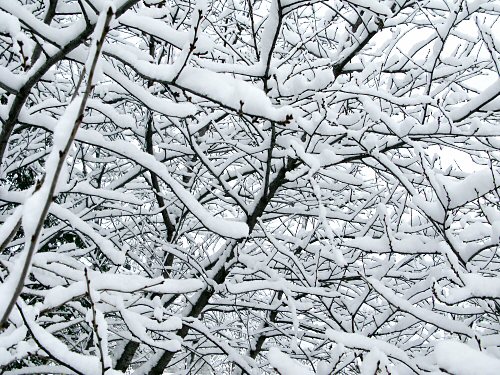
Around here, nothing says WINTER like snow in the trees (except, of course, solid ice in the trees). Three inches (7.5mm) or so of powdery snow overnight transformed the entire outdoors with that magical winter wonderland effect. At some point every year, I’m struck by how strange and wondrous snow like this must look to someone seeing it for the very first time (the feeling does wear off…). It’s pretty, breathtaking, even, if you’re out in the woods, and great for invigorating walks. Eventually, it gets good for winter sports. It perfectly complements the endless strings of holiday lights that’re already going up in the village, completing the classic look of a white Christmas. As for tiny farming, snow moves the action mostly indoors…
Weather
Veggies in snow
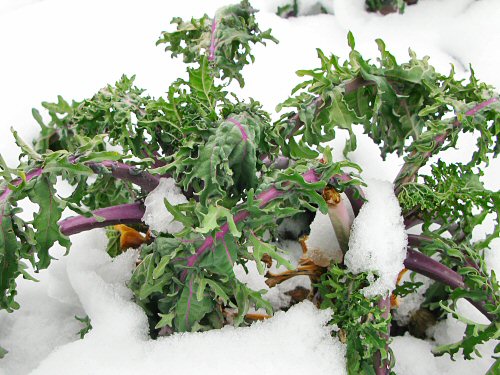
Every season there’ve been hardy veggies left to the cold and snow, and this season, it’s a record quantity, with nearly 2,000′ (610m) of broccoli, cauliflower, cabbage, and kale that mostly started sizing up just as the farmers’ market finished at the end of October. It seems like a waste, but it’s only a typical garden gamble on the weather (I was trying for an extra, really late crop). The risk was clear back in August, and we didn’t get enough sun to push things along a tiny bit quicker. We did harvest a lot of the Red Russian flat-leaf kale (above), for a good four weeks, and one round of 1-2 lb (450-900g) cabbage (a nice size for a meal for one or two). And there’s been a lot of personal-use picking in November. The rest is a giant farm lab experiment, more exploration of the snow-on-veggies effect…
More than the snow, the many nights of extreme cold (-15°C/5°F) that came with it this year really blasted these guys, wilting them and burning leaves and buds. So, none of the crops are too firm or pretty, BUT, they’re still alive: for the most part, there’s good color and texture. The kale, always super-hardy, did the best from a let’s eat some perspective, with good texture and great taste. The broccoli, while a little wilty on the stems and burned on the buds, also tasted great, fresh and flavorful. The cauliflower did the worst, the heads really damaged by the freezing and thawing, too mushy for me to bother with a taste. (Eating raw was fine, but how would this all cook up? We may see…) We’d already reaped most of the filled-out cabbage, so the rest aren’t going to go anywhere from here…
What’s all this odd information worth? Not much, I guess, I’m not planning on deliberately planting for snow harvests. But checking things out is always fun, no experience goes to waste, and there is at least one advantage to knowing there’s still good eating out there: the laying hens will be feasting on a fabulous greens buffet for a while!
Bringing in the pipe
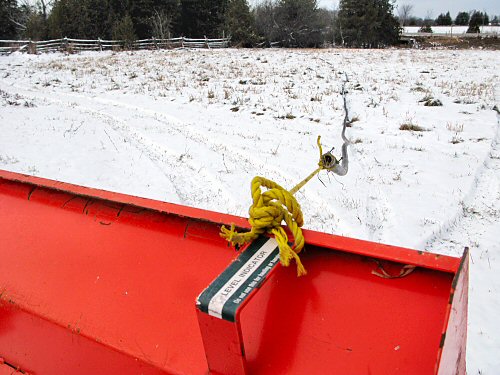
Bit of unusual fieldwork on the menu today, something we don’t do every year. Bob and I brought in about 1,000′ (305m) of 1″ (2.5cm) and 1-1/2″ plastic irrigation pipe, that ran all the way from the pond to the gate into the garden field. Why wasn’t this done in better weather, when, besides having no snow to deal with, warmer plastic would’ve been a lot easier to handle, especially to BEND? There’s no good answer, except maybe, “Didn’t think it’d be this cold and snowy so soon!” Anyhow, it got done, and probably in exactly the same time…
I used the Kubota compact tractor to drag the pipe in three 300′ sections, right into the barnyard (the rope is tied to the front end loader bucket; in the pic, this is at the very end of the garden, where it meets the hay, so all that stubble is mainly long grass). Backing up down the field, I worked it from the far end for the section that lay in the unmown grass right near the fence, so that it could more easily tear its way out of the overgrowth. Then, some coiling (that’s Bob), tying off the loops every few turns with baler twine (plastic twine used to bale hay, it’s all over the place)… Easy!
It’s really cold
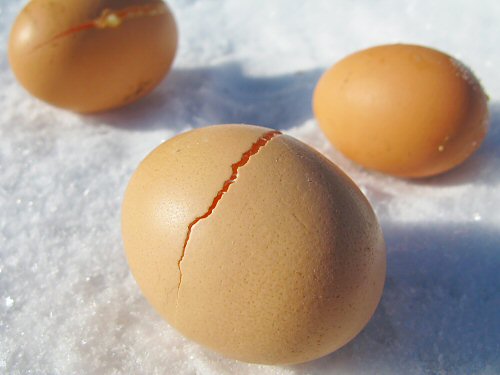
It’s taken a couple of days of this pretty intense cold snap for me to realize it’s yet another whimsical display of the crazy weather we’ve been having for the last six years or so. It’s not that overnight temperatures around -14°C (7°F) are unusual for southern Canada, just not in November. This time last year, there was a ton of snow, but without the unreasonable deep freeze. The winter before, I posted here in mid-January that “winter’s a no-show”—I was still digging carrots! Interesting… Inspired by the cold, I decided to see what it would do to chicken eggs and left a couple out overnight (there was a kinda practical purpose, it’s pretty cold in the chickenhouse). Of course, they froze as hard as hockey pucks. And cracked..
Real live south-facing slope!
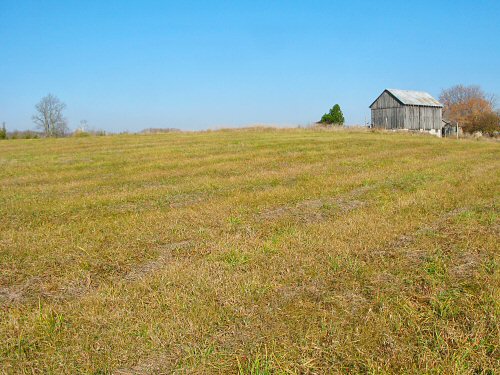
A third trip to the new farm, with more tiny farming conversation and checking things out. The weather: beautiful once again. The view in the pic: a perfectly south-facing slope (when you’re thinking about growing, pictures of promising farmland never fail to excite!). The benefits of a gentle SFS are well-known, and they’re particularly precious in a climate like ours, with harsh, snow-bound winters and a relatively short summer growing season. A slope facing south receives sunlight much more directly than flat land, so the snowpack is much lighter during winter, and more quickly melted off in spring. Then, the soil warms up more quickly, and gravity does its thing, providing better drainage, allowing the ground to dry out more quickly. All around, this simple incline could provide a couple of weeks of spring headstart, compared to flat land right beside. How well this actually pans out will be fun to see!
Flies to heat
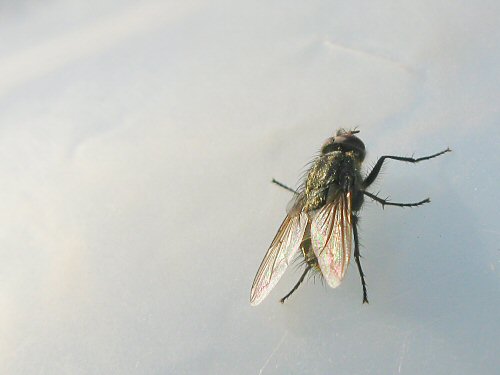
It’s summer again! At least, it’s suddenly a whole lot warmer than it’s been for a while, as any fly can tell you. I headed out to the greenhouse in the late morning to find flies all about, buzzing to get out, and basking on the plastic outside. It’s kinda creepy how they slow as it gets colder, like some sort of tiny machines winding down, eventually disappearing off somewhere to hibernate (I think that’s what they do), only to suddenly reanimate given a little heat. Anyhow, a few days of 60°F+ (15°C) and sunshine are in the forecast, and I believe it!
Tossing onions
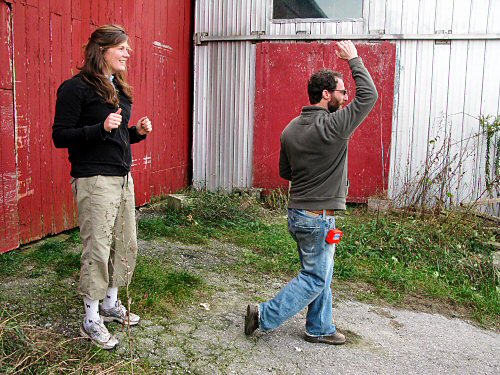
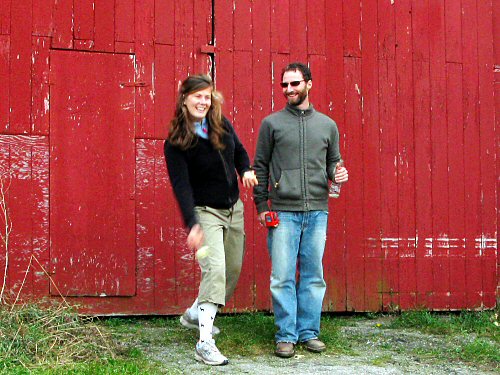
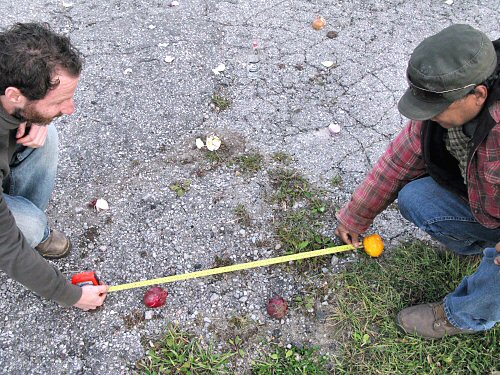
Well, Friday harvest is over…what to do? A few onions and a little winter squash you’re set for ALL-TERRAIN ONION BOCCE. Libby used yellow cooking onions (Stuttgarter), Grant took a mild white (Superstar), I went red (Red Wing), four onions each. A stunted orange acorn squash (Table Gold) served as the target ball. Toss away!
The rules are simple: the player with the closest one or more onions to the squash scores a point apiece. The all-terrain part means the winner of a turn gets to toss the squash anywhere. We played up and down the gangway to the barn, through gravel, long grass, chicken hazards (roosters peck onions)… Good thing no-one got really competitive, ’cause onion bocce is pretty imprecise, what with eventually exploding onions (largest piece counts), and ragged edges that make down-to-the-millimeter measuring kinda futile. Still, we did get out the tape measure… Wholesome outdoor fun on the farm. With veggies. Must be a new age of innocence! :) (Guest measurement photo by Libby)