
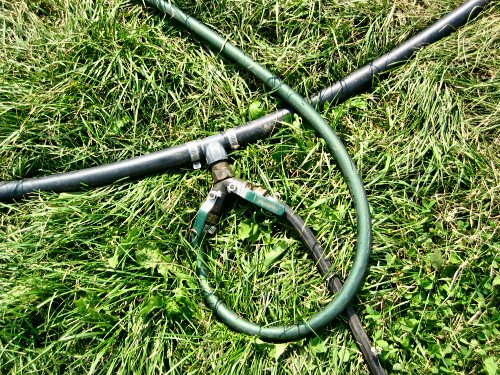
We’ve been watering heavily (well, as heavily as our gear allows) for what seems like weeks. Rain has been teasing us, 5mm a few days ago after an impressive, all-day cloud build-up; last night, 2mm following a brilliant extended lightning show and promising bit of a shower that soon faded away. It’s terrible. Conall has been honing his newly acquired hose rigging and sprinkler positioning skills. For heavier watering, the set-up begins at the pond and continues along a 1″ pipe (a little small, but it’s what I have from Year 1, intended for the much lower capacity barn well) that runs the length of the field. Water arrives through a series of shutoff Y-valves and from the valve of the moment snakes through up to 500′ of 5/8″ garden hose. (Fluid dynamics is something I should apparently be studying, to get a grip on the water-reducing effects of our often convoluted hose, valve and quick coupler combinations.) The hose leads to sprinklers (never too efficient, and quite a waste with anything above a hint of a breeze) and soaker hoses (MUCH better, but a pain to run up and down beds and then move again). The pump can deliver only so much, so it’s a multi-day rotation of gear to get around the entire field. The golden upside: WATER to the crops!! It’s amazing how much energy half an hour of heavy rain can save…!
Weather
At least a little rain
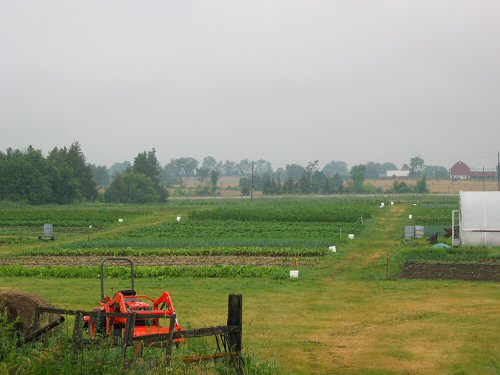
Today had all the makings of a slow, steady, gentle soaking, but so far, a mainly misty downfall has added up to a measly 5mm. Of course, I’m not unappreciative of ANYTHING in the way of rain. And the plants are looking mighty perky. Overall, the field is heading into that final sizing up stage that leads to main season fullness (see three weeks ago). Time can move so fast. Some real rain, please!
Spin cycle
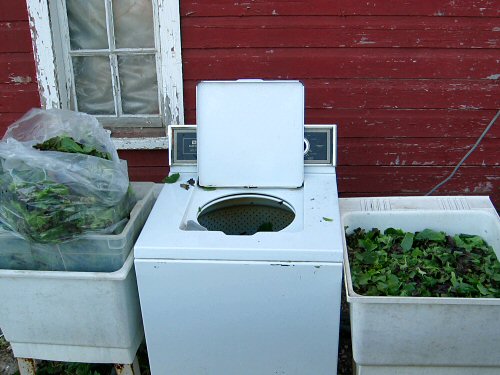
Here’s an important piece of the post-harvest station, the trusty washing machine-turned-salad spinner, flanked by laundry sinks, working on Sunday CSA harvest. The washer idea I read about someplace. When the washer here on the farm started doing odd things to clothes and was heading for the scrap heap, I intercepted it and pressed it into veggie service. With the agitator removed, it’s used on the spin cycle. Good ol’ centrifugal force! The trick to preventing leaves from getting crushed—either shredded (spinach) or veiny (lettuce, other light leaves)—is not to load too much at a time.
The sinks contain cold well water. For the most part, rinsing greens is done to quickly cool them down after being cut in warm conditions (like…a hot afternoon, you can’t always pick your moment). Sometimes, it’s also to wash off dirt splashed up by rain. Rinsing greens for one reason or another happens about 75% of the time during late spring through midsummer. Once the days start getting shorter (yuck…), greens harvests can usually be timed for the cooler evening, and rinsing happens less often. The sinks are also used to rinse other crops when they need it!
Simple, effective!!
Cloud show

Second only perhaps to badly done snapshots of kittens are unfortunate attempts at capturing majestic cloud formations. Still, this evening, I couldn’t help but point the camera at the sky and snap away… For an hour or more as the sun set, all manner of clouds formed and reformed into the most fantastic combinations and configurations I’ve seen in a while. At one point, the wind suddenly picked up from a breeze to maybe 40km and low, menacing storm clouds, seemingly close enough to jump up and touch, raced across to one side but missed us entirely, then the wind as suddenly died down. Everywhere you looked, fancy cloud action was going on. I spend a fair amount time looking at the sky, usually to see if rain is actually going to make it all the way to us instead of veering away at the last minute. But a lot of the time, as you look around, the sky joins the field, your gaze travels up, and it’s all…good! (Hope the photo manages to stir fun memories of…looking up!)
Perfect growing day
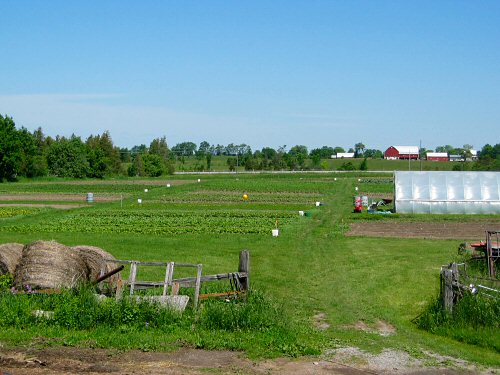
Hot but not a scorcher, a bit of a breeze, full sun in a clear blue sky… Even at a distance, the field is starting to show clear signs of vigorous veggie activity (see one month ago). And, amazingly (although, according to plan!), we’re on top of the weeds. Today was a bit of a semi-day off for me, with only a few hours here and there of hand-weeding, and lots of strolling around thinking about this and that (mostly, about things on the neverending to-do list…). Particularly now, still in spring start-up mode, tiny farming is REALLY full-time, you’ve gotta be into it 100%…so, you’d best love it as well. I’m having fun!
Good weather is also strange
These days, great weather is as unusual and unexpected as anything else that comes along. The last month or so, we’ve been getting rain around weekly, with sun in between. Ignoring the two days of overnight cold snaps, it’s been excellent. Today, after a half day of sun and heat, clouds rolled in on a cool breeze, a good inch (25mm) of rain came down in half an hour…and it was back to clear skies! We haven’t touched the sprinklers in ages. Bonus!
Back to growing
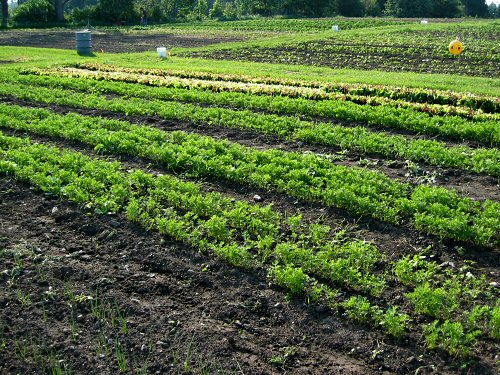
From the left: green onions, carrots, mesclun, snap beans, potatoes… After back-to-back frost warnings for the last two nights, the sun is shining, the air is warm, conditions have returned to reasonable, veggies are growing. Overnight, the min/max thermometer in the field went down to -1°C, but only a few rows of beans were slightly burnt by cold. Meanwhile, 25 miles away where we dropped off some greens today, the pond had frozen over solid and a kitchen veggie garden was completely toasted. Lucky us!