Bringing in the pipe

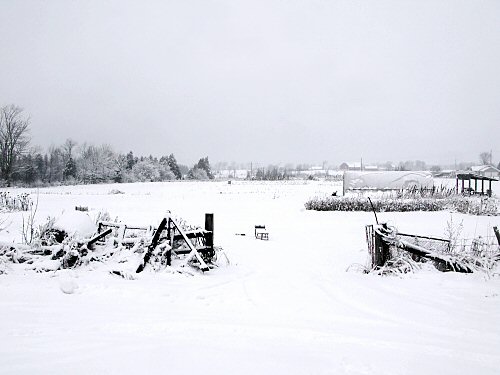
Bit of unusual fieldwork on the menu today, something we don’t do every year. Bob and I brought in about 1,000′ (305m) of 1″ (2.5cm) and 1-1/2″ plastic irrigation pipe, that ran all the way from the pond to the gate into the garden field. Why wasn’t this done in better weather, when, besides having no snow to deal with, warmer plastic would’ve been a lot easier to handle, especially to BEND? There’s no good answer, except maybe, “Didn’t think it’d be this cold and snowy so soon!” Anyhow, it got done, and probably in exactly the same time…

I used the Kubota compact tractor to drag the pipe in three 300′ sections, right into the barnyard (the rope is tied to the front end loader bucket; in the pic, this is at the very end of the garden, where it meets the hay, so all that stubble is mainly long grass). Backing up down the field, I worked it from the far end for the section that lay in the unmown grass right near the fence, so that it could more easily tear its way out of the overgrowth. Then, some coiling (that’s Bob), tying off the loops every few turns with baler twine (plastic twine used to bale hay, it’s all over the place)… Easy!

It’s really cold

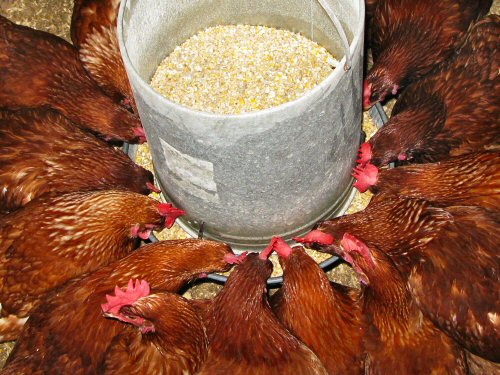
It’s taken a couple of days of this pretty intense cold snap for me to realize it’s yet another whimsical display of the crazy weather we’ve been having for the last six years or so. It’s not that overnight temperatures around -14°C (7°F) are unusual for southern Canada, just not in November. This time last year, there was a ton of snow, but without the unreasonable deep freeze. The winter before, I posted here in mid-January that “winter’s a no-show”—I was still digging carrots! Interesting… Inspired by the cold, I decided to see what it would do to chicken eggs and left a couple out overnight (there was a kinda practical purpose, it’s pretty cold in the chickenhouse). Of course, they froze as hard as hockey pucks. And cracked..

Drive shed clean-up

The drive shed is in a transitional mess. I’m part way through the post-season clean-up, delving into shelves, unpacking boxes, dragging things around, sorting it all out. Even with the trusty Troy-Bilt Horse rototiller as a bit of a clue (on the left, in red), to the untrained eye, it might be hard to tell that all of this is essential tiny farming gear. Who’d know that the stacks of Rubbermaid storage bins are in fact our mainstay harvest containers? Or that the weathered cedar trays and folding metal sawhorses (leaning on the left), transform in minutes into the farmers’ market stand. Those indoor/outdoor twin halogen lights are critical lighting components for after-dark veggie sorting and rinsing in the barnyard. That front-loading dryer I’ve kept around for years, in case it could become as useful as its companion the top-loading washer has been as a heavy-duty salad spinner. And so on. Every little item in the pic has its purpose. Much of tiny farming gear is plain, old ordinary stuff, pressed into garden service. And it all works!

Snow carrot harvest

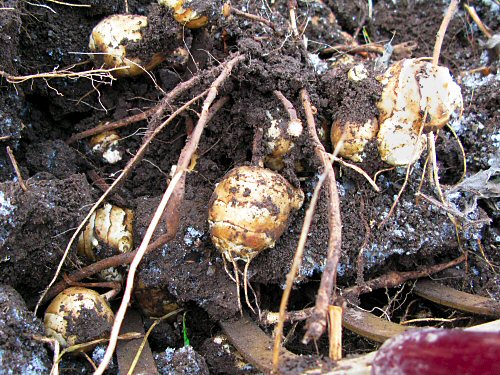
What’s a little snow when there’s crispy-sweet CARROTS buried under there? Lynn (the new Celebrity Farmer) and Raechelle headed up the field late this subzero afternoon, digging forks in hand, and scored sackfuls of Nelson and Napoli, no problem. It’s been well below zero (32°F) recent nights, and for the last couple of days as well, but the ground isn’t nearly frozen, and the layer of snow, fresh from overnight, actually acts as an insulator and helps soften it up. For now… The season’s not over until we SAY it’s over… :)

Hoarding wood like gold

Calling it scrap lumber doesn’t do any pile of spare wood justice. On the tiny farm, you always make space to accumulate someday useful stuff that elsewhere might get tossed. Waste not, want not! This collection of old fence boards, rough cut cedar planks, odds and ends of 2×4’s, and other bits will piece by piece have its day. Meanwhile, it needs to be moved to a more sheltered spot, raised off the ground, before the snow really comes in. Today seemed like a good day to do it…

Real live south-facing slope!

A third trip to the new farm, with more tiny farming conversation and checking things out. The weather: beautiful once again. The view in the pic: a perfectly south-facing slope (when you’re thinking about growing, pictures of promising farmland never fail to excite!). The benefits of a gentle SFS are well-known, and they’re particularly precious in a climate like ours, with harsh, snow-bound winters and a relatively short summer growing season. A slope facing south receives sunlight much more directly than flat land, so the snowpack is much lighter during winter, and more quickly melted off in spring. Then, the soil warms up more quickly, and gravity does its thing, providing better drainage, allowing the ground to dry out more quickly. All around, this simple incline could provide a couple of weeks of spring headstart, compared to flat land right beside. How well this actually pans out will be fun to see!

1 77 78 79 80 81 169