
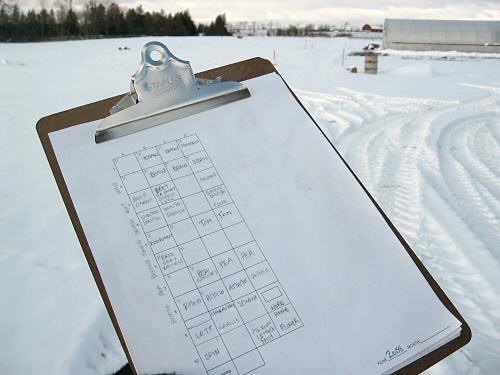
Here’s the new garden map, companion to the two calendars, all part of the latest version of my planning set-up. The simplicity and spareness are deceptive, this is the result of FIVE YEARS of refining complicated planning and record-keeping paperwork, stripping away stuff I didn’t really use. Really! My old maps were way more detailed, with varieties and planting dates for each bed, hand-printed in really tiny letters (each of those squares represents a 50’x50′ section containing 10 beds). The grid now takes up only half the page, leaving lots of room for little notes, and the sections are just big enough for blocking in the crops (varieties, dates and bed locations go on a separate list). It’s not fully filled in yet, and everything’s in pencil for easy rearranging. I was working on it today along with the seed order list, and took it for a walk to take the pic. Pretty plain on paper, but when I look at it, I see the whole season unfolding… (Overnight last night, the snow suddenly came back!)
Series: Tools for making plans
Tiny farming is pretty simple, but without a plan, it’s easy to get literally in the weeds. How many tomato plants to grow for how many pounds (or kilos) of tomatoes a week? How much ground to prepare for those plants? How much space for those seedlings under lights? When to plant the seeds, and how much seed to buy in the first place…? To get set and stay organized, you need some tools…
Calendars love catalogs
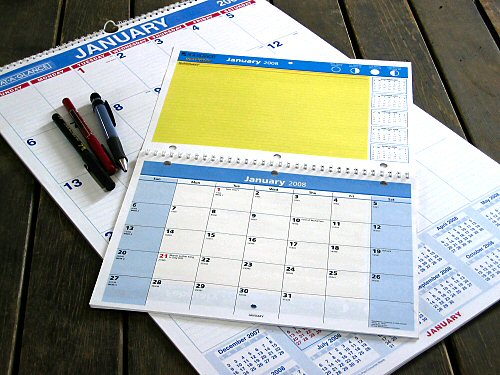
I got these about six weeks ago, when the selection was good (because, just any calendar will not do!). Today, I busted them out of their plastic. It’s only three weeks to the new year, the Holidays will vanish in a blur as they always do… I don’t know if it’s the new extra focus that comes from garden BLOGGING, this year’s extended Real Winter, Garden Season SIX coming up, or merely some planetary alignment thing (or…something else), but I am really, well, unusually EDGY and wanting to get started… Hmmm. Anyhow, the calendars…
It comes down to record-keeping. You read about all kinds of intense systems of garden notes and, from market gardeners, intricate planting schedules distilled from reams of precise planting data. I started out with all that in mind, recording every crop and variety by planting date on a map, and meticulously noting all the action in a pocket notebook (use waterproof ink, field notebooks in your pocket inevitably get SOAKED…forgotten in the laundry or otherwise!). This note-taking activity would trail off a bit as the season got underway, and more so over the years…
Now, I’m a minimalist when it comes to records, and this season’s system is the simplest yet. Almost everything worth noting goes into these two fabulously FRESH calendars. And there they are! Like the new seed catalogs, for me, new calendars in December hold all the promise of things to come…!
Details! Well, these aren’t just any calendars, they’re At-A-Glance brand calendars. Like any other tool, when you find the right one, nothing else will do.
I’ve examined and tried all kinds of free and commercial calendars (and notebooks, and journals…) and there’s always been something missing, something slightly WRONG. Then I discovered the large-format AAG, which I’ve been using for the past three years. It is…just right. I tend to get distracted and a little messy when it comes to field notes as the season progresses, and a simple thing like not having enough space to write in can throw things off. The AAG large wall calendar gives me ample, uncluttered room for every day of the week, and a crisp, matt surface to write on. And it doesn’t get lost. I hang a pen on twine from the same nail and it’s set. Perfect!
The little AAG I found this year. It’s the ideal companion to the wall calendar, the missing link. It even has the monthly moon phases, which I used to fill in by hand on the big one (planting by moon cycles is somehow always at the back of my mind…). The little one replaces scraps of paper and various notebooks for jotting down field work hours, market and stand sales, and the like. It’s more “business”, while the wall model holds the field stuff: planting and harvest dates, mowing, rainfall and other weather notes, a very few other basics like gas can refills, repairs and the like, plus upcoming events and various due dates. Easy! Whenever possible, I use a black pen for notes, red to highlight future stuff, and a mechanical pencil to pencil things in.
Bonus: For the small mountain of annual organic certification paperwork, the calendar format is a ready-made chronological log (They really insist on one…!).
So there you have it! A straightforward, impossible-to-lose place for everything usually keeps me on track, and this two-calendar system certainly ought to do it. ;)
Map day!
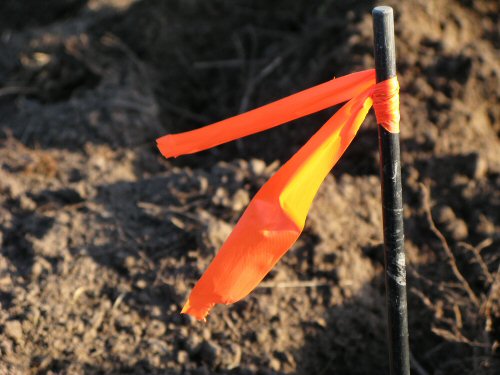
Finally, the first production map for this new market garden! Usually, it’s a good idea to get a detailed map done early in the winter, before making up the main seed orders (or, if that’s where you’re at, before taking inventory of your vast store of saved seed!). Here, with our hasty start-up in late November, and piecemeal plowing of sections over the last month, it’s been hard to tell how much area would be ready when. This morning, Peter down the road disked the final large area, and as the sun set, I walked around staking out sections with fluorescent marking tape, then sketched out the first production map. Each square is 50′ x 50′ (15m x 15m). To be filled in…
Tape time!
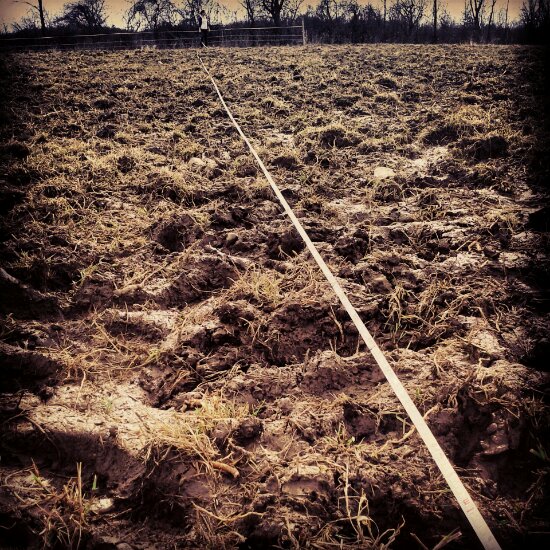
Tape time again, measuring out this year’s market garden. I’ve come up with various schemes to do away with this step as an annual thing, but end up wanting to move things around, or accidentally tilling under a critical stake or two left from the year before. The method is pretty primitive: walk around with a 200′ reel tape measure, trying to keep things square (the 3-4-5 trick!), staking an outline that can be used later to easily line up smaller sections as needed. That’s Rochelle at the other end, doing this two-person is the preferred way to go. The eventual result: a new garden map.
Harvest board revisited

As the afternoon shadows get longer, Michelle checks out the harvest board to see what’s left to do for tomorrow’s farmers’ market. This same whiteboard is now in its third season of service, a little worse for the wear, with the surface no longer coming clean, and one edge of the frame fallen off (it’s lying there, right behind, waiting for repair), but fully functional. As long as I remember to keep it out of the rain and too much sun, it could have a few years in it yet. And I’ve grown to really like it. The shiny WHITENESS is a little glaring and kinda office-like—I considered switching to a chalkboard—but the printing stands out so well… It makes things clear, which is always good!
50 feet!
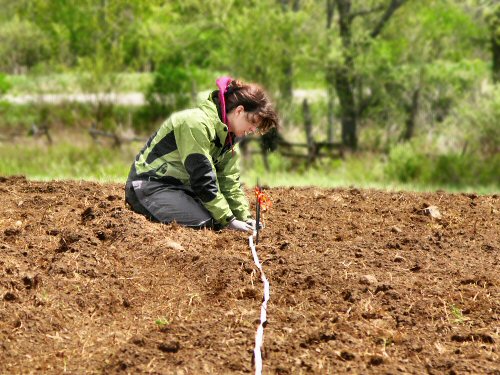
Nice sun, but kinda cool and definitely windy. Michelle came by for a day of mostly organizing and arranging: managing seedlings, and measuring and staking out garden sections (now, according to the new garden map). We’re once again using 50′ (15.2m) squares as the basic garden unit. The 100′ (30.5m) reel-up vinyl measuring tape is the handiest tool for this, as we walk up and down and around, a person on each end of the tape, calling out measurements and planting fluorescent-flagged stakes… There’s a satisfying sense of order when a freshly tilled section is staked out. All those neat squares tell you, you are master of your garden, and things are well under control! :)
Seed ordering sanity
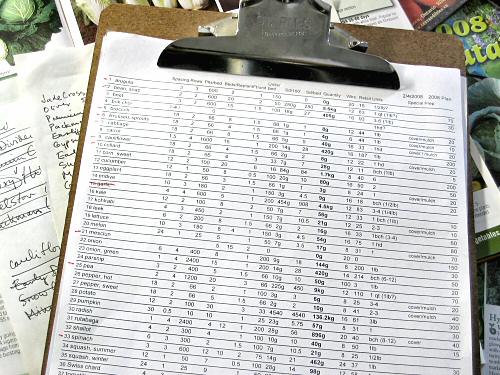
The first main seed order is finally done. There will be one more in a week or two, and then I’ll be set for the season. Working out the order was relatively painless, it does get easier every year, but without this handy Seed Quantity Calculator, my head would still be spinning. There are at least 65 different veggies, herbs, and flowers, and must be well over 200 varieties overall (wow, hard to believe when you add ’em up). It’s a lot to piece together.
Of course, I could REDUCE. That’s a whole other story (and then there’s the hybrids/seed-saving issue), but basically, I think variety is a great thing on all levels, so instead of reducing, I resist the urge to add more. For mainstay crops like green snap beans, I’ll try at least 2 or 3 similar varieties to see how they perform in this particular field (depending on conditions, the differences can be quite big). And you’ve gotta Try New Things, grow a little okra, some Jerusalem artichoke, LOVAGE, a row of tomatillos, and…lots more—even if a crop’s not exactly popular (self included), we can all learn! Crops, cultivars, there’s a lot of seed to choose from… And it gets more complicated.
On this tiny farm, where plantings are measured in multiples of 50 row feet, not in acres, the catalog price breaks are a maze of temptations and false economies. Seed for many crops becomes tantalizingly less expensive right after the first “bulk” quantity. For example, if 5g of something is $6, and 25g is $18, how can you pass up savings like that, especially when the difference is “only” 12 bucks? Freeze the extra and it’ll be good for years! But those extra 10 and 20 dollars add up real quick, and there are always lots more varieties to try.
So it goes, crop by crop, variety by variety, at ordering time. It could get real messy if I hadn’t long ago (Year 1!) worked out my seed quantity order sheet, which at least allows me to instantly check on how much space I really have, how much seed I really need, what the yield might be like… That helps!