Eggs from the wild

Collected eggs

Four or five of the girls have been escaping every day, creating their own day pass, and doing a fair imitation of flying while they’re at it. In the morning, I open the chickenhouse door and barricade it with a strip of plastic fencing that leaves a 2′ gap at the top. After I leave, they hop up on the roost, propel themselves, furiously flapping, to the top of the fencing, perch there for a moment, and then head out.

I’m not sure if it’s always the same ones. There are 25 Shaver Red layers, and I haven’t spent enough time hanging out with them to really tell them apart. But I suspect it’s a gang.

They spend the day foraging far and wide around the farm, and return at night, waiting to be let back in. This has been going on for several days, since the meat birds left…

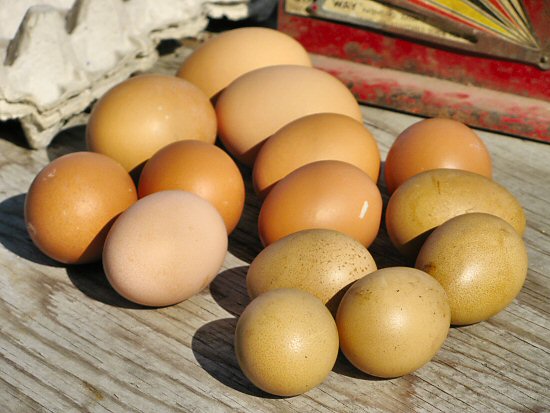
Today, Connor found a few eggs in a thicket they seem to like. Besides being a different color  from all that exposure, the eggs are clearly getting SMALLER (they’re the ones in front). As varied and nutritious as their free-ranging diet may be, it’s lower in protein than the carefully concocted feed available inside. I guess that’s what’s up.

In any case, we’ll soon put up some kind of fence, cut out a chicken door, and they’ll have the best of both worlds: grass and bugs on the outside, protein-rich feed from the feed store inside, and a convenient place to lay.  That will be our state-of-the-art in natural eggs for the next little while…
Chickens: ranging too far

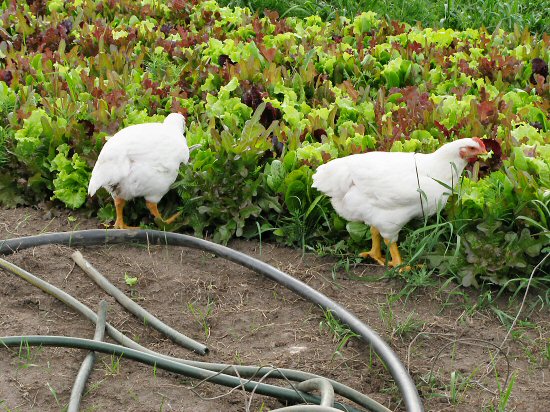
These guys, the White Rock Cornish X meat birds, have free-ranged too far, making it to the edge of the veggie garden in the big field. Luckily, although it looks good in the photo, this all-lettuce mesclun is done, cut at least twice and now too full of damaged and crowded, stretched leaves to make harvesting for market worthwhile. So, the chickens are actually putting it to good use. But  of course, they won’t stop here.

So far, they’ve been completely free to roam during the day. I count and shut ’em in out of harm’s way at night, and pop open the door soon after sunrise. If they found farm life dull, they could hit the road and head to town, just like that. Instead, they tend to wander further from home bit by bit.

I’ve been watching their circle of foraging territory gradually expand away from the chickenhouse. A few advance scouts lead the way, sometimes alone, or in twos or threes. Eventually, over a couple of days, more follow. It’s fun to watch the process, and they seem to appreciate the freedom (since they use it), but it’s still three weeks to Processing Day, and they’ll keep on exploring right into the garden. Time for some fencing action…

(In front, pieces of old hose and water pipe are being sorted out on a clear patch of ground.)

Abandoned bee village

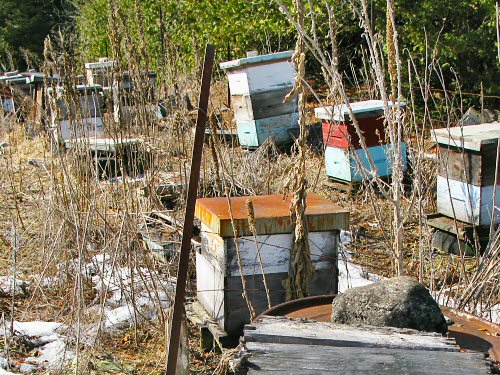
There’s an apparently abandoned bee village on the edge of the tree-enclosed clearing just beyond the main field (the clearing is past the fence, covered in snow, in this pic). There is a backstory here, still to be fully figured out, but the basic fact of the moment is a forlorn, ghost town-looking double row of hives, maybe 15 in all. I don’t know anything about beekeeping, so I did a little research. These seem to be the standard Langstroth hive design, used all over the world. From the photos I saw, the set-up here looks pretty normal, except for the tilting, the worn out paint, and the solidly rusted electric fence that surrounds them. Sorting this out is something new to do this spring. Our future in bees…

Winter light

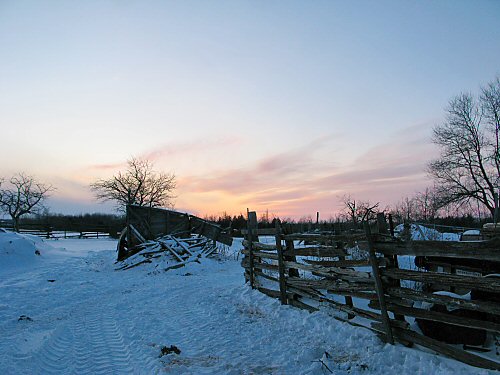
Mid-January, 5pm and still light out. This is the view to the west, with the big barn just out of frame to the left, looking past the loafing barn yard to the second, 11-acre pasture—the 9-acre field where the market garden lives is directly to the right—and then the trees. At the end of the rail fence in the foreground is the gate where the cows come home at night. It’s bitterly cold, my fingers are going numb after only a couple of minutes on the camera, but I’m enjoying the sunset, out here in the deep freeze, thinking about all the work ahead for the new-farm market garden season. It’s crazy. Cool!

Chickens, bull, fence…

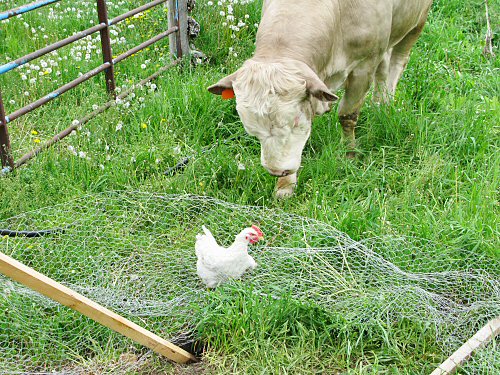
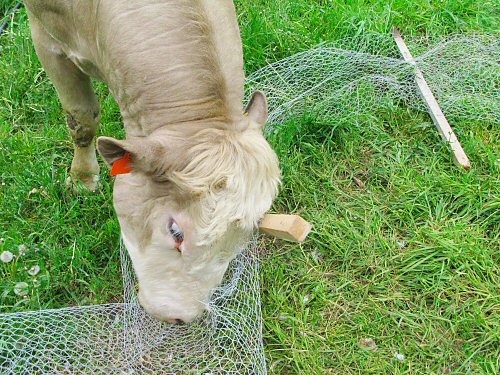
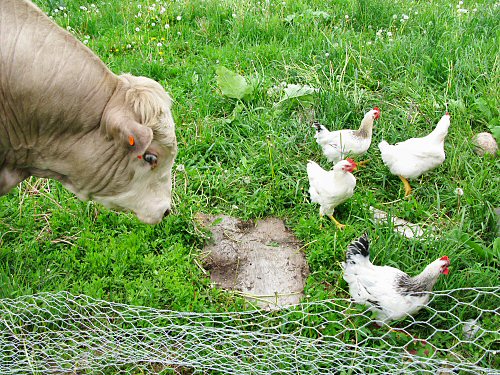
The chickens have been loose by day for a couple weeks in a small, temporarily-fenced run in one of pens just off the barn. Today, the cows were let in to the pen to graze down the long grass. The rough plan was to let the chickens free-range around the whole area, which is about half an acre, and the cows would act as bodyguards, keeping out…predators. Dunno, sounds like good plan, livestock’s all pretty new to me… Consensus was the cows would not respect the chickenwire, so I went to take it down, just as Monty the Young Bull discovered it. I couldn’t help watch, kinda fascinated by the slow motion, low key destruction, as he methodically butted down the posts…scratching.

From one post to the next…

…and now, the chickens, at least, the Frey’s Dual Purpose and the couple of White Rocks that follow them outside…are free as they wanna be!

First snow comes and goes

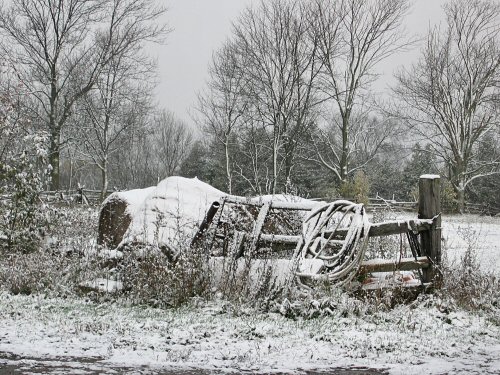
Even a section of fence sorely in need of clean-up and repair looks kinda interesting under a little snow. We’ve had the lightest of powder trickling down for a few minutes here and there over the last couple of days, but overnight, it finally snowed enough to stick around for a bit. This was about 9 a.m. Within a couple of hours, the sun was out and the first snow was gone without a trace…

Anti-raccoon measures

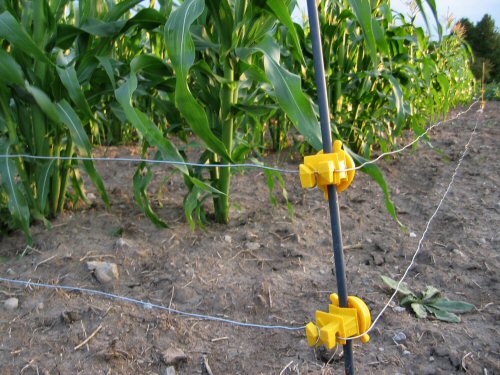
Electric fenced corn

Finally strung up the electric fence to protect the corn from raccoons. Powering the short, hopefully sharp shocks is a solar-charged controller. The lower wire is place about 6″ (15cm) from the ground, with a second strand about 10″ (25cm) above it. The perimeter has to be kept clear of weeds that might ground the fence, which would reduce or eliminate the shocks. In theory, this is a totally effective, non-lethal, physically harmless method, but coons are clever. Already, there’s been some pre-fence eating activity. We shall see what comes next!