
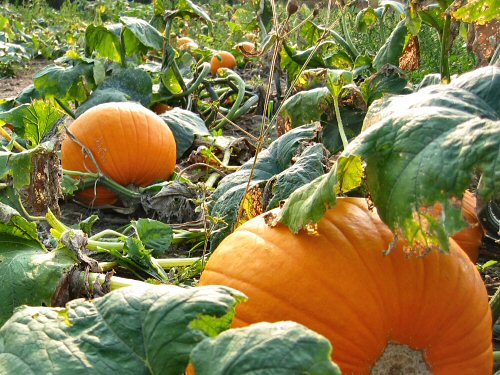
The pumpkin patch, recently a soothing sea of green, is now a mess of dried out leaves and expired plants. Most varieties were all but obliterated by the last month’s heat and lack of water—no rain, no spare irrigation. Still, they’ve all done quite well. It’s always fun to have fat orange and pale green-white pumpkins assembled on the grass in the field in the fall. So far, I haven’t had much other use for them, most are too bulky and low-priced to haul to market (we load in a pick-up truck, a trailer is the next step), or fit into off-farm CSA shares. This year, maybe a one-day “organic pumpkin” mini-sale on the farm stand… And there are some small pie and seed pumpkins (Small Sugar, Snack Jack), more portable at 3-5 pounds (1.4-2.3kg). Here, a row of larger Neon, looking nice!
irrigation
Water in the air!
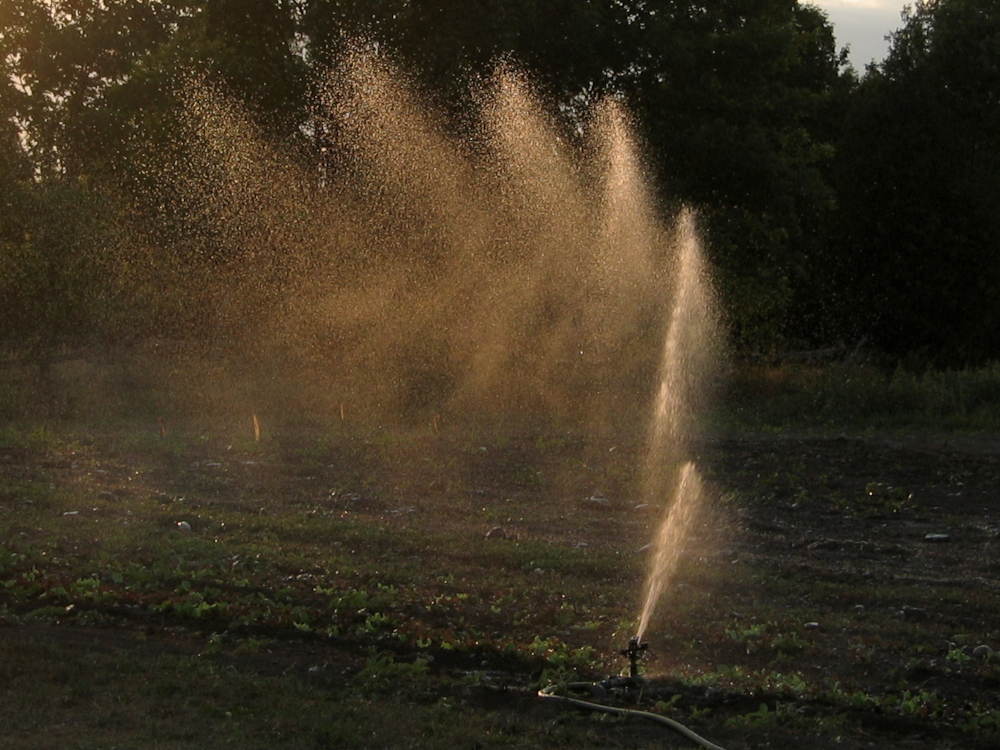
It’s supposed to rain tomorrow… I’m as skeptical as ever, still, as illogical as it is, you figure it’s gotta rain EVENTUALLY, so the longer it’s been, the more accurate the latest “60% chance of showers” forecast must be. Until then, we continue the piecemeal irrigation effort, with a combination of sprinklers and soaker hoses. The pond level is noticeably down, but bottom still isn’t in sight…and it’s gotta rain soon, right!?! :) Here, the latest beds of mesclun and spinach get their daily sprinkle. You can see by the fine mist in the air how easily much of the water can be lost to even a slight breeze, and to evaporation under a hot sun. Still, soaker hoses are only practical for larger standing crops, and pretty near useless for keeping newly seeded beds moist. From the pond pump, we get enough pressure to run four or five sprinklers and have 500′ of soaker hose set up, which means two or three of 40 sections can be covered at once. It takes a couple of hours to put down maybe 3/4-1″ of water. And the majority of days, we have to do early morning and evening sprinklers only, because of wind in the day. So, lots of moving hoses around… Next year, I’ve gotta figure out a drip irrigation solution…
Farmer in field
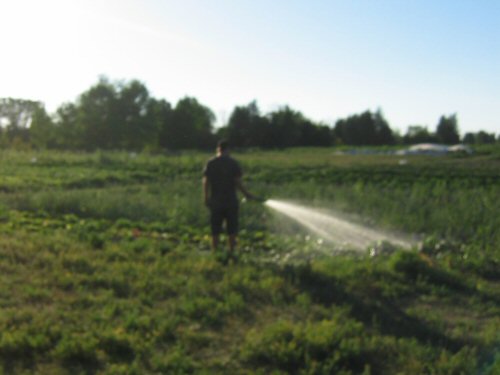
Conall watering in mesclun in the late afternoon. Even on busy harvest Friday, plants need water if they’ve had no rain. Guest photo by Erin, with a different than usual, no less…realistic, view of the field. There’s nothing like being there to see for yourself! I cropped the photo to fit the format, but it’s the original that just catches a certain tiny farm feeling…
Water work
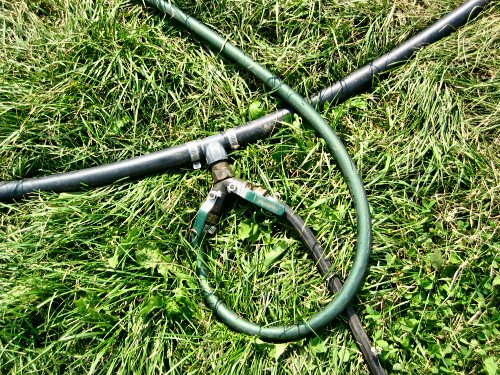
We’ve been watering heavily (well, as heavily as our gear allows) for what seems like weeks. Rain has been teasing us, 5mm a few days ago after an impressive, all-day cloud build-up; last night, 2mm following a brilliant extended lightning show and promising bit of a shower that soon faded away. It’s terrible. Conall has been honing his newly acquired hose rigging and sprinkler positioning skills. For heavier watering, the set-up begins at the pond and continues along a 1″ pipe (a little small, but it’s what I have from Year 1, intended for the much lower capacity barn well) that runs the length of the field. Water arrives through a series of shutoff Y-valves and from the valve of the moment snakes through up to 500′ of 5/8″ garden hose. (Fluid dynamics is something I should apparently be studying, to get a grip on the water-reducing effects of our often convoluted hose, valve and quick coupler combinations.) The hose leads to sprinklers (never too efficient, and quite a waste with anything above a hint of a breeze) and soaker hoses (MUCH better, but a pain to run up and down beds and then move again). The pump can deliver only so much, so it’s a multi-day rotation of gear to get around the entire field. The golden upside: WATER to the crops!! It’s amazing how much energy half an hour of heavy rain can save…!
Wheel turning
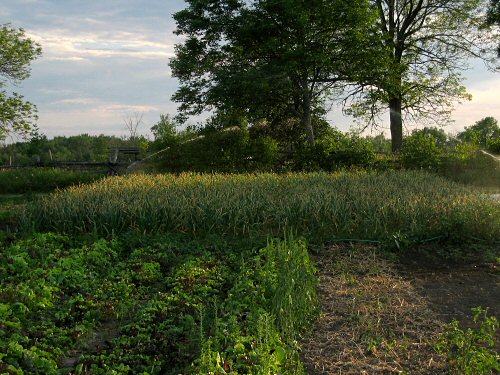
Life moves fast through our short growing season. Lushness and abundance peak and fade quickly into decline. The garlic, so green and promising only a few weeks ago, is already dying back, ready for harvest by month’s end. (Here, we’re splurging on a watering by sprinkler; I’m not sure of effectiveness of this exact timing, but a nice soaking round about now should give those garlic bulbs an extra growing boost during their last days.) In front of the garlic, more crops past their prime. The third planting of mesclun (we’re already harvesting the fifth) has started to bolt, ready to be plowed under. And a bed of arugula that, despite row cover, had been invaded by flea beetles, was chopped down and now lies brown and overdue for tilling in. Wheel keeps on turning…! (LATER NOTE: Watering garlic during its last few weeks is not considered a great idea, but in this case, it didn’t hurt.)
Pond and pump
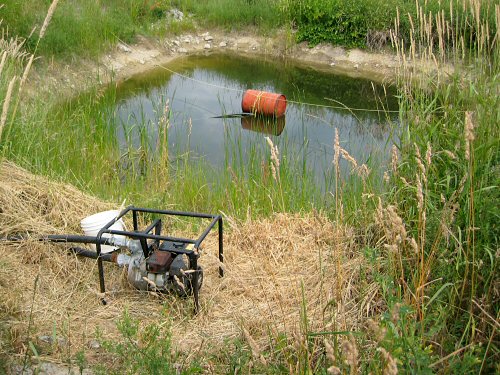
With only a little over an inch (25mm) of rain for most of June, and a near constant breeze on top of sun and heat to help dry things out quicker, we’ve had to hit the pond. Full irrigation here is a time-consuming process, involving dragging around and repositioning a network of hoses, soaker hoses, and sprinklers, and making trips every couple of hours to refill the pump set-up by the pond (see also “Pond and barrel”). The pond was dug out a couple of years ago, is ground-fed, drops level at an alarming rate (it starts the season full to the top of the photo), and replenishes slowly. If you look closely at the perimeter, the darker strip just above the water shows the level drop just for today. Still, it was used quite heavily last year and I’ve yet to see bottom! Meanwhile, I’m visualizing RAIN!
Three generations…
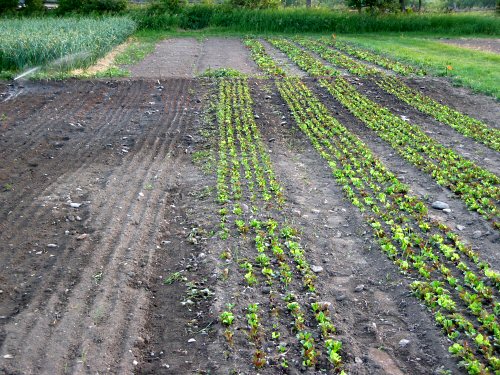
On the left, watering in the latest of six succession plantings of mesclun with a basic lawn sprinkler that’s quite efficient for shallow irrigation of newly seeded beds, when there’s no wind. Here you see the last three generations. I started planting four beds at a time, a week apart, and stretched that to nearly two weeks as the sun, heat and regular rain we’ve had so far made the growing fast. With the great weather, they’re catching up to each other—you can see the beds on the bottom right are moving up on the previous planting up top—and I’ll be tilling under a lot. This is absolutely strange for me, in past years, cutting every last bit of available salad greens every week was normal. But the people and planting expansion this year make this sort of abundance the new normal, production levels that assure harvests for all the CSA members, market and stand, even if conditions get tough. It’s not WASTED, I tell myself, it’s organic matter and even nutrients, back to the soil… I’m getting used to it!