
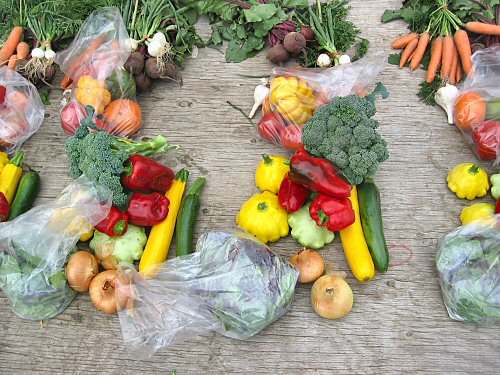
After the long holiday weekend, I did a quick new harvest for the handful of usually-on-Monday CSA shares. We have three CSA pick-up days, Saturday, Sunday and Monday, and harvest for the last two can be mostly combined on Sundays. With kinda cool and cloudy weather today, veggies could be left outside on the table for a few minutes—in full summer heat, they’d quickly start to get toasted. I’ve tried to reduce PLASTIC to a minimum (tiny farming has somehow made me averse to much packaging, especially with plastic). The tomatoes need to be kept together, they’d be crushed if let loose in the final shopping bag. And the greens, well, no other easy solution (I’m looking into reusable cotton salad bags that could be put in the fridge, another future project; I’ve moved to paper bags this year for potatoes). As for the shopping bags, I’m considering reusable tote bags, two per shareholder, that could be swapped empty-for-full each week, but the extra BAG MANAGEMENT I know would be fairly, let’s see…time-consuming. Details…
onion
Share of the week
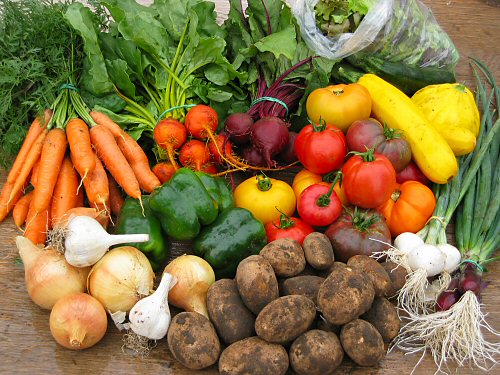
A specially Thursday-picked Large share, tiny farm flexibility in action for a shareholder who missed the weekend pick-up. A Large is about one and a half the size of the standard Single share. This week: carrot (Touchon), beet (Golden Detroit, Scarlet Supreme), tomato (assorted heirloom), mesclun (9-lettuce), spring onion (Ramrod, Red Baron), summer squash (Sunburst, Golden Dawn III, Ambassador), potato (Gold Rush), pepper (Ace), onion (Stuttgarter), garlic (Music). The shares have been pretty good this year, not over the top (in a superabundant way) as they have been at times in the past, but definitely solid value for the fresh, local, organic dollar!
Pulling onions
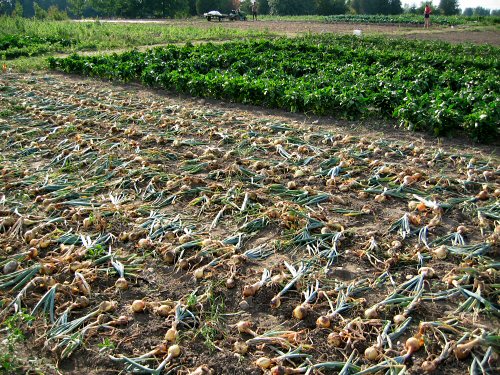
Started the full onion harvest today. This is about half the crop, pulled and layed out to dry (although, with NO RAIN, drying is hardly an issue). Above, it’s peppers and eggplant; at the top left, an almost depleted section of Yukon Gold potatoes with a scraggly weed cover that needs to be tilled in. The onions will be topped, put around half deep in the old style wooden bushel baskets (lots of air, no sweating), and set in the barn to cure. Once again, this year I took the easy way with onion sets, which limits my selection and also seems to produce flatter rather than rounder bulbs. Here it’s the usual two: Stuttgarter yellow cooking and Spanish Yellow (that’s apparently the variety name). Next year, it’s gotta finally be onions from seed! For now, nothing fancy: strong, flavorful onions that bring tears to your eyes!
Red onions, golden beets
Veggie variety is great: different tastes, textures, shapes, colors… From the start, it seemed only natural to grow several varieties of each crop rather than just the most “efficient” one. This has worked out to at least a couple per crop (this year, two types of spinach so far, three potato, two corn…) to many (at the extreme end, 50+ varieties of tomato). The biggest difference is quite often in maturity date: crops fairly similar in taste and appearance can be two or three weeks or more apart in maturing for harvest. Sometimes the difference is only skin deep. The Red Baron spring onions in the pic are only red for a couple of layers, but they look great when you get ’em. The Golden Detroit beets taste a little different from red varieties, but the fun (for me, at least) is mainly in the striking and unusual golden-orange flesh. Look before you eat!
Doing the rounds
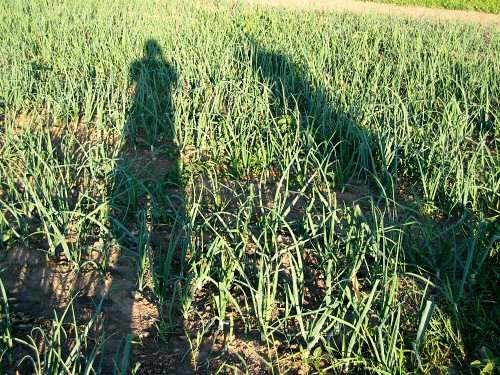
Since the start, the idea of a daily full garden inspection—”doing the rounds”—seemed to make sense. It sounds easy enough, but somehow, it doesn’t get fully done all that often, there’s almost always something that seems absolutely pressing to do early in the morning or in the evening when a stroll about is most practical and pleasant. But of course, I do get around to see everything every couple of days at least: checking for weeds alone insures that. Today, Conall and I managed to do a pretty full walk about. You look to see how things are doing in general, check for the start of new weeds and pests…it’s amazing how things can creep up and then jump out at you if you’re not watching closely. Here, we’re checking out the onions. So far, they’re doing well!
New view
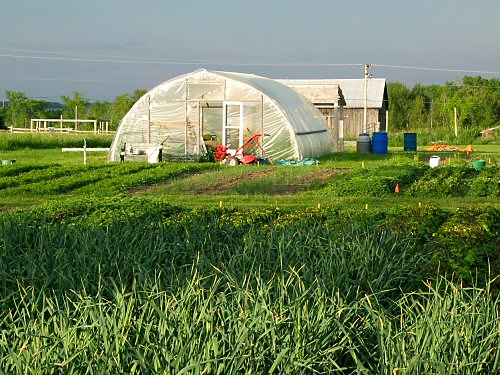
Here’s a view of the lower part of the field, from an angle that I don’t check out too often, looking over the garlic, past mesclun, carrots, green onions, beets, to the greenhouse, and you can see the veggie stand—it’s still roofless—tucked away behind. (Normally, only the mesclun would be in this area, with the root crops at the top of the field, but because the new section wasn’t ready in time for putting in fine seed—too much sod to break up—I’ve had to move things around a bit.) And so, it’s nearing the end of another hot and sunshiny day of weeding, seeding, more weeding…and so forth. We started pruning, staking and caging tomatoes, before they got too far carried away—it’s good to be on time!
Found onions
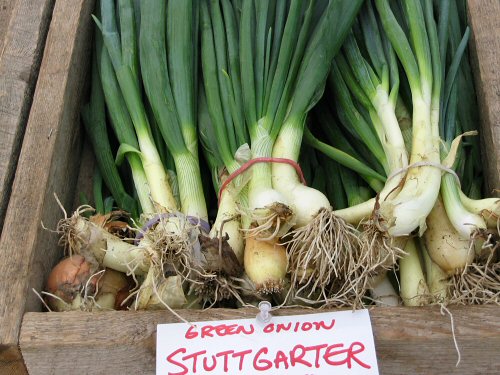
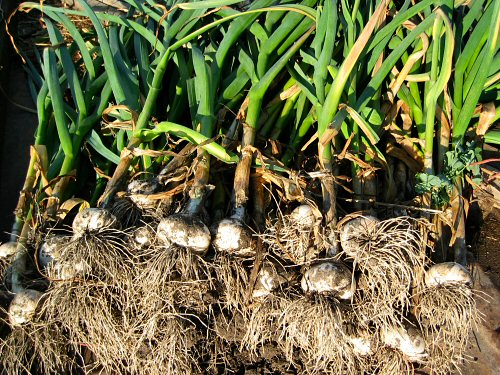
There still wasn’t much to take to the farmers’ market today, mesclun and radishes both weren’t ready, so it was baby spinach, the last harvest of early lettuce, and this surprise crop, volunteer green onions sprouted from a few dozen of last year’s cooking onions that had been overlooked in the field. I made a last minute decision to harvest them at 6:30 am, just as we were about to leave. I pulled them up—no time to dig—and filled a bushel bin in just a few minutes. At the market, I explained how they were grown and that they’re stronger tasting than regular bunching onions grown from seed. They were snapped up in no time. One of the great things about taking fresh veggies that you’ve grown yourself to market is that you’re not forced to conform to standardized tastes and sizes and appearances. So long as quality and freshness are consistent, unusual offerings provide a cool extra bit of variety and freedom all around!