
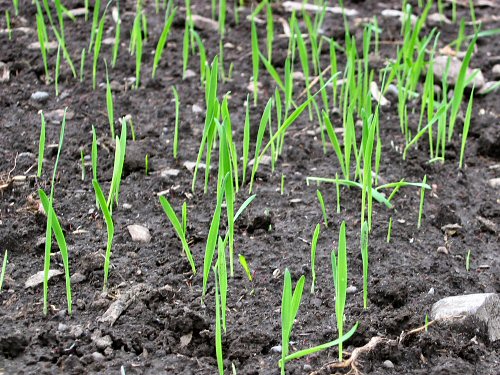
Promptly the day after the first rain in a while, OATS is surging up. Actually, strips of oats in one section planted a few days ago are appearing, the rest to hopefully follow just as vigorously. Oats anywhere but in a breakfast cereal bowl is a first for me. As a fall green manure cover crop, it’s an all new growing experience—if I didn’t know where this had come from, it’d look like an alarmingly healthy new weed attack…but it’s not. A couple of days ago, we seeded most of the open sections with an Earthway broadcast seeder (a simple, fun contraption, a bag with a shoulder strap that flings seed far and wide as you walk along turning the crank). In most sections, I used the rototiller on the Kubota compact tractor to till in the seed, skimming the surface in order to bury the seed no more than an inch or two. A couple of sections were raked so that the oats was lightly covered. In a couple more, the seed was left on the surface, a potential bird buffet. We’ll see what happens! Without the recent rain (we got another 1″/25mm today!), this wouldn’t have had much of a chance (oats needs to germinate by the end of August around here if it’s to get any growth on before winter kill)—we lucked out. So far, I’m liking oats!!
rain
At last, rain!
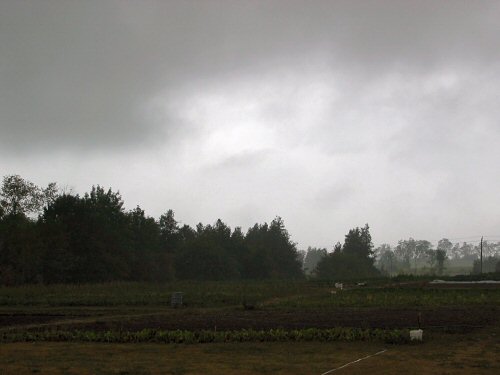
Gloomy, overcast, a typical rainy day…and it actually rained! A couple of heavy downpours and a few gentler extended falls added up to a satisfying full inch (25mm) over a few hours. This is great timing for the second planting of summer squash, which is just starting to produce heavily, and for, well, everything else! Even the pond filled up nicely. It’s too late to make up for nearly three months of near zero rainfall, calculating that effect is best left to the quieter late fall and winter months, when the lessons of the season are reviewed and new year plans get firmed up. Right now, it’s all forward looking, week to week, harvest to harvest. Any decent rain is excellent!
Milkhouse looking out
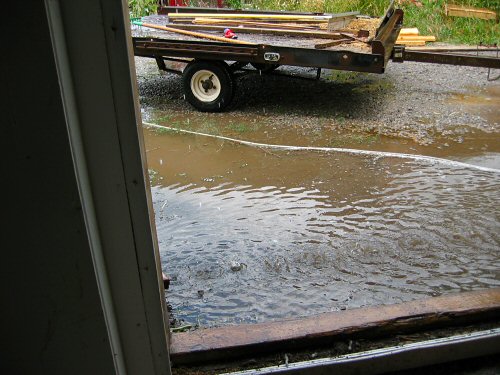
The view out of the extended Milkhouse sliding door is not yet a great one—gotta move the big storage shed that blocks the view straight out to the field—but it’s become a common one this year. Amongst other things, the Milkhouse is a place to take refuge from extreme heat and, very occasionally, from…rain. And the extreme teasing continues. The latest is rain from INDIVIDUAL CLOUDS in an otherwise largely clear blue sky, that comes down just heavily enough to make you take shelter. A gutter hasn’t yet been installed at the front of the Milkhouse, so water streams down from the roof, which picks up more from the main barn roof, creating a deceptively abundant pool in no time. Actual rainfall for this little session: 2mm. (The tiny grey hose running across the pic is the original lifeline from the barn well to the field that in the first two and a half years was all that supplied water when the weather didn’t!)
At least a little rain
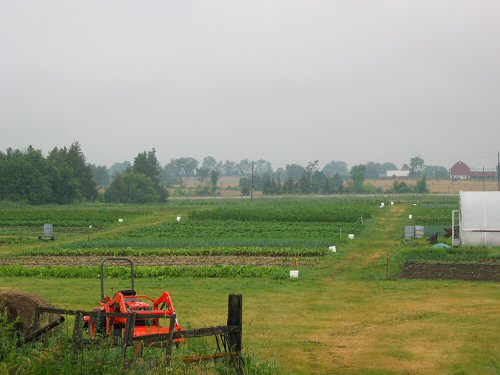
Today had all the makings of a slow, steady, gentle soaking, but so far, a mainly misty downfall has added up to a measly 5mm. Of course, I’m not unappreciative of ANYTHING in the way of rain. And the plants are looking mighty perky. Overall, the field is heading into that final sizing up stage that leads to main season fullness (see three weeks ago). Time can move so fast. Some real rain, please!
Good weather is also strange
These days, great weather is as unusual and unexpected as anything else that comes along. The last month or so, we’ve been getting rain around weekly, with sun in between. Ignoring the two days of overnight cold snaps, it’s been excellent. Today, after a half day of sun and heat, clouds rolled in on a cool breeze, a good inch (25mm) of rain came down in half an hour…and it was back to clear skies! We haven’t touched the sprinklers in ages. Bonus!
Working in the rain
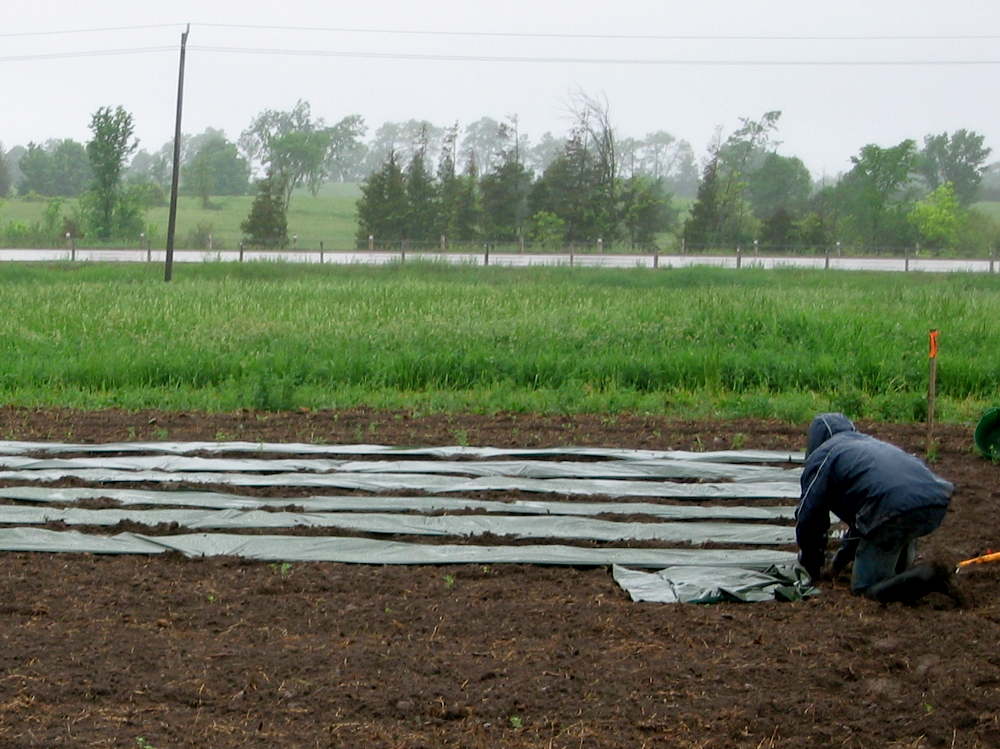
The rain is good (15mm over the last day), the chill (there’s a frost warning for tonight and tomorrow) and sticky clay-loam mud are not so good. But the calendar is flipping and there’s really no time to take shelter. Conall puts in plastic mulch for melons, anchoring it every few feet by scooping out soil, pushing down the plastic, and replacing the soil. We’ll cut X’s to transplant into, and water by hand around each plant as necessary. Labor-intensive, but it’s the most reasonable way to decent melons I’ve found so far, and it worked out well two years ago. After experimenting with straw mulch for tomatoes and melons last year, I’m back to using plastic for melons, and that’s it. Straw is great, but the extra work of spreading and then the fall clean-up seemed like stretching it for everything else that has to be done this year.
After the rain…
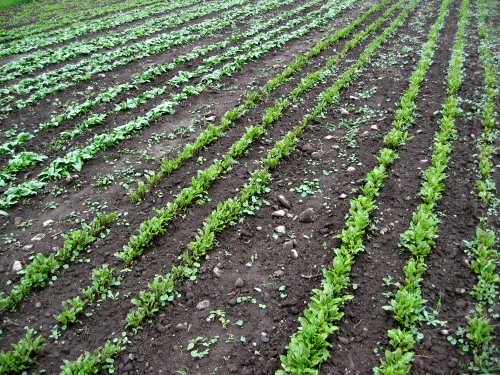
After a rain, it’s easy to see exactly how much work is ahead in the organic field! The dark wet soil and the flat light of a cloudy day make every detail stand out: weeds exploding, dense rows that’ll need thinning (thanks to the generous Earthway seeder), rocks to get in the way of hoes and tiller both. But it’s usually better than it looks. Here, the Horse tiller can be walked up each path in about a minute. Thinning the beets (first two beds on the right) is actually a harvest of excellent beet greens. The rocks, well, the bigger ones just have to be picked. The worst is in-row weeding, for stuff right in with the crops. This has to be done mostly by hand, but if you get the worst spots, the veggies soon grow to where they can more or less fend for themselves, shading out new weed growth. Or the crop is soon finished (like spinach, on the left) and the whole bed can be tilled up. With a little thoughtfully directed labor, it all works out! (We got 15mm (3/5″) of rain… Not bad.)