
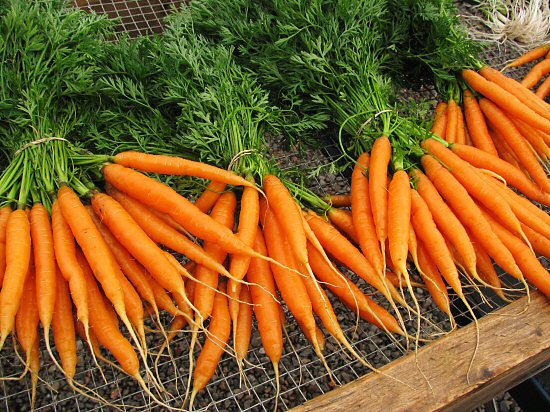
Just-rinsed carrots in the soft light of an overcast day: beautiful every time! Some veggies look particularly good without trying… These are freshly pulled Nelson, at a pretty fair size but not yet fully mature, from our fourth planting of the season. Every year so far, I’ve put in at least four, sometimes five plantings in succession, and we rarely see really fat, full-sized carrots. This has worked well for CSA and farmers’ market: our carrots are freshly harvested every week, never from storage, and at a versatile size, always perfect for eating raw and usually big enough for convenient cooking as well. Today’s haul, bundled and laid out for rinsing on the long screen table, will be heading into CSA share bags in just a minute, for pick-up this afternoon…
screen table
Packing shares: done!
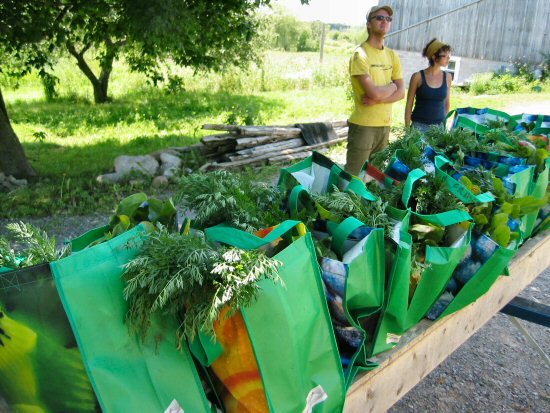
CSA shares are packed for another Monday of on-farm pick-up! It’s one of those great hits of momentary satisfaction to see them all, 100% absolutely and finally done, waiting to be collected. Mel, Jordan (above), Michelle, and Tara were all in the field, and the whole harvest went by kinda quickly, maybe three hours. I’m also figuring out the easiest ways to use different spots around the new farm. Today, as a temporary improvement, we moved the long screen table into a tree-shaded part of the drive, allowing us to line up the bags in one row, instead of grouping them on two smaller tables indoors in a shed (it’s all in the details! :). Keeping the packing space uncluttered is kinda critical if you don’t want to spend half your time rechecking shares to make sure that they’ve got everything. When the set-up works, filling shares is really suprisingly satisfying. On the tiny farm, assembly lines can be fun!
In the share: baby leaf lettuce salad mix, baby zucchini, cauliflower, garlic scapes, young carrots, beets, new potatoes, curly& flat-leaf parsley.
Harvest wet work
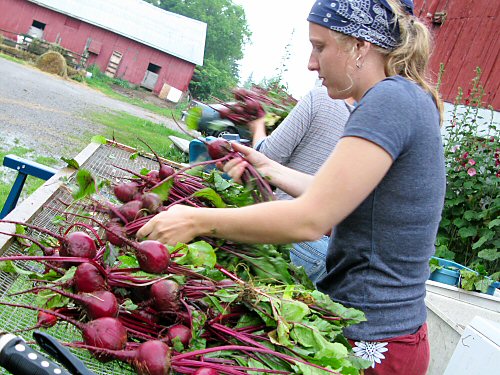
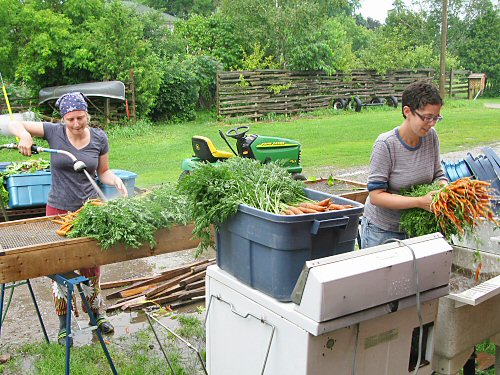
Yet another in this summer’s series of wet and gray afternoons, the weather blending perfectly with the wet work of rinsing and sorting muddy root crops. Instant efficient team chemistry between Rachel and Mel, both doing post-harvest here for the first time. (Above, carrots, below, beets.) The process is very small scale and manual. Crops are first dumped from harvest bins onto the screen table, clinging earth is quickly blasted off with the jet setting on the water wand. Next, double handful bunches are dunked for a final rinsing. Then it’s back into the bins… Simple and quick for a few bushels. Get wet!
Pick your own CSA share pick-up
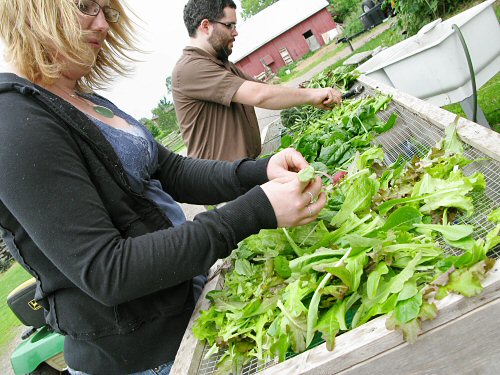
CSA shareholders coming to the farm this year are encouraged to harvest as much of their share as they feel like! Here, it’s sorting through mesclun and spinach on the screen table, removing bad leaves and the odd weed, before packing in their own bags. This approach is great fun all around, with me explaining what to do and helping out when needed. There are only a couple of on-farm pickups (most are at the farmers’ market), so this approach might be a little more personalized than if the number of shareholders was bigger. Regardless, this DIY approach is a tiny farm first that seems to work!
Tiny harvest!
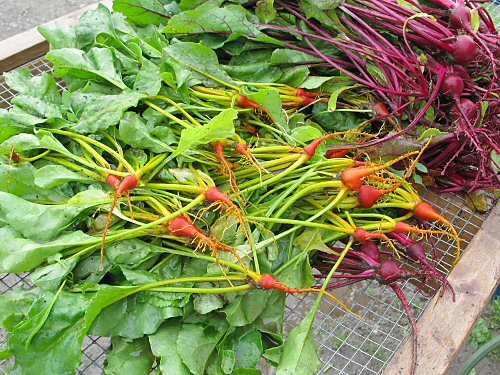
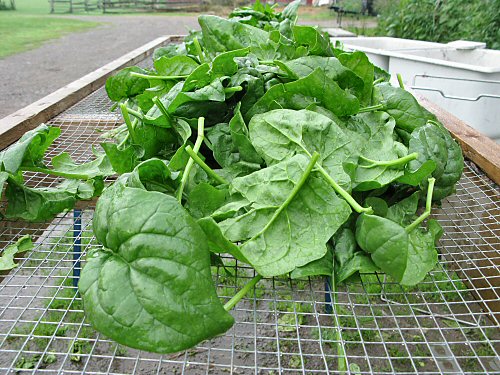
Spent the early morning harvesting a few CSA shares for a Monday drop-off. This is the first week of shares, and they’re still small, mainly greens… There are many tiny farming routines, things you’d probably never do in a bigger operation, that I find extremely relaxing and fun: the final rinsing and putting together of a handful of shares is one of them (it’s not really economical to separately harvest and drop off less than 10 shares or so, this is an…exception). There’s something deeply satisfying about this final post-harvest step, with the veggies together at their finest, the memory of the different quick individual harvests—picking, cutting, pulling—still fresh, that’s…cool! The spinach (above) was quickly dunked in cold well water to rinse off dirt splashed up from recent rain, then allowed to drip dry for a bit on the screen table.
Picked two types of beet greens, Golden Detroit and Scarlet Supreme. The stems are a little long on these—it all depends on the density of the rows, the weather, the harvest timing, leaf size is the luck of the draw since these are really thinnings, they’re not being grown just for the greens. Still young and tender, the baby beets and all can be cooked up, or the leaves used raw in salad (or as a salad!). Really tasty…
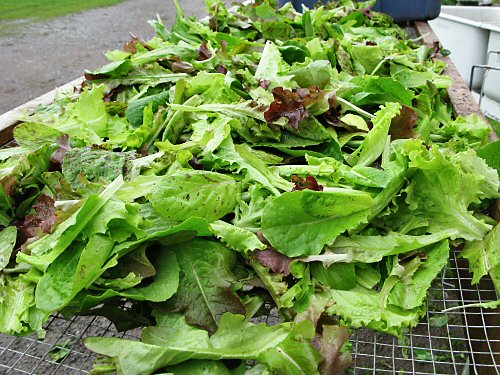
And mesclun, of course. This all-lettuce salad mix is a staple crop this year as usual, always on my mind! This cut’s nice and clean! Unrinsed—I let the morning dew dry off a bit on the screen table… More simple pleasures for the simple of mind! ;)
Screen table
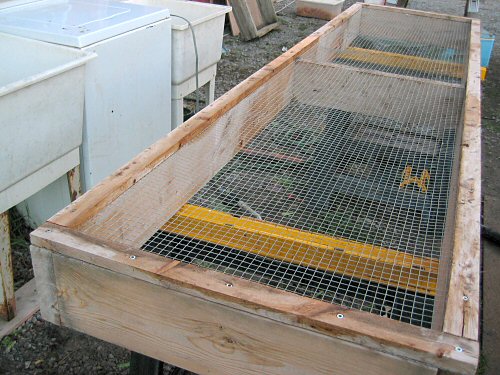
The new screen table was this year’s big addition to the washing up section of our little post-harvest processing area. Building it earlier this year was quick work: some 2×6 and 1×2 lumber, screwed together, with 1/2″ hardware cloth sandwiched in as tight as I could get it. Hardware cloth is the mesh of choice because it’s welded where the wires cross, so leaves and the like don’t get snagged the way they would in plain woven screen, like chicken wire. Positioned on sawhorses close to the washing machine and tubs makes it easy to pluck crops out of the water and onto the rack to drain. Simple, inexpensive, and one of my favorite bits of harvest gear… The last couple of harvest Fridays have been more work for fewer people, as part of the summer crew left at the beginning of September. With the days getting shorter as well, it’s the first time this year we’ve been finishing up the sorting and packing after dark! This week: mesclun, beet, carrot, spinach, radish, kale, tomato, potato, a few cauliflower and broccoli, squash, hot and sweet peppers, and onions and garlic from storage…
First carrots plus beets!
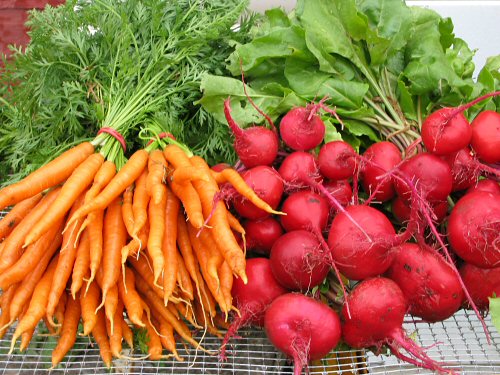
Today we harvested the first carrots of the year (baby Nelsons), along with baby Chioggia beets, for a small custom order. Veggies seen outdoors, especially when wet, are impossibly colorful in their own particular way, quite unlike…other colorful things! I’m still and forever surprised at how deeply pleasing and satisfying it can be to simply gaze at fresh veggies in sunlight (especially after harvesting them, and on overcast, diffuse light days!). Leafy greens are great, but the time for MORE is upon us once again!