Spring rain

Spring rain

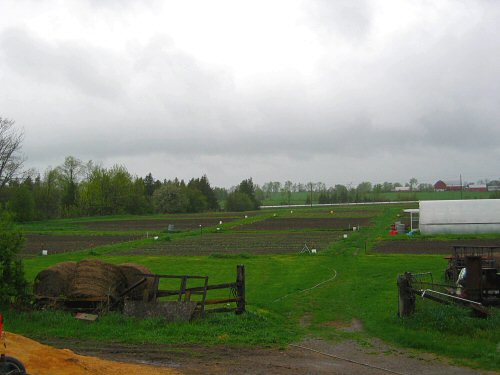
Finally, not a moment too soon, 40mm (1.6″) of gentle rain over the last day and a half, with likely a little more to come. Slow and intermittent is best for soaking in. This is great. Things were starting to get really dry: over the last week, I had to fire up the pond pump and (inefficient!) sprinklers to help along the just emerging and newly seeded beds. Now, we’re good for better than a week, for some of the crops at this stage, even two (the clay-loam is great at holding moisture). Some days, gloomy is good!

More hands on deck

Working in the field

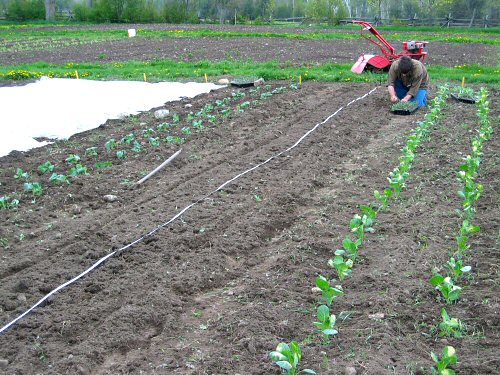
Conall, the all-new organic grower, is back after being unexpectedly called away two and a half weeks ago. That happened after we’d worked together for seven days straight. For me, making the transition from essentially solo tiny farming to having regular help was that quick. Having everything bouncing around in your head, with little need to explain it, is a luxury and efficiency of sorts. On the other hand, if you have people who you can sync with, sharing the gardening in an ongoing way seems like even more fun. And you can grow MORE STUFF with LESS WEEDS!! :) It’s a really welcome return. FREAK FROST: Three nights ago, according to the min/max thermometer, the temperature bottomed at a little below 0°C (and there was no reported cold snap or hard killing frost), but some of the brassicas (Brussels sprouts—see the whitish spots on the leaves on the right of the pic, bok choi, cauliflower) and two out of three varieties of peas got fairly toasted, burnt by the cold. Many of the pea leaves were totally killed off. I only noticed the extent of the brassica damage when we took off the row cover today. This is something I’ve never seen, and Bob, with 40 years of farming, hadn’t either, especially with peas, which can grow in the snow. The additionally odd thing is that some varieties (one of the peas, broccoli) weren’t affected at all. These are all plants that can normally take an overnight freezing and bounce back no problem—temperatures around zero should be nothing. Weird. My random theory: a very rapid temperature drop, many degrees in a few minutes, that didn’t give the plants enough time to adjust…? Anyhow, everything’s recovering just fine! The crazy weather effects continue…

More seedlings to the greenhouse

More seedlings to the greenhouse

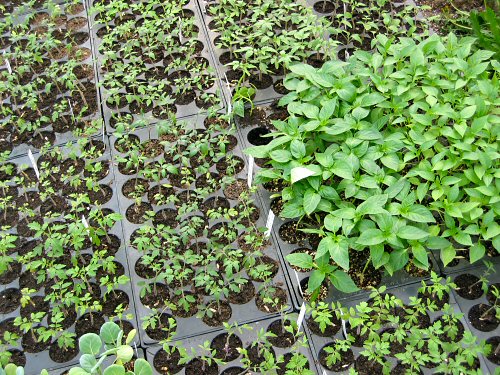
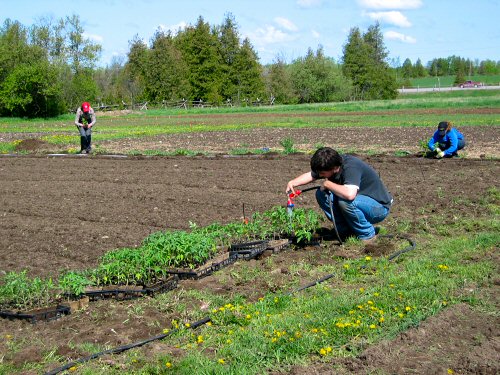
The spring seedling starting days are rapidly winding up. Moved about half of the remaining trays from the Milkhouse to the greenhouse, including most of the experimentally late-started tomatoes. Based on the marginally useful long-range weather forecast, I’m aiming to begin the main field transplants around the end of this week…

Gardens within gardens

Garden within a garden

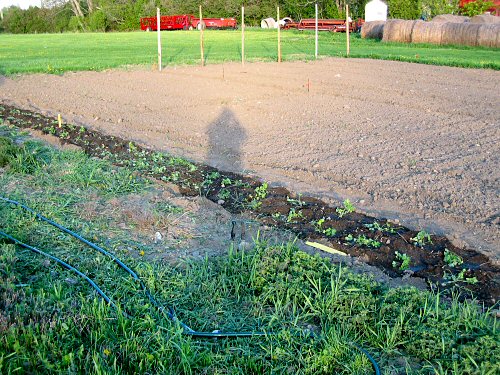
One part of this year’s plan is to expand the herb area from a few beds into a real little herb garden AND to create a home veggie garden. Here is the starting point (along with my shadow). At the bottom of the photo in the overgrowth are sections of sage, oregano and thyme, all doing fine after overwintering with no cover whatsoever, other than the snow. They need to be cleaned up and I’m going to move some. Next, I finally transplanted the parsley from plug sheets started in February, two varieties, Plain Italian flat leaf and Green River curly. The open area is waiting for warmer nights—over the next couple of weeks, I’ll transplant dill, basil, and see if cilantro can survive the jump from tray to field, and direct seed a bunch of others. I haven’t quite figured out where cutting flowers will go, maybe some here as well. And then, in the top corner, marked by 6′ stakes for trellis netting, I’m doing a home veggie garden, 20’x25′, with a little bit of everything, a tinier version of the big garden… It’s a little crazy as far as making work, but the idea is to have a demo for farm stand customers who want to start their own gardens. The more veggie gardens the merrier! :)

First day at the farmers’ market!

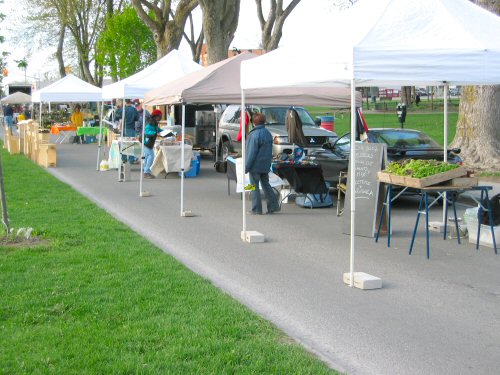
Up at 5 am, in the greenhouse at 5:30 to harvest more early lettuce and arugula. On the road by 6:30. Set up right at the 7 am opening. The photo is OK, though I find farmers’ market snapshots tend to look so stark and literal, they usually don’t capture the FEELING. Markets are fun because of the goods, you don’t expect a slick and snappy shopping mall presentation, your focus is on the food and crafts, and chatting with people. In pics, you see the mish-mash of basic tabletop presentation, but you don’t get the…experience. This one is a small market, 7 am-1 pm Saturdays, around 25 vendors, a dozen with fresh veggies, and usually about three hours of fairly packed traffic during the summer. Not like a big city market. I’m the only “certified organic” guy, and only one other stand has salad greens and a good selection of veggies beyond the standards. My stand is first on the right of the pic, with the newly repainted chalkboard and sharp new collapsing metal sawhorses debuting this season. I like the really basic display and circus-on-the-road feeling of setting up at 7, gone by 1:30. It was a good day, I was there mainly to show up, with only about 30lbs of the five-lettuce-and-arugula mix to sell (the first field crops won’t be ready for another couple of weeks). It was quiet, the cloudy, chilly weather didn’t help. Chatted with lots of regular customers, handed out some CSA flyers, and sold out by around 11… Fun!

Sorting

Tools sorted out

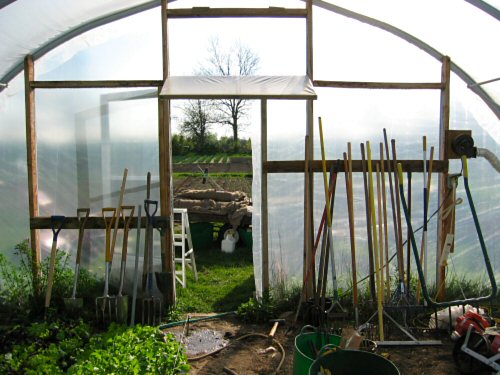
Tiny farming requires lots of bits and pieces, gear inevitably gets jumbled and misplaced, and the whole show can start to slow down as things get in your way and you spend time searching for this or that. Sorting things out is an on ongoing, neverending process. Last year, it seemed like a fine idea to stick all the hand tools in a 55-gallon barrel, so that nothing would be leaning against the hoophouse plastic. What a bad idea. Everything got tangled up, I began leaning my most used stuff against the barrel, and this year, when other people also started using the tools, it got completely out of control. Today, I screwed a couple of boards across the studs in the end wall—instant (if temporary) relief, and it got the barrel out of there, making it easier to move around the seedling tables. A place for everything and everything in its place—here, that often annoying recommendation does make sense!

Flea beetles

All of the brassicas, except for radishes, start out under floating row cover. It’s the only way they’ll survive the flea beetles. Around here, the FBs are a clear and present menace to the cabbage family. They chew little holes in tender baby leaves until nothing but stems and dried out leaf skeletons remain. It’s awful. I could use organic sprays, like rotenone or pyrethrin, but although they’re “approved” and from natural sources (other plants), it seems to me a slippery slope, or at least habit-forming. I haven’t sprayed so far. I did try a garlic blender concoction as a repellent once, but it was like cooking for the FBs, they hopped off and hopped back on once the spraying stopped: salad dressing! Anyhow, this is bok choi (pak choi). FBs eventually managed to get under the edges and do a bit of damage, but that’ll be outgrown, bok choi grows fast (as do radishes). Once the leaves get a bit more substantial, the FBs can’t as easily chomp on ’em. Cauliflower and broccoli, under this same 14′ wide sheet of row cover, are untouched. FBs REALLY like bok choi!