
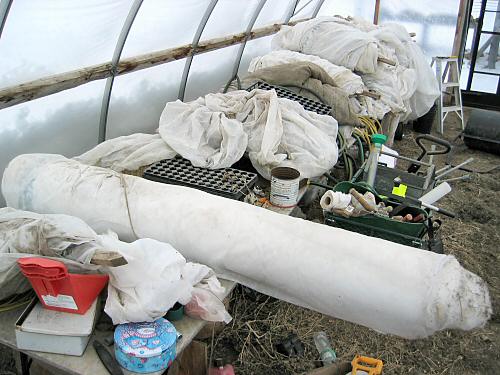
The greenhouse is small, and the layout hasn’t really changed in its three full seasons. A row of tables on the north side are where the seedlings go. On the south side, unshaded by the tables, is an open strip, about 8’x32′ (2.4x9m), where I pursue ever earlier lettuce, trying to have something for the very first farmers’ market of the year (it’s the first Saturday in May; last year’s second Saturday is the earliest so far). It’s a simple set-up. Still, every year, there’s one day when I head out there to assess the clean-up requirements and plan what to do. This year, today was that day. A lot of different gear gets stored on and under the tables. It varies each year. Here, it’s mostly floating row cover, kept up off the ground because, apparently, voles don’t like to climb (voles gnawed a hole through a good part of a roll one year…very annoying, imagine unrolling a neat row of ragged holes). Exposure to UV from the sun is not good for plastics particularly, and I do store most things in the drive shed, or the Milkhouse and barn, or under the tables, but things do get left out… Anyhow, this year’s action plan is settled: clean up!
Greenhouse
The basic tiny farming greenhouse is a steel-ribbed, plastic covered hoophouse, the bigger, the better for season extension.
First day of winter
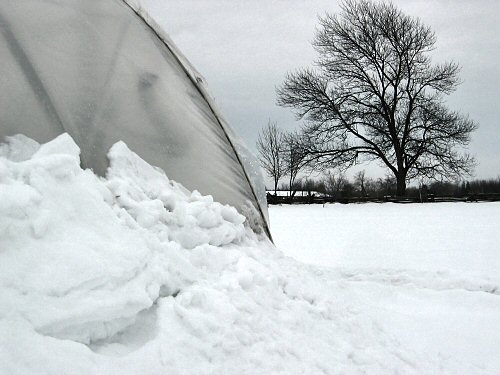
Winter: today, it’s official… Every day I head out to the field to take a look, even if it’s only for a few minutes. I check the greenhouse, and…look around. There’s not much to see. The snow is now about 3′ (91cm) high on the sides of the hoophouse. I don’t bother clearing it off, it seems to do fine. It may not be obvious from the pics, but the side walls are double layers of plastic, inflated by electric fan with about six inches of air between (electricity for the fan is run out from the drive shed). You can see the hose for the fan on the inside, right near the curved rib (the fan and hose are on the left of this shot). This keeps the sides rigid enough to stop the snow from pushing in. And the trees are bare… And the days are now getting longer! :)
Winter watch: the greenhouse
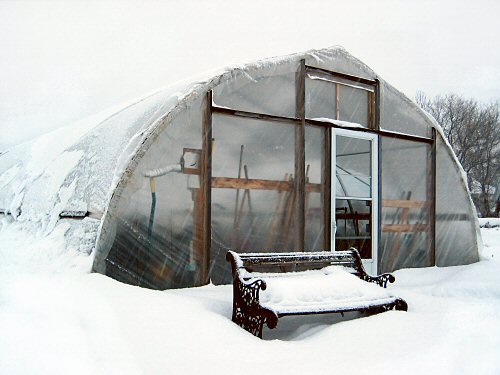
We haven’t gotten a really heavy single dumping of snow so far, but it’s coming down steadily every couple of days and the weather’s staying cold, so there’s build-up. That means increased vigilance on the greenhouse front. The right combination of freezing, a little thawing, and more snow can stick heavy slabs of ice on the hoophouse plastic. It usually slides off, but the weight can build up quick, so I check. If things were to get really weighty, besides removing the ice, I’d have to support the whole thing on the inside by wedging wooden beams under the ridge. I doubt it’ll come to that. And there’s the build-up around the base, some sharp shards of fallen ice could have puncture potential, none so far. AND THEN, this is going into the fifth year for the plastic. The special 6mil hoophouse covering is UV-resistant and rated for four years, so round about now, it’s time to look out for signs of fatigue and disintegration. I haven’t seen this before. I imagine it’ll start tearing at exposed pressure points, the way regular plastic shreds or tears under slight pressure after a while in the sun (well, in the UV, sun or not). I should ask around. The west-facing side, with the door in the picture, is most exposed to really battering winds that occasionally sweep across the fields with not much of a windbreak nearby. (It took me a season to get over being amazed that the hoophouse was still standing after bad storms—I’d actually head out in the howling wind in the middle of the night to check!) So, the usual winter greenhouse watch is on, upped a little. (I should drag that bench inside…)
Cleaning up
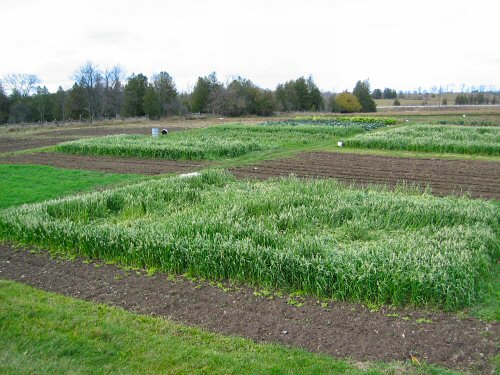
Here’s a look to the north from my new favorite photo spot, on top of the farm stand. We’re down to mainly brassicas, oats and rye (that’s the low, darker green section poking in on the left). The oats has started to die off and topple over, leaving collapsed areas that look as if animals had bedded down… The days lately have mainly been overcast and quite cold, just above 0°F, with a fair bit of rain that leaves the ground mucky. My hours a day spent in the field are winding down, a two or three hour job at a time, weather permitting. Elsewhere, there’s lots of putting in order and stowing away, and clean-up in the Extended Milkhouse where all kinds of junk accumulates over the year. Getting set for winter.
Turn to the left and here’s the view over the greenhouse. The grass-alfalfa mulch is still inside, along with stacked rolls of row cover.
Making mulch, part 3
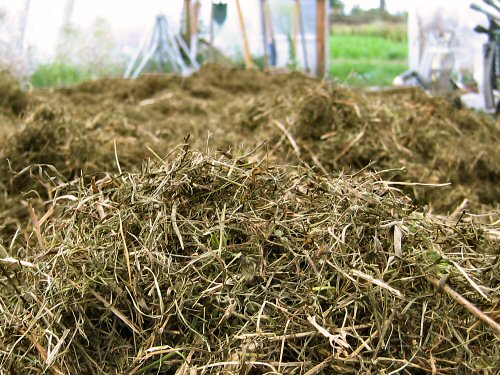
The grass and alfalfa mix spread in the greenhouse a few days ago is drying nicely—it’s almost done! It was a tad touch and go at first, the rows in the field were starting to turn black and decompose, and no sun in sight. So I turned it a couple of times a day for the first couple of days, doors wide open on both ends let through lots of air…and things worked out! Seems like a nice mix, with good bulk, not too fine. Then again, my mulch experience is in its early days, so we’ll see. Rough calculation: there should be enough to spread a fluffy 3″ (7.5 cm) over the new garlic plot. This experiment so far: not too labor-intensive, room for easy improvement to the process, seems like it would scale well (for covering larger areas), and RELAXING (some fieldwork is particularly enjoyable)… Grass-and-alfalfa mulch may have a big tiny farm future!
Hand tools
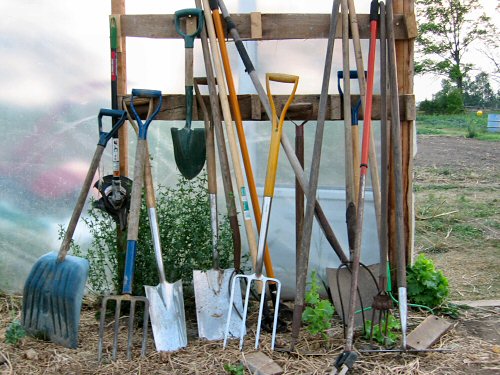
The quick hand tool reorganization in May has worked out well, with everything staying sorted and easy to find. Oddly this year, the hand tools themselves seem to be getting less of a workout than in the past. It only struck me today, kinda strange, so I gave it some thought. Forks are still used regularly for harvest digging, rakes for finishing off beds for seeding, but the various hoes, usually grabbed daily, have in great part been replaced by the wheel hoe! Even the Horse rototiller is getting noticeably less work. Cool. The wheel hoe has proven, as expected, to be a brilliant tool. Saves countless hours, makes tedious jobs fun. Don’t market garden without it!
Evening harvest
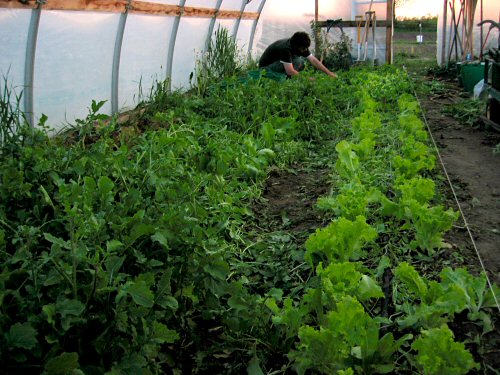
In the greenhouse, harvesting in the first and last couple of hours of the day is the only way to ensure tasty salad greens. Daytime harvest is near futile, as the leaves go limp and require serious rehydration. In the chilly evening weather, plants perk up, and it’s all right as rain! Here, cutting greens in the evening before market means clearing the arugula that bolted during the week and rapidly buried the lettuce. Out of arugula chaos comes delicious, garden-fresh salad mix! (On the tomato front, yesterday’s field transplants did well, only a few leaf burns where they touched the cover, this despite quite a hard frost. That’s good.)