
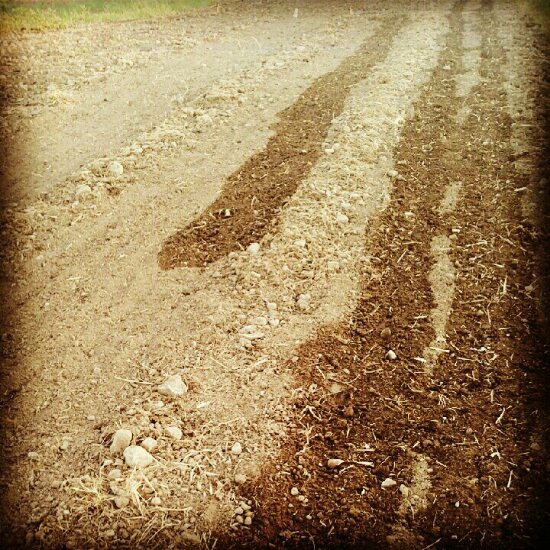
End of the line: what it looks like when your well bottoms out and the water stops flowing. Just like a power failure… We’ve been watching the level in the dug well we’re using, and the refresh rate is pretty dismal. Today, while watering in newly seeded beds, the water finally stopped. After last fall’s failed well drilling, figuring out short and longer term water solution is big here now. The water will come back eventually in this well, but the water table drops as the winter reserves go, and at this point, the well won’t refill high enough or quickly enough to be useful even for seedlings. Water barrels filled from the house well and distributed by watering can is a possible labor-intensive emergency measure. And of course, there is always…rain.
watering
Watering cans
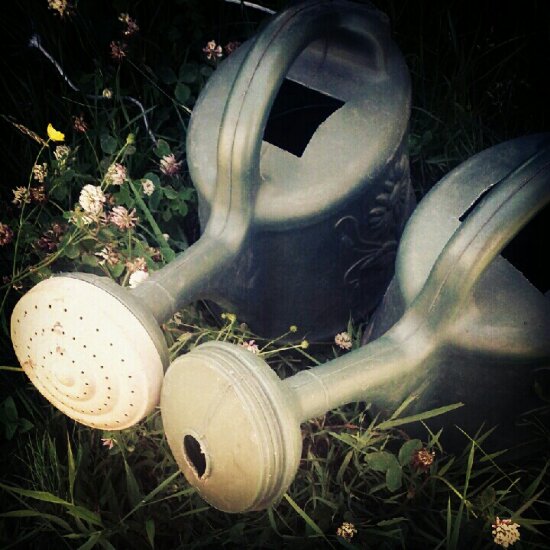
Good tool! These watering cans have been all over—seedling room, greenhouse, field—for the last few years, near perfect for hand watering missions. Five bucks, plastic construction means they’re lightweight, two gallon capacity is decent amount of water that’s still easy to handle, even with one in each hand. The spout cap pours a nice, heavy shower for speed and unscrews for cleaning and for filling smaller containers. I cut square holes on top for quick plunge filling from open barrels. Great!
A little extra watering in
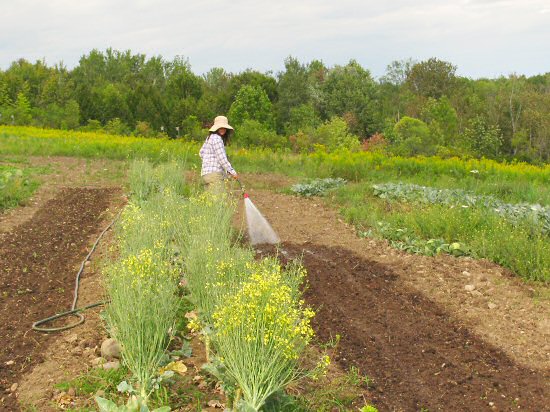
The last-plantings-of-the-season fun continues as we watch the weather and hope these crops get a jump before cool temperatures and weaker sun start to seriously slow things down. More sun is the main thing, right now, and that’s been going well. Our last beds of spinach, lettuce, radish and Asian greens, direct seeded a week ago, got well-rained in the day after seeding, and they’re all coming up now. Still, it’s been fairly windy and dry since, so we decided to hand water them, to help ’em all along. Here, Tracy uses the RedHead water breaker to gently lay down a little flood (behind her that’s broccoli, exploded: tiny broccoli flowers from unharvested heads that we take to market as a free edible flower salad garnish). In this section, 100′ x 5 rows of lettuce mix, and the same of Bloomsdale spinach… Grow, little plants, grow! :)
Water, water, everywhere…
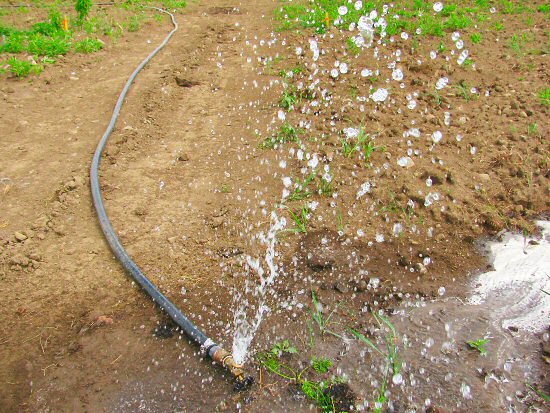
It’s getting dry! A few parts of the field are still wet below the surface, but most of it has gone from pretty well waterlogged a month ago, to dry a couple of inches down, and there’s no rain in sight. The forecast is for heat and sun for the next week at least, with a 60% chance of “showers” on just one day—no holding breath for that. So it’s time to think about spot irrigation.
Step 1, finished this afternoon, is to run a water pipe from the well right through the L-shaped garden. Our watering methods are quite slow and labor-intensive, by hand and with soaker hoses, but on the upside, there’s no huge volume requirement , so the 1″ black plastic pipe already on hand will do fine. Part of the line was already set up, and I added the last 200′ today, for a total of length of about 800′. Taps with quick release connectors are spaced along the line: just plug in a hose as close as possible to where you want to go, drag it out, and there you have it, a little water…everywhere.
Another hand-watering method
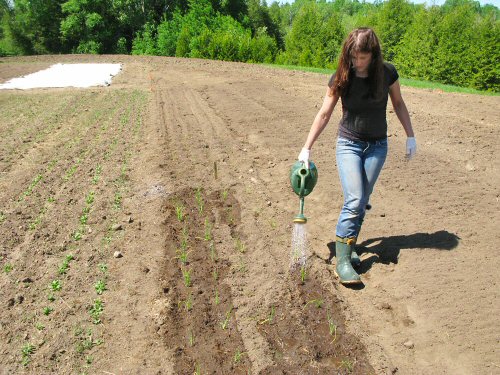
Another fine temporary measure this spring (and another of the many things the trusty Kubota compact tractor can do) is our new spot-watering method. Michelle waters in a last, experimentally late tray of onions with a slightly modified, inexpensive ($5) plastic watering can that holds about 2 gallons (8 l), and has big holes for fast, high-volume output. These cans we usually plunge into a rain barrel (or snow barrel) for filling, and to speed that up, I cut a squarish opening in the top (I always forget to cut the opening to the back, so water doesn’t escape from the top when pouring when full). The trick here is that the water comes from the Kubota’s bucket, maybe 30-40 gallons (110-150 l) of it, depending on how carefully the drive. You fill up, then head over to exactly where you want, like a movable rain barrel! The whole thing is quick and easy, good for watering in new seedings and transplants, until I hook up the field-long irrigation pipe. Quite the luxury, in a way, but the tractor’s already there, and we gotta keep things moving along! :)
Water pipe
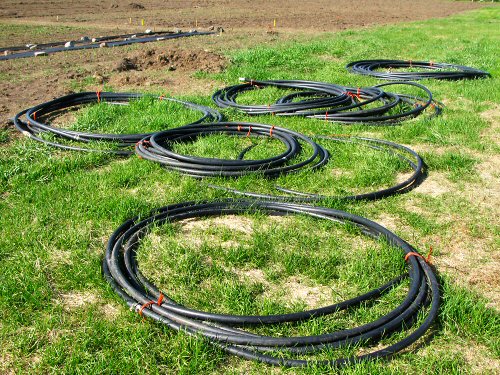
A bonus this spring has been the steady rain, not too frequent, like, once a week or so, and somewhere around 1″ (2.5cm) each time. Perfect! Still, today, in the middle of a hot, sunny stretch, thoughts turned to water (not that it was ever far from mind). Out came the coils of 1″ water pipe. In our barebones spot irrigation system, there’s 1″ pipe and a bit of 2-1/2″ pipe, endless 5/8″ garden hose and 50′ sections of soaker hose, the gas-powered irrigation pump, and even 55-gallon barrels and watering cans. Not to mention, piles shut-off valves, quick connectors, and various hose fittings. For now, all that I’m looking to set up is one central line running from the well pump at the house, right down the length of the side-by-side fields, where it can feed the garden hoses. So, uncoiling we go…
The goats
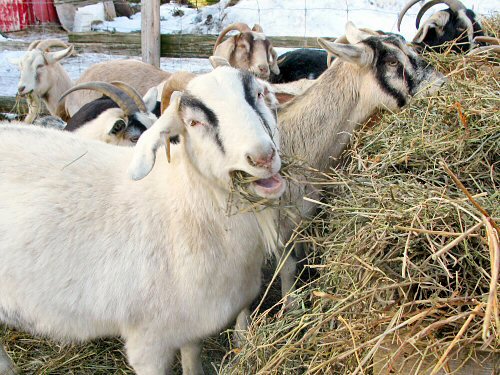
Haven’t been paying much attention to the goats lately, so I checked ’em out for a while this morning. They have absolutely no problem with the cold, eating hay and hanging out pretty much as usual. Of course, serving them is a lot more work when it’s freezing, lugging buckets of hot water from the main barn, since the pipe to the convenient goat barn tap is frozen. I did goat chores for a winter, but right now, it’s Bob’s thing. Oh, well. :) This gang of girls has had the same line-up for the last couple of years, and some I’ve known since birth… Familiar faces. A couple even have names…