
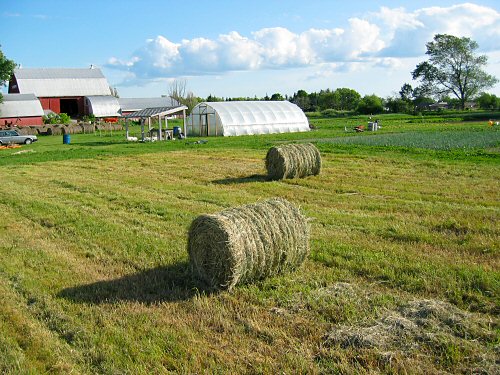
The garden, approaching 2.5 acres with this year’s addition, floats near one corner of a 9 acre field of hay. I could fairly easily expand into much more of the field, and ride around all day, machine seeding and cultivating. This is definitely not the plan. Instead, it’s stay small in area and add people—I’m somehow attached to the idea that, in a pinch, I could still (with help!) manage the whole thing without gas-powered machines…more or less. So, twice a season, Bob cuts and bales the hay that’s all around, using 30-year-old big tractor gear, carefully kept up over the decades. Since the whole farm is certified organic, I suppose we could find a specialty market for “organic hay”, but that seems a little precious—this stuff gets fed to the half dozen cows, couple of dozen goats, and single miniature donkey, who live to eat and loaf on other parts of the tiny farm (I call ’em 10,000 lbs of pet…they’re Bob and Karen’s, it’s not I who takes care of ’em!). This field is overdue for reseeding, the hay has lots of grass that’s grown into the diminishing clover and alfalfa. Oh, you can also see Conall’s old Volvo station wagon, in the parking circle mowed out of the hay in front of the stand—it’s rapidly become part of the season’s local errand routine (it will lose some character when he gets that rear bumper reattached). And that’s the hay story.
Year: 2007
Three generations…
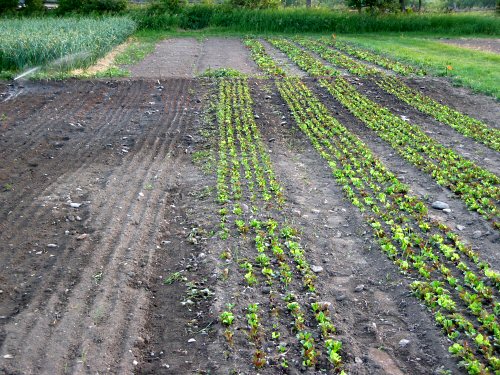
On the left, watering in the latest of six succession plantings of mesclun with a basic lawn sprinkler that’s quite efficient for shallow irrigation of newly seeded beds, when there’s no wind. Here you see the last three generations. I started planting four beds at a time, a week apart, and stretched that to nearly two weeks as the sun, heat and regular rain we’ve had so far made the growing fast. With the great weather, they’re catching up to each other—you can see the beds on the bottom right are moving up on the previous planting up top—and I’ll be tilling under a lot. This is absolutely strange for me, in past years, cutting every last bit of available salad greens every week was normal. But the people and planting expansion this year make this sort of abundance the new normal, production levels that assure harvests for all the CSA members, market and stand, even if conditions get tough. It’s not WASTED, I tell myself, it’s organic matter and even nutrients, back to the soil… I’m getting used to it!
Cloud show

Second only perhaps to badly done snapshots of kittens are unfortunate attempts at capturing majestic cloud formations. Still, this evening, I couldn’t help but point the camera at the sky and snap away… For an hour or more as the sun set, all manner of clouds formed and reformed into the most fantastic combinations and configurations I’ve seen in a while. At one point, the wind suddenly picked up from a breeze to maybe 40km and low, menacing storm clouds, seemingly close enough to jump up and touch, raced across to one side but missed us entirely, then the wind as suddenly died down. Everywhere you looked, fancy cloud action was going on. I spend a fair amount time looking at the sky, usually to see if rain is actually going to make it all the way to us instead of veering away at the last minute. But a lot of the time, as you look around, the sky joins the field, your gaze travels up, and it’s all…good! (Hope the photo manages to stir fun memories of…looking up!)
Checking potatoes
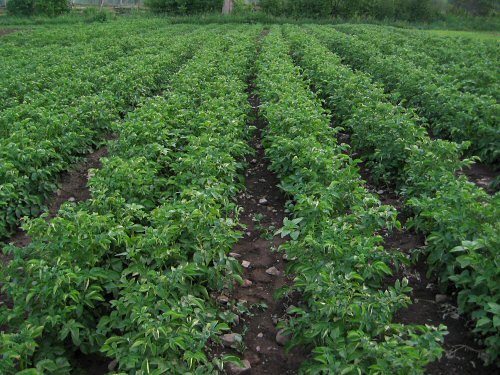
Potatoes are looking good, all weeded and hilled, around seven weeks after going in. There’s been a Colorado potato beetle watch on for the last few days, the little guys are out in some force this year, more than in the last couple, although not a major problem so far. Control is time-consuming (what isn’t ! :) but easy: they tend to congregate conveniently on the topmost leaves, munching away, so we pick them or shake ’em off into a small bucket of water. A simple end.
Doing the rounds
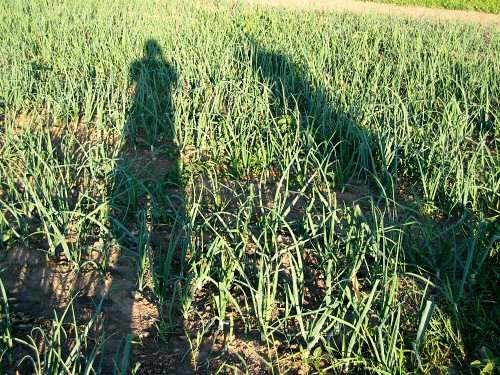
Since the start, the idea of a daily full garden inspection—”doing the rounds”—seemed to make sense. It sounds easy enough, but somehow, it doesn’t get fully done all that often, there’s almost always something that seems absolutely pressing to do early in the morning or in the evening when a stroll about is most practical and pleasant. But of course, I do get around to see everything every couple of days at least: checking for weeds alone insures that. Today, Conall and I managed to do a pretty full walk about. You look to see how things are doing in general, check for the start of new weeds and pests…it’s amazing how things can creep up and then jump out at you if you’re not watching closely. Here, we’re checking out the onions. So far, they’re doing well!
Packing station
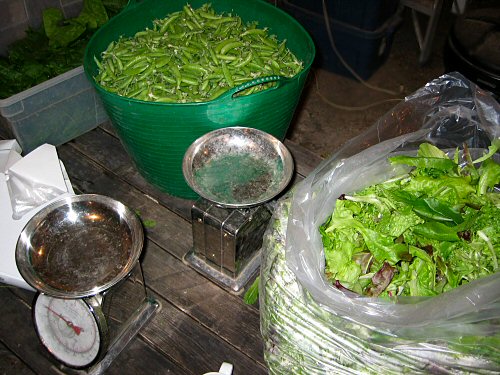
The post-harvest is a simple, straightforward process that has to be done fast since we don’t have a cooler. The set-up is manual and basic. Today, we packed indoors to get out of a stiff breeze that would’ve taken the salad greens sailing (usually, we do everything outside, in the shade of the barn; the indoor option is part of the new luxury of the Extended Milkhouse). There are a couple of 2 kg kitchen scales for the snap peas and lettuce mix. Everything is sold by bunch and bag, not weight, but the scales are useful for keeping things consistent. It’s quite easy to get the right amount by eye, so it’s into plastic bags and pop onto the scale for a quick check. If it’s underweight, add more, otherwise, somewhat over is just fine!
Farmers’ market stand described…
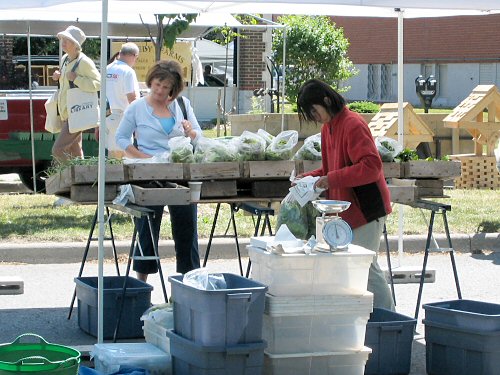
Setting up a stand at the local farmers’ market reminds me of a traveling circus, at least, the way I imagine one to be. Everything has to be compact, easily packed away in a limited space (in our case, a pick-up truck), quick to set up and tear down, and quite rugged to handle the wear and tear. There are also lots of critical bits and pieces that it simply doesn’t do to forget. Overall, the stand is a bunch of simple pieces, assembled into a functional little veggie selling spot. In this picture, taken from behind the stand, it’s near the end of a fairly busy day, with crates and big leaf bags of greens all empty, and Kikuyo the WWOOFer-for-a-week from Japan helping out.