
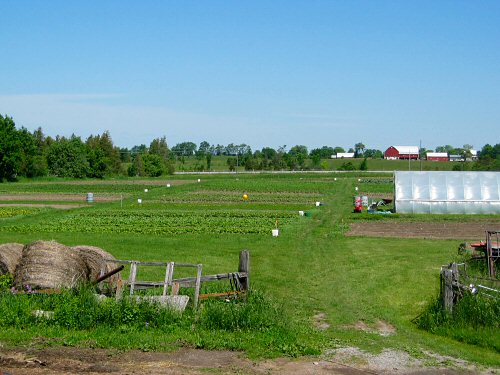
Hot but not a scorcher, a bit of a breeze, full sun in a clear blue sky… Even at a distance, the field is starting to show clear signs of vigorous veggie activity (see one month ago). And, amazingly (although, according to plan!), we’re on top of the weeds. Today was a bit of a semi-day off for me, with only a few hours here and there of hand-weeding, and lots of strolling around thinking about this and that (mostly, about things on the neverending to-do list…). Particularly now, still in spring start-up mode, tiny farming is REALLY full-time, you’ve gotta be into it 100%…so, you’d best love it as well. I’m having fun!
Year: 2007
New view
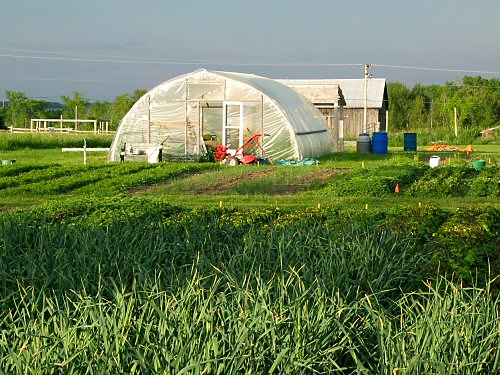
Here’s a view of the lower part of the field, from an angle that I don’t check out too often, looking over the garlic, past mesclun, carrots, green onions, beets, to the greenhouse, and you can see the veggie stand—it’s still roofless—tucked away behind. (Normally, only the mesclun would be in this area, with the root crops at the top of the field, but because the new section wasn’t ready in time for putting in fine seed—too much sod to break up—I’ve had to move things around a bit.) And so, it’s nearing the end of another hot and sunshiny day of weeding, seeding, more weeding…and so forth. We started pruning, staking and caging tomatoes, before they got too far carried away—it’s good to be on time!
Tiny eggplant
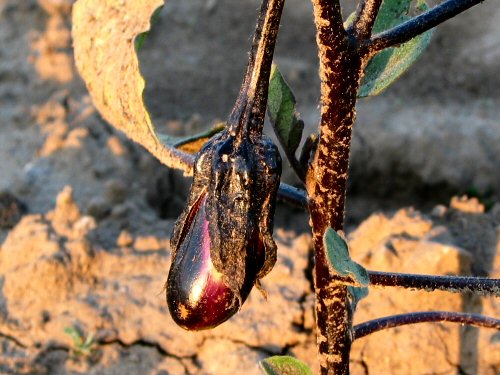
Tiny eggplants—this one’s about 1″ (2.5cm) long—are appearing on a few plants, also, tiny peppers! I’m not sure what this is about, heat stress, maybe, although it hasn’t been that hot. And the seedlings weren’t old, oversized, or root-bound when transplanted—no great STRESS all around (unusually stressful situations seem to make plants, like people, do odd things). As far as I can tell, conditions this year, from seed starting on, haven’t been overall different from in the past, so why all this early, TINY, flowering and fruiting? I’ve seen this when plants were left too long in small pots and…miniaturized, but that wasn’t the case for these guys. It doesn’t worry me so far, but I’ll check into it. Meanwhile, off they come, and then, well, as usual, we’ll see what happens next!
Stakes and cages
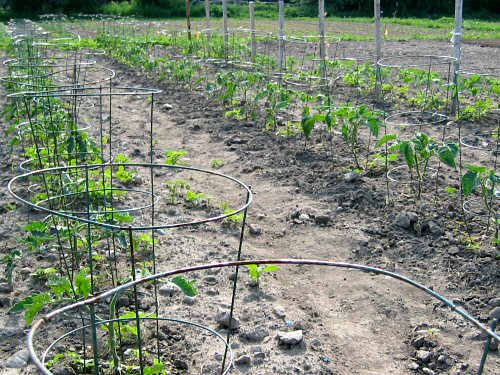
Prune, sucker, stake and cage—there’s a lot of (brutal-sounding!) stuff to do with tomatoes. On the other hand, as I’ve done in past years, simply by not having enough time to support them all, you can let ’em sprawl. I’ve always wanted to have the toms neatly assisted by the basket-weave method. This involves pounding in stakes every second plant (maybe every third would also work), then weaving twine in and out, in front then behind every other plant in one direction, then back again, weaving the opposite way, this done every 12″ or so of growth. This way, each plant is then supported by twine on both sides. You also have to prune and sucker (remove the shoots that grow at the intersection of new branch and stem), so that you have one main stem. This year, we should have several beds set up this way. There are also around 250 home garden-style tomato cages, which are quick, but don’t provide that much support when the plants get heavy. An advantage of caging: you don’t have to be as strict with the suckering. For at least a few plants, I’d also like to try caging with cylinders made of 6″ mesh concrete reinforcing wire, a heavy duty (and fairly expensive) approach… This year’s mix of methods is underway. More as it happens!
Not a pretty picture
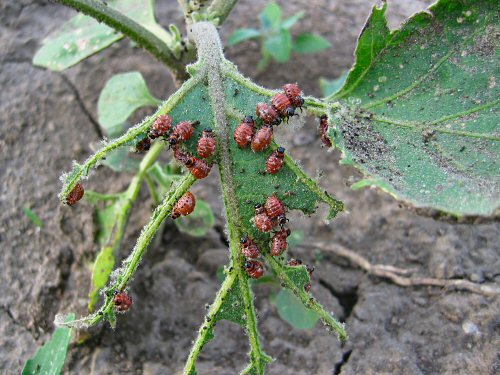
In today’s field photo selection, there was a kinda cool shot of a last-season carrot starting to flower, a freshly hand-weeded onion patch looking quite sharp, or this shiny, slimy cluster of baby Colorado potato beetles, going to town on a Black Beauty eggplant…
Pests and disease have thankfully not been a big problem in this organic field. I like to think that the garden is in some sort of balance, but perhaps it’s just location and luck… In either case, there have been some outbreaks: many tomato hornworms on the…tomatoes in Year 1, same for Colorado potato beetles on potatoes, early blight on tomatoes three years ago when the summer was cool and almost always cloudy and damp, and, of course, the everpresent flea beetles (brassicas) and striped cucumber beetles (cucurbits).
The FBs and CBs are defended against with floating row cover. The rest have recently died down, to the point where I let them do their thing, handpicking a few, but really accepting a small amount of leaf damage (they all eat leaves) and no plant loss.
This year, the CPBs seem to have crossed over to eggplant (another of their natural targets, but one they never really took aim at in the past). They seem to be favoring the Black Beauty eggplant…
The worst of the major damage in the photo happened in probably less than a day, as I’d taken a walk through there just yesterday. Only about four or five of 60+ Black Beauties had a significant presence, with a few loner CPBs on other varieties (and I’d noticed no eggs on the leaves in earlier checks). So, I squished ’em. Vigilance is somewhat increased.
Beet greens harvest
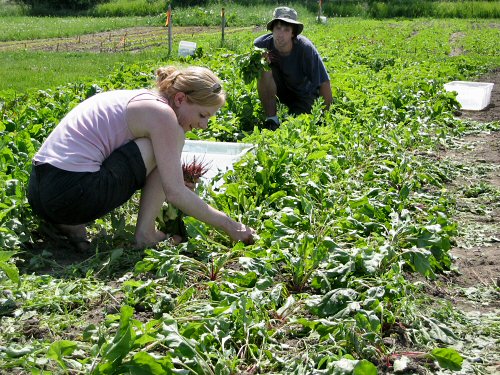
Andrea and Conall harvest Cioggia beet greens in the hot mid-afternoon sun. In tiny farming, it seems that every action has several different effects and offsets, some good, some not so, and a balance, hopefully leaning to the positive side, is struck each time. Here, harvesting greens in the heat is not the greatest for the freshly pulled leaves or the plants that remain, but this is the time we had (a cloudy afternoon with a mild, refreshing breeze every harvest day would be nice!). A quick bath in cold well water instantly refreshes the harvest, and the plants will recover overnight. This particular bed of beets had gotten quite weedy, so weeding while harvesting slowed things down. But, the fairly dense piles of pulled weeds, spread between rows, dries into a decent mulch that’ll help retain moisture and prevent more weeds from germinating. And, the harvest is also a thinning session, giving the remaining plants the space to fill out into proper beets. It all works out…!!
Beet greens at market
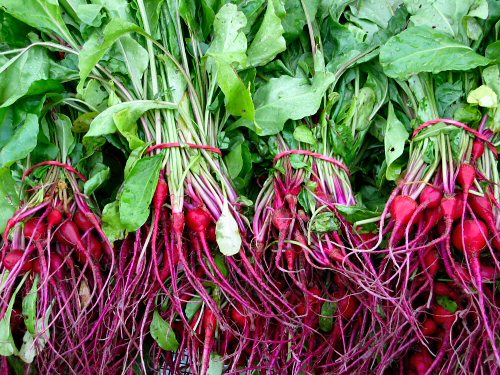
Yesterday’s beet greens harvest is today’s fresh produce at market—well under 24 hours from field to stand! The fine dining action is really up top with the leaves—great raw or lightly sauteed at this size—but the tiny, unusually bright red Cioggia beets at the bottom got all the attention, with every third passerby asking about these strange looking “radishes”. Beet greens aren’t a staple veggie around here, still, enough people know ’em and love ’em to make these 500g bunches move briskly. A little slow, people-wise (it picks up in July), it was nonetheless an all around enjoyable, successful day at the farmers’ market, with beautiful weather to boot.