
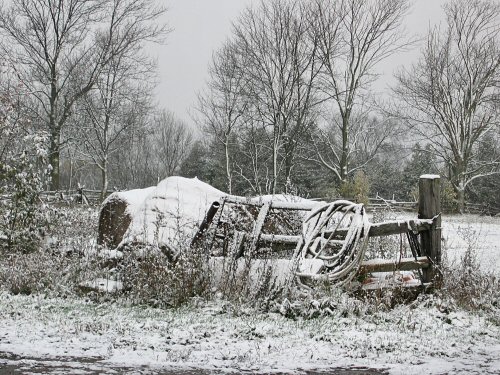
Even a section of fence sorely in need of clean-up and repair looks kinda interesting under a little snow. We’ve had the lightest of powder trickling down for a few minutes here and there over the last couple of days, but overnight, it finally snowed enough to stick around for a bit. This was about 9 a.m. Within a couple of hours, the sun was out and the first snow was gone without a trace…
Year: 2007
Spearmint and the other herbs

The fall season that wouldn’t quit has more or less come to an end. For the last few days, overnight temperatures plunged well below zero, we’ve had hard frosts and some snow, but the ground is far from frozen, and there are apparently warm days ahead (for more tilling, planting additional garlic, harvesting the last of the carrots and beets)! In the herb garden, there’s not much to do, except bring in the rosemary. Flat leaf parsley is in fine shape, doing better than the curly stuff. Sage seems indestructible, thyme and oregano are largely toast above ground, while the tarragon starters seem to be fine—I’ll put them all under a couple of layers of row cover, although the sage, oregano and thyme have come back no problem for the last two years after overwintering right out in the open. Some of the peppermint was killed off, although the roots may be okay. Apart from a few cold-burned leaves, the spearmint, in the picture, is right as rain…
Rototiller breakdown
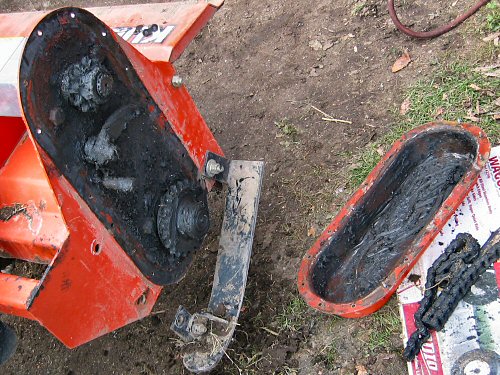
Like machinery everywhere, gear on the farm tends to break down just when you need it. This may be obvious, but it’s no less annoying for it!! Some breakdowns you know are coming sooner or later, like when you decide to let it wear out rather than fix it at the first signs of trouble. This you can avoid with regular maintenance including INSPECTION—checking things out for looseness and wear always eventually pays off—but often I, uh, don’t get around to it (as with, recently, the riding mower). Most breakdowns are, at least on the surface, sudden failures, like today, when in the midst of tilling with the 48″ rototiller on the back of the Kubota compact tractor, the tines suddenly stopped turning. This had happened once before, so the diagnosis was easy: broken chain. And that’s a good one. Every time something breaks and we fix it, I stock up on extras of whatever was used in the repair—DIY repair and a good selection of spare parts go hand in hand on the tiny farm! So, for the chain, there are parts: full links, offset links, master links. A replacement chain is also quite cheap and a good thing to have on hand. This particular repair job is dirty but extremely simple and straightforward, same as for a bicycle chain. Pop off the chain guard, scrape off the excess grease, bang out the rivets on the broken links and add new ones, or decide to replace the whole thing, put the chain back on…it’s about as simple as that, and you’re back in the saddle again!
More fall finishing
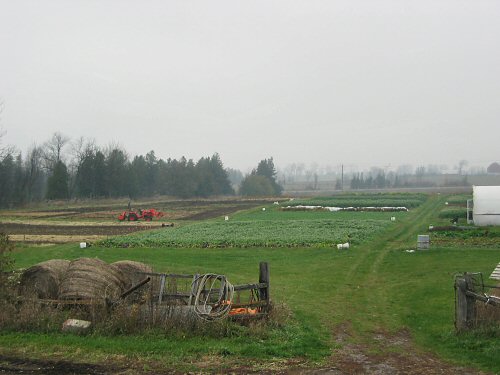
Fall clean-up is moving along bit by bit between the weather. Half the field is cleared, fertilized, and tilled or about to be. The rest is mostly covered by oats and a little rye. The Kubota compact tractor is ready to take up where it was stopped yesterday by the broken rototiller chain. At this point, I have an hour or so before the rain…
Bye-bye, sweet peppers…

A mildly golden late afternoon sun turned the beds of dead peppers into a stunningly rich sea of color amongst the greens and browns. Peppers seem to have their own way of dying off in the cold (at least, under row cover, where they usually are in autumn). Instead of turning a sickly, muddy green, then quickly to grayish-brown as they dry out, like eggplant and tomatoes, the peppers tend to fade from green to greenish-yellow and dry in pale golds and tawny browns. Interesting… I’m not sure if this is standard behavior, but it’s how they seem to go around here! After rolling up the last of the row cover and snapping a couple of pics, it was on to the Kubota compact tractor for a quick tilling, and this year’s sweet peppers are…gone!
Checking on rye
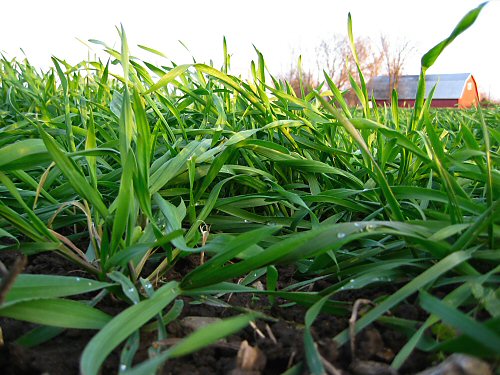
The fall rye has stayed low and not gotten too dense, but filled out nicely. As a cover crop/green manure experiment, I guess it’s doing fine. It’ll be there overwinter, and we’ll see how it does come spring. My only concern is that it gets too established and turns into a weed—it’s supposed to be potentially invasive—and that we’ll find out when the time comes!
Compact tractor tricks
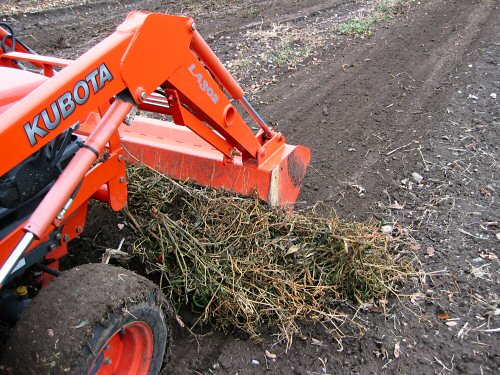
For some reason, I always feel a little guilty when I use the Kubota compact tractor in ways that make things way too easy. For instance… Probably the worst is the clearing technique I came up with a couple of years ago when it was cold and hand work was going slow. If you set the bucket of the front end loader pointing nearly down, and drag backwards, you can completely clear old plants in NO TIME AT ALL. Here, I’m removing a 50′ bed of hot peppers in one pass (the sweet peppers, in another section of the field, were lower growing and got tilled under a couple of days ago…). Is this gratuitous soil compaction, driving the machine over the beds unnecessarily? Well, maybe. But it’s so QUICK, and not an all-the-time thing. Does it drag off valuable topsoil? Not if you start feathering as you go, lifting and lowering the bucket a few inches lets the tangled mass of plants roll, freeing the soil. I try to do most clearing by hand, but sometimes, well, you take the shortcut…!