
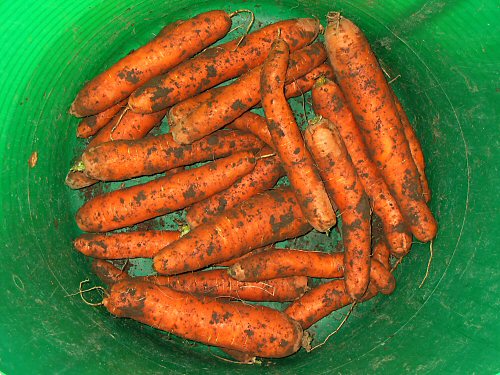
Dug up about five pounds of carrots for a phoned in order for “whatever there is”. The ground isn’t frozen, but the many sub-zero nights have really chilled it out. These heirloom Touchon carrots benefited from their cool storage conditions. They’re crisp and super-tasty, not as sweet as my other standby, the Nelson hybrid, instead delivering a rich carrot flavor. Also still being picked in the cold, there’s spinach, kale, collards and flat-leaf parsley…
Year: 2007
All clear
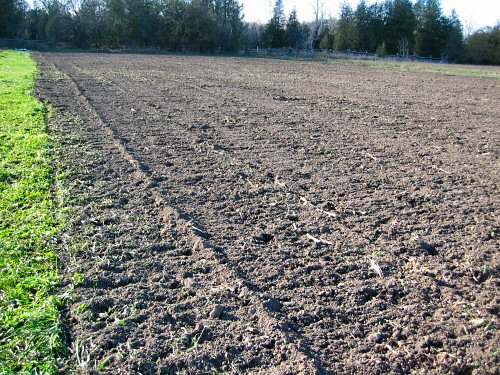
The new section at the north end of the garden, all clear after yesterday’s rototilling. The area is 120’x200′, about half an acre. Although it looks light and crumbly after drying for a few hours in a stiff breeze, the clayey soil is pretty heavy and moist. It never really dries out after mid-October or so, it only gets wetter until it freezes… A low cover crop, to winter-kill and then be tilled under in spring, would be great. I’m working on it, and this is the next best thing: no weeds!!
Cleaning up
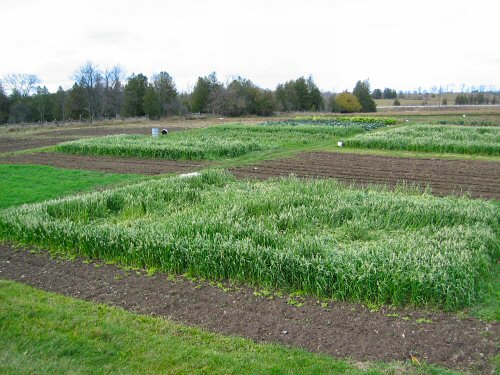
Here’s a look to the north from my new favorite photo spot, on top of the farm stand. We’re down to mainly brassicas, oats and rye (that’s the low, darker green section poking in on the left). The oats has started to die off and topple over, leaving collapsed areas that look as if animals had bedded down… The days lately have mainly been overcast and quite cold, just above 0°F, with a fair bit of rain that leaves the ground mucky. My hours a day spent in the field are winding down, a two or three hour job at a time, weather permitting. Elsewhere, there’s lots of putting in order and stowing away, and clean-up in the Extended Milkhouse where all kinds of junk accumulates over the year. Getting set for winter.
Turn to the left and here’s the view over the greenhouse. The grass-alfalfa mulch is still inside, along with stacked rolls of row cover.
Spreading grass mulch
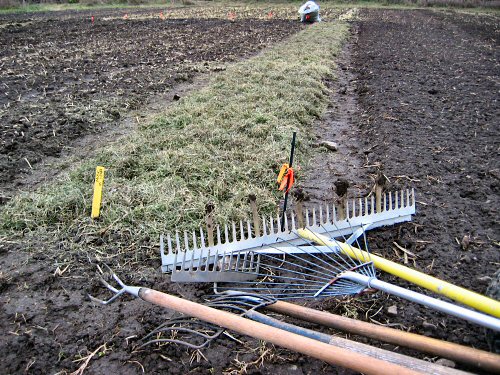
Today, I took advantage of a one-day reprieve from the cold—it was a pleasant 9°C (48°F)—to test the new grass-alfalfa mulch on a bed of garlic. I suspected spreading the light, loosely clumped mix would be more of a chore than tossing around straw, and it was. I first tried dumping it out, but the big clumps took forever to break up and spread, so I switched to pulling it apart by hand. The large bags of mulch weigh next to nothing, so that wasn’t hard, but you wouldn’t want to do it in the wind. Next, spreading it evenly. This proved to be a bit of a puzzle. I started with a hay rake, with three widely spaced tines, but this just slid through the grass, not catching enough to move it around. Out came an unlikely array of other hand tools to try: the compost fork (dark tines, right at the bottom of the pic), the 3-tine cultivator, a regular rake, and a leaf rake with round tines (the wide landscape rake was for marking rows in another bed). None of these worked well. Closely-spaced tines caught too much and cleared areas rather than covering them. I eventually used a combo of the 3-tine cultivator to break up the clumps, then skimming with the small rake to even it out. The results were pretty good, with a fluffy 2-3″ layer down the 50′. But it was delicate, picky work as the grass is very light. There are five more beds to go to refine my method (basically, figure out a better way)! I also planted a final 50’x5-row bed, using up the last of my seed reserve, bringing the garlic total to about 3,000…
Jerusalem artichoke update
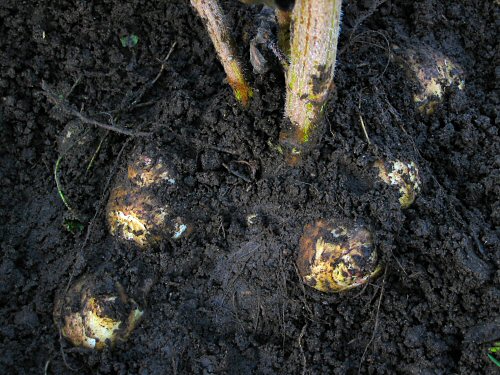
The Jerusalem artichoke leaves died off in the cold a few weeks ago, not too long after flowering, and I’d kind of not thought about ’em in a while (they’re right by the 26 rosemary plants that have to be potted and brought in at some point, maybe that had something to do with it—I’m trying to figure out how to keep the rosemary without putting them under lights…another little puzzle). Anyhow, I wandered over today and cleared away an inch or so of dark, cold soil to find…beautiful, big, bulbous TUBERS. I’ve been looking forward to this from the beginning. It’s always excellent to see a first-time crop come through! I didn’t dig deeper, but from this peek, it looks like my original stock of 45 pieces has multiplied at least six or seven times, well on the way to real choke production next season. I’ll harvest some soon and…eat them!
Buckets of snow
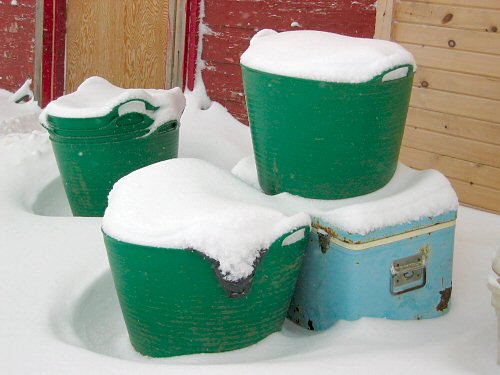
Woke up to a world of snow. Unlike the heavy dusting a few days ago, this was a serious snowfall, looked like 5-6″ (12.5-15 cm). This will stick around for a while. I didn’t finish mulching the garlic, and there are still carrots out there, but no worries, I’m SURE it’ll melt off in the next week or two, and meanwhile, snow is a great insulating mulch!
The goats have no problem with snow. It’s eating and looking out as usual!
Rosemary under snow
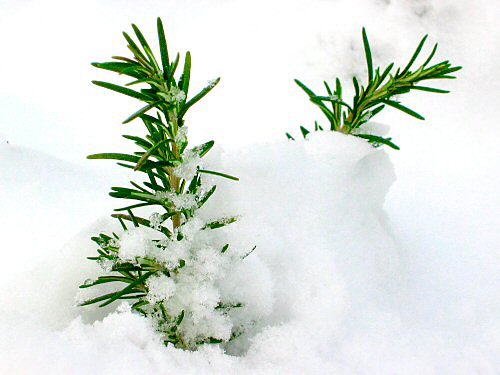
The rosemary’s looking quite fresh and perky, buried tip deep in snow. There are many cultivars, some apparently able to overwinter in quite brutal cold. I have three types here, two without names (one a survivor of last winter’s rosemary greenhouse debacle), plus a new Barbecue cultivar. How hardy are they? Are they as happy as they look in the snow? Will I eventually take them in (as planned)? Or mulch them where they stand?