Rough carpentry

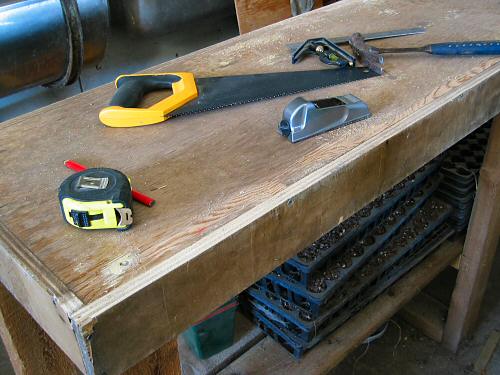
Added a shelf to the potting table today, a quick bit of rough carpentry. It also needs a couple of coats of varnish to waterproof it for the season, so I took the time to shave down the little edge where the sides join the tabletop. Normally, I wouldn’t bother with a minor detail like that, but I spotted the cool little surform plane (the blade is kinda like a grater) in one of the toolboxes and felt like using it! Rough carpentry may sound like nothing much, but it’s really a particular, essential skill of its own on the tiny farm. I’ve been learning as I go. The “rough” doesn’t mean sloppy or shoddy, just practical: functional, sturdy, simple construction, as much as possible using whatever materials are at hand, and not waiting around to get things done. Need a shelf over here? A workbench fit in right there? A couple of quick walls to turn a corner into a storeroom? A roof on the veggie stand? Grab the tools, hunt down the materials, and bang it up!

The simple shelf is a couple of 1×6 boards. It’s for keeping plug sheets handy when I’m seeding lots of trays of transplants at once. The potting table started out as a long, shallow bin, built from scraps of plywood, to hold harvested tomatoes. I later reassigned it: flipped it over, added legs, and voila! (There’s that trusty saw again.)
Virtual local?

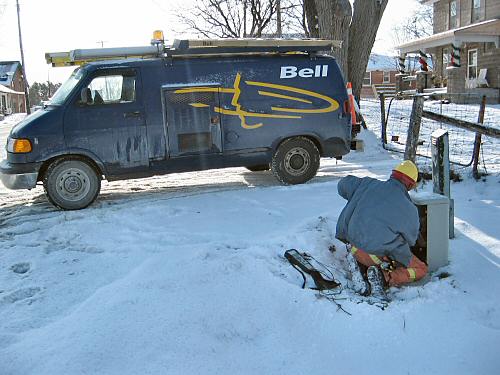
This morning, there was a phone company tech at work on the junction box at the top of the drive into the farm. I’m not sure what the guy and his logo-truck were up to exactly, but the picture made me think about tiny farming and the Web. Right now, Bell and an independent telecom company are in an extravagant, introductory-offer battle for subscribers to the newly available DSL broadband service. High speed Internet access has been in this area for years, in towns and even villages, but dial-up was the only easy, painfully slow connection for most farms (we’re on the edge of a village, so we’ve had cable modem all the while). Now, word-of-mouth is that people on farms are signing up for DSL—will more abundant web access mean more interest in having a web presence? This could be interesting because, out of 30+ vendors at the farmers’ market, I think this farm is still the only one with a web site. An odd situation, considering that online is really the only practical place for small producers to let people know what they’re up to. With the novelty of DSL, maybe more farms will finally get around to getting online, which is probably a good thing, because it takes more than a few people to make a local market thrive. Just as Tiny Farm Blog has rapidly become embedded in my farming life (BTW, TFB isn’t the farm site), maybe this technology, where you sit in front of a screen and TYPE, is what it takes these days to hook people up in the communities where they actually live… I suspect, in some ways, to at least some people, you’re not all that REAL if you’re not represented online… Even if you’re practically next door! A little weird, but whatever works!

Orchid, wintergreen, heather…

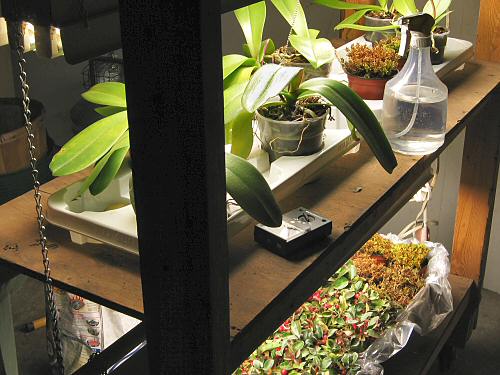
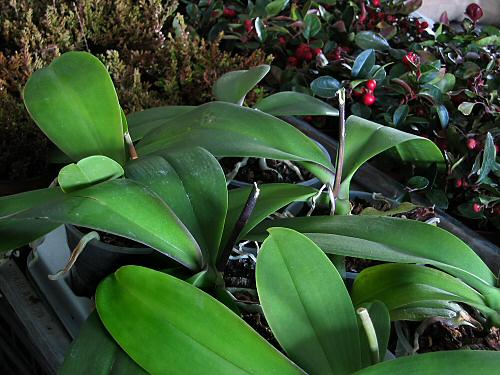
Surprise! I’m used to getting helpful recycling donations, like carefully saved flower pots, mesh onion bags, fruit baskets, plastic bags, even elastics, but a boatload of plants is a first. I was given about 20 each of potted heather and wintergreen, and six orchids. No idea what I might do with them. They’re from a big floral design company that makes up fancy settings for high-end special events, and throws everything out afterwards. I could easily be buried in random decorative plants if this stuff was to keep coming… In any case, these are here now! I looked up wintergreen, it’s a creeping evergreen shrub. Outdoors in winter, it holds its clusters of bright red berries—they stand out in the snow. Good eating for birds! Heather is quite the versatile plant, seems to have a cult of its own. A heather garden? The main stems of the orchids have been clipped, but apparently they’ll flower again. After a good watering, the orchids and most of the wintergreen are doing fine. Most of the heather came in bone-dry soil, and except for a few, it looks like they’re toast. Well, there’s space on the grow racks for a few weeks, so I’ll keep ’em around and see what happens next…!

New cows!

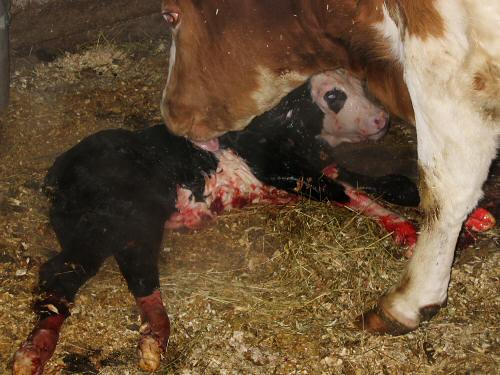
There was action in the barn in the wee hours today. A couple of the cows gave birth. Here’s the first new one, around five minutes after his 4 am delivery into the cold barn.

This is the second time I’ve watched the whole thing unfold. The first was maybe a year ago. In both cases, human intervention was required, which consisted of Bob with a length of chain wrapped around a pair of calf’s feet, pulling.

Last time, he explained it was a dry birth, where the embryonic sac breaks too soon, the head dries out, and, less lubricated, it sticks on the way out. A little feet-planted-firmly tug-o-war type pulling and…a new cow!

This time was a little more complicated, a breech birth, with the calf turned right around so its back end was aiming out instead of the head. Particularly with first-time births, the mothers aren’t relaxed enough to let the bigger back end out first.

To help things along, the stainless steel calving chain was wrapped around the hind legs and attached to a cable with a ratchet, in turn attached to a steel fence post set in concrete.

The long-handled ratchet allows the cable to be pulled with more force than a person alone could manage, as long as the cow stays put and sets herself against the pull (which she seems to do, since I guess she too wants the baby out!).

After some minutes of pulling, out popped the calf. It’s a boy!

There’s lots of bloody fluid and trailing bits, and the calf lies there at first like a limp, wet, bloody corpse. But the mother is right on it, licking away, and within minutes its head is up and peering around, and if all’s well, it’ll awkwardly stagger to its feet in under half an hour. Pretty cool!

The second mother gave birth around four hours later. The first time watching all this was interesting, a little sensational with all the bloody fluid. The second time, it was simply satisfying, another really basic part of life that most of us in the modern world just plain miss (we eat meat and drink milk, don’t we…well, a lot us do)?

I’m not sure about the breeding timing or anything like that, like, Why calves now? With Bob’s cows, I’m an observer, sometime consumer, occasional chaser.

Here’s the second calf, three hours after an 8am arrival, up and tottering around! Sturdy!! It’s fascinating to watch them rapidly get used to their legs, steadier by the hour.

Snow plowing…

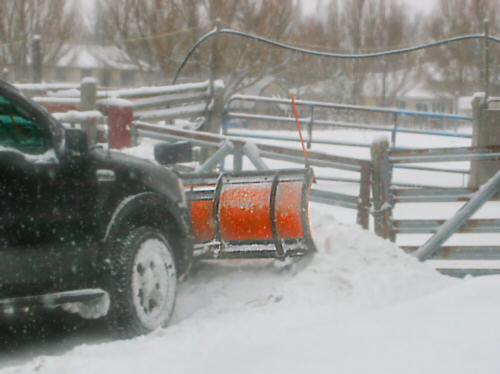
I suppose you could call these the dog days of winter! Our freakish week of warmth and melt-off are already faint memories, and this year, it seems like snow and cold have been around forever. January is an odd time for me on the tiny farm. Five years have gone by, and I’m still cruising on the original discovery that this is incredibly absorbing FUN, and there’s still a ways to go before the start-up is really done. Heading south for sun isn’t even at the back of mind. Ice fishing is only vaguely tempting. From what I’ve picked up, farming used to be a full-time, day-in-day-out kinda thing. Old school farmers generally had animals, which meant getting away from the farm was not really practical at any time. Of course, in recent decades, working off the farm became a necessity just to pay the bills. And now, the original farmers have all but vanished. Which leaves the new farmers, who I imagine are usually smaller and more specialized, and can treat farming as a seasonal thing if they like. For me, sticking to the farm seems only natural. Right now, I’m buried in bits of paperwork, reading, clipboards of jotted ideas, lists, notes, and it’s now time to set up the grow racks and start the first of the new seedlings. If the clouds and whiteness everywhere do get a little trying, here and there, well, it’s all part of farm living! And spring IS just around the corner!!

Grow lights, on!

Grow rack lights went on today for the first time this season. They’re only for the rescued houseplants (orchids, wintergreen, heather)—I guess every plant deserves a place in the sun—but, I’ll be starting super-early lettuce soon, a month earlier than ever, for an experiment in planting them out to the greenhouse at the beginning of March. Getting the grow racks ready is another familiar routine. In early summer, I remove the fluorescent light fixtures and the chains and dowels they hang from and store ’em somewhere (last year, it was on the new Big Shelf). For spring, I dust them off, wipe them down, hang them, and a new seedling season begins!

Paperwork!

January paperwork

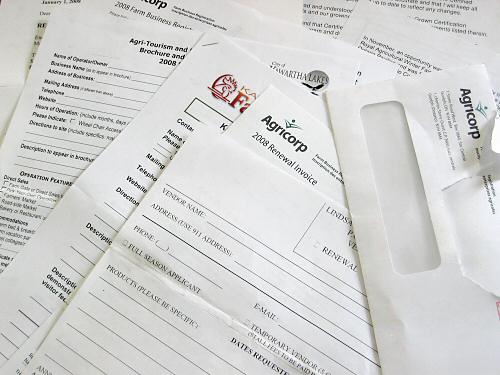
Ahhh, nothing quite like a pile of blank forms, waiting to be filled in, fitted with checks, and returned by deadline. January is the month to get the market garden squared away with the various powers that be. There are renewal forms for the farmers’ market (this form I like to see every year), farm business registration (need it for agricultural property tax rates, and to generally be considered an “official” farm), organic certification (a LOT of forms for that one), and for our spot on the small farm promotional map put out by the municipality. This farm is tiny and local and sells fresh veggies, all of which exempts it from a whole other world of paperwork that comes with organic wholesale, larger scale livestock, and anything to do with food processing. Once my forms are filled in and sent out, I’m luckily able to more or less forget about rules and registrations, and turn to the big garden for another year!