
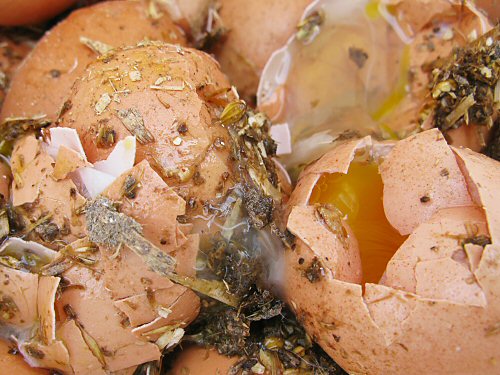
Today, a bit of an egg disaster, around 20 eggs down, by far the biggest single egg loss in my brief egg-collecting career. The girls choose to do most of their laying in one nest box (there are six in a row), so there’re usually around a couple of dozen eggs in there, conveniently waiting for pick-up. This time, there were only 8 or 10, all slimy with egg white and coated with shavings and droppings, with tiny bits of eggshell thoroughly mixed into the rest of the litter. What I think happened was, one of the eggs somehow broke, the girls jammed into the egg-packed nest in a feeding frenzy, their jostling and mad pecking broke some more, increasing the frenzy and the breaking, and so forth. As I was cleaning up the rest, one egg slipped and cracked, and half a dozen chickens went crazy slurping it up. Man, do they love eating eggs… I tossed the rest into a bucket (whereI later took the pic)… I don’t expect this to be a new regular thing, as the girls don’t seem to be interested in actually trying to break eggs…though I’m sure they could learn.
Animals
Chickens in snow
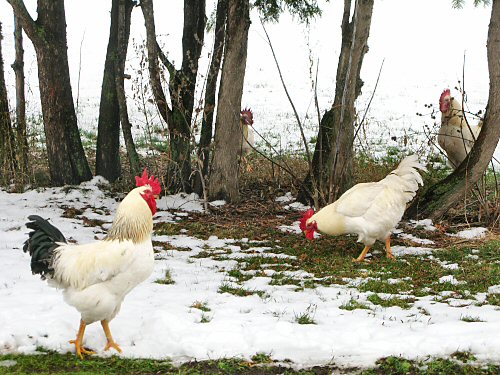
These chickens like snow! The eight remaining roosters have been out and about in some fairly wild weather, making their way through 6″ (15cm) blankets of snow, gusting winds and absolutely freezing cold. They always have the option of heading out of the little door in their half of the chickenhouse, or not. I’ve only kept it closed in the morning a couple of times, when the weather was ridiculously nasty. They’ve only stayed inside once by choice, on not such a bad day, which was a bit of a mystery (maybe snow had built up at their doorway that I didn’t notice). They still roam all over—chicken tracks just about everywhere in the barnyard snow—but tend to hang out on exposed ground, like around the small stand of trees in front of the farmhouse. So far, no frostbite and no frozen feet falling off. They’re pretty tough birds…
Chickens at work
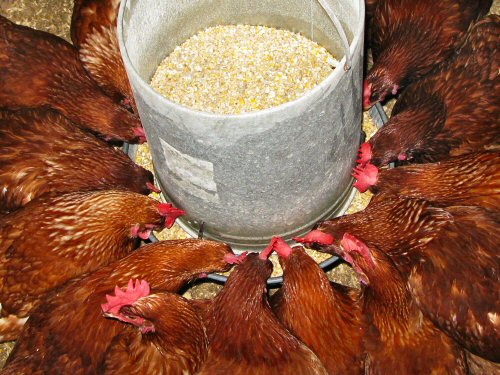
The Shaver Red Sex-Link laying hens are doing fine in the fairly chilly chickenhouse, eating up a storm, looking and sounding healthy and happy, and producing away. They’ve been in artificial light days for the last couple of months, about 16 hours made up of daylight extended by a 60W bulb on a timer that’s on till 11pm. I’m curious whether at least some of the girls would really stop producing for the winter if the light dropped below 15 hours for even a single day. I don’t actually want to see it happen, but what if there’s a power failure? Hmmm… Kerosene lamp? In any case, fall egg production has so far stayed steady at about 20-23 a day for the 25 girls… Chickens are easy, you don’t have to know a lot to raise them casually, but there is a lot you could know. And of course, the more you know, the less you need! My winter chicken reading is Storey’s Guide to Raising Chickens.
Roosters: alive and kicking
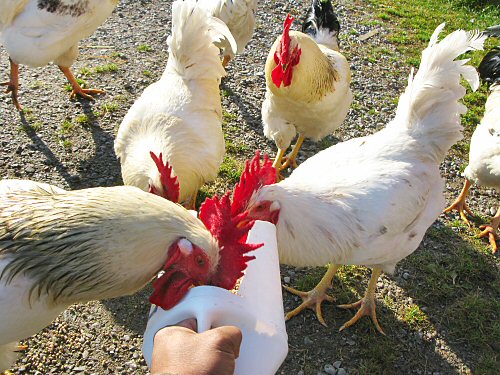
Eight of the Frey’s Special Dual Purpose roosters are still around, in fine form, roaming the farm. Clearly, I have yet to kill them! Not even one… We’ve been eating chicken often since summer, but there’s still a good supply of fat, frozen White Rocks. Meanwhile, I imagine the meat on these guys getting tougher by the week as they run around and do their thing: turning on one another in brief, furious bursts, digging deep, bowl-shaped holes, hopping on goats, sitting on fences, crowing at all hours, scratching and pecking. It’s a little out of control, but also fun to watch, and they haven’t done anything really bad so far (one has grown quite mean and somewhat vicious, though, and menaces or even attacks people—he’ll be first to get it in the neck! :) They’re truly free-range, they’ve put on impressive weight strictly by foraging, which includes stealing some of the goats’ grain, but mainly involves bugs and whatever else they find in the fields. Most mornings, they get a little scratch, or some of the girls’ feed. Sometimes I’ll hand-feed ’em for a few minutes, for no real reason, but maybe to keep ’em feeling safe with me, and easier to catch down the road…
Big egg
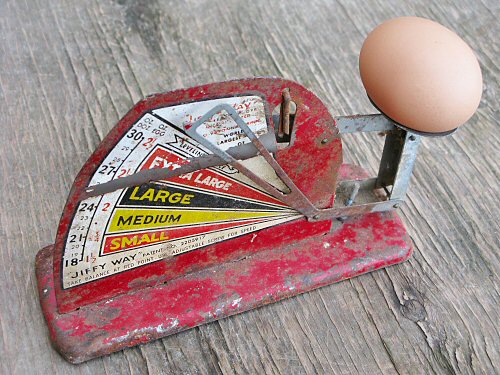
Every few days, at two dozen a day, along comes one very big egg. It’s hard to see with the chipped paint on the old egg scale, but these big guys take it right off the chart. Beyond measurement by this technology. Poor girls (I think, or maybe not). They’re too big to fit into extra-large egg cartons, they won’t let the cartons close, so I put ’em aside and eat them. They’re pretty big, fat eggs!
Donkey care
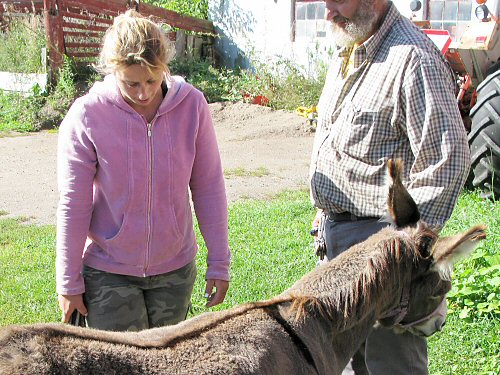
Tanya the Farrier drops in on Jack the Miniature Donkey every 6-8 weeks to clean and trim his hooves. It’s a pretty quick operation, maybe 20 minutes. You might expect trouble, Jack being a fairly frisky, 400+ pounds of muscle, hard head and hoof, but he’s also easy-going, and Tanya seems to have established authority way back. I’ve been watching this routine for the six years I’ve been here. Bob does the holding, and Tanya goes to work…
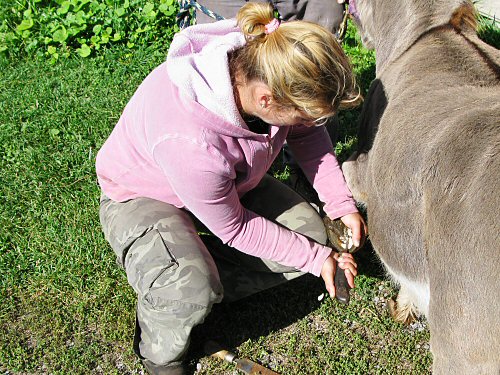
…using a hooked knife to prying out built up gunk…
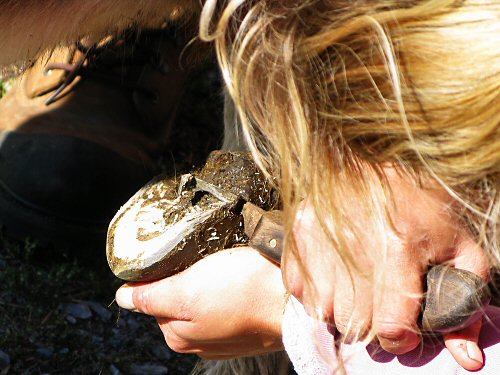
…and trim down the hoof.
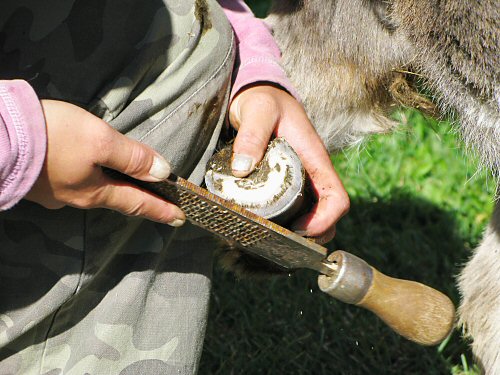
A rasp is used for finishing touches…
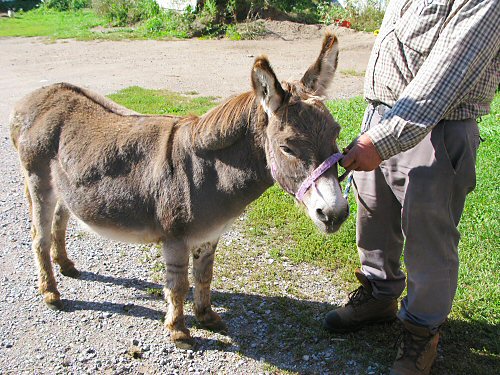
…and in no time, Tanya’s gone and Jack’s good to go…
Fantastic egg tray technology!
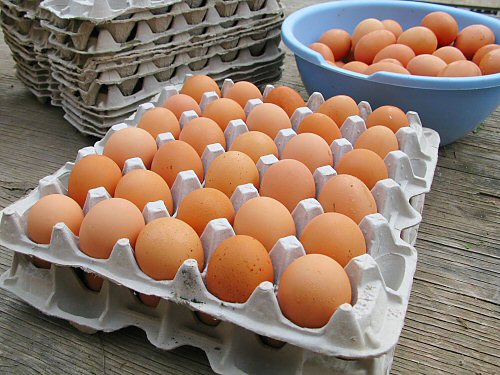
OK, so they’re just regular cardboard egg trays from the commercial kitchen world, and they’ve probably been around exactly like this for decades. BUT, they haven’t been around HERE. Lynn recycled them from Shelter Valley Folk Festival, where she was last week, where they were feeding big groups of volunteers. The trays are fantastic! Our chickens produce only about two dozen eggs a day, but that still adds up. I’d been keeping them at first in regular one-dozen cartons, then in bowls and small baskets. It was getting a little out of control. Now, they simply, efficiently stack in the fridge, 30 per tray. Every second week, like today, we bring a bunch to the farmers’ market as a bonus in the CSA shares, and the trays make transport a lot easier as well. Amazing. :)