Cold crop lettuce

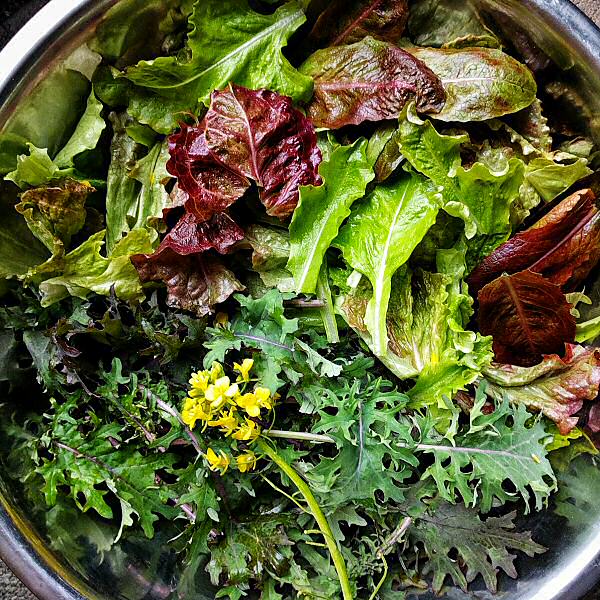
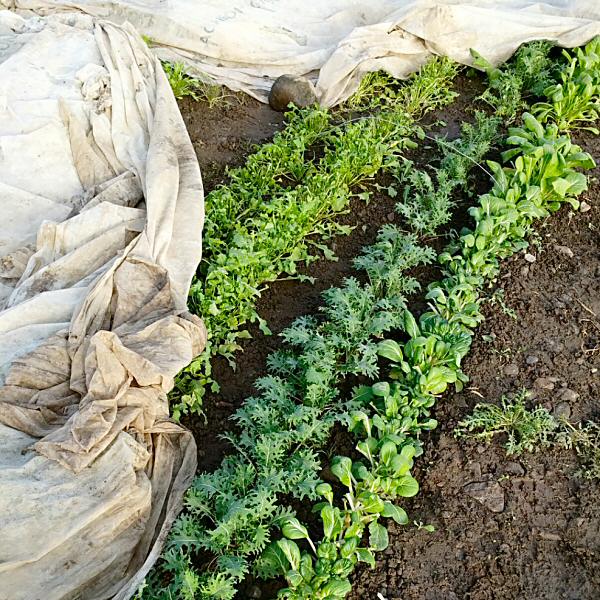
Greens in unheated hoophouse after the deep freeze

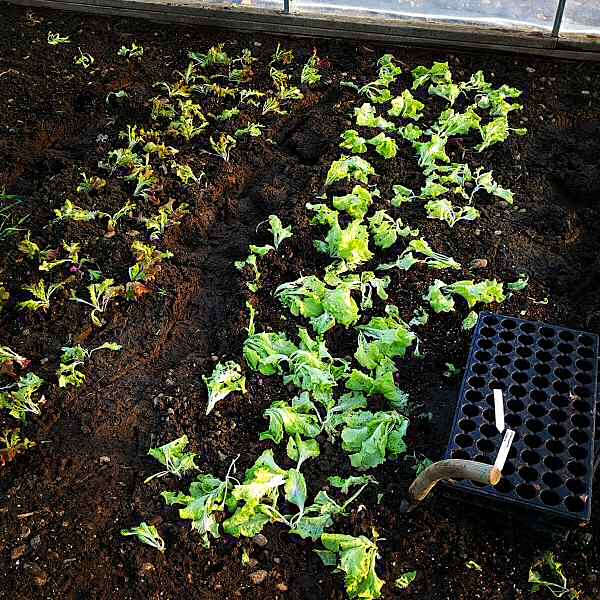
Lettuce in the unheated greenhouse, under a couple of layers of medium-weight row cover, is doing fine so far, firm and tasty after weeks of sub-freezing nights, all the way down to -30°C (-22°F). Now there’s even a noticeable bit of grow-back from the last cut, late December (even the weeds are getting in on the protection, see bottom left). My first full-winter tiny farming experiment continues…!

Wire work

Fence wire as row cover support

Electric fence wire work, snipping 6-foot pieces of 9-gauge wire for hoops to hold up floating row cover in the greenhouse. Hopefully this wire is stiff enough to do the job, supporting up to three layers of row cover, heavy with moisture from humidity and being dripped on by water condensed on the inside of the hoophouse plastic, or weighed down by ice, when the soaked cover freezes at night. This test batch of about 180′ came coiled, in a circle about 2½’ in diameter, and the built in curve is perfect for stretching slightly to span about 4′ of bed. So, no bending required, it’s all about the snipping!

50 Things I’ve Learned from Tiny Farming: #38 Use a pencil

50 Things I've Leaned from Tiny Farming: #38

See the growing list of 50 Things I’ve Learned from Tiny Farming:

#38 – Use a pencil: You can find no finer quick-planning and sketching technology than the PENCIL, used with a crisp sheet of paper, a supporting clipboard, and a quality white eraser. There is a curious kind of commitment only a pencil can bring to the start of something. The impermanence, the erasability, the chance to begin now but make sweeping changes later, is the cool thing. Pencils are perfect for roughing out garden maps, preliminarily filling in tricky forms, and sketching all sorts of construction and fabrication projects, mobile chicken coops to better farm stand shelving (even crudely done, a picture is worth…a lot). Forget digital—lappies, tablets, smartphones, batteries, cables, software, formats and files—there’s nothing like good old straightforward no-frills paper and pencil (traditional or mechanical) for freeing you up to think!

Cold-grown salad

Cold-grown: Tiny lettuce leaves, crisp, fresh and delicious…and grown oh so slowly, without cover, in the unheated greenhouse, through many freezing nights, some down to -15C. Still a while till it’s big enough to harvest, and it was seeded way back at the beginning of October: that’s already 50 days compared to the usual spring/summer 25-35 days for baby lettuce mix). Also, the cold effect gets trickier as the leaves get bigger. All in all, though, seeing food grow in the cold with a minimum of help is quite fantastic.

Sifting compost (every tool has its day)

Sifting compost

[8-May-2012] Every tool has its day! I bought this metal mesh-bottomed soil sifter in my first couple of years of tiny farming, it seemed like something that would come in handy, but for years after was used only as a handy storage tray. Today, it caught a break as the perfect tool for an experiment with compost in the seedling mix. Took only 20 minutes to fill 1/3 of the can with finely sifted composted cow manure. Beautiful! Some things take time. (Nope, I didn’t finish sifting that whole bucket load, a little went a long way.)

Winter spinach

Later and later we go: More late season/winter harvest experiments, with four-week-old spinach transplants into the unheated greenhouse. Also trying out a trench approach to transplanting—a furrow about 6″ deep, made with a hoe—instead of putting them in one by one. Seems a little quicker, but it all takes time!