Trimming parsley

Trimming parsley

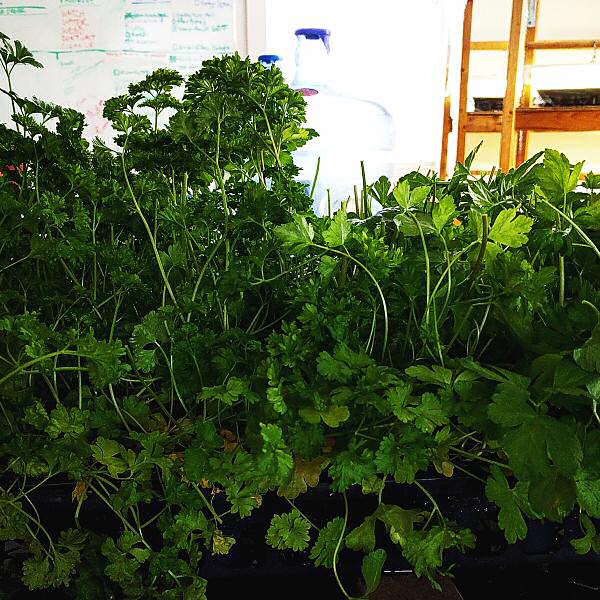
Parsley, curly and flat-leaf, overflows its 72-cell plug sheet. Time to trim it back (again), so they still fit under the lights. To be unfussy and safe, a quick shear of only 2-3″ off the top literally takes a few seconds and does the trick. Snip-snip-snip-snip-snip! This is what you have to do when you start seedlings extra early, and then wait on the weather!

Weed ID-ing in the Digital Age

Weed ID app photo

Wormwood of some sort, this weed from the greenhouse, according to our best guess from a selection of possibilities offered up by the smart smartphone plant identification app I’ve been playing with/trying out. There are several such apps for Android: this one’s called Like That Garden—”See a plant, take a photo, and find out what it is – instantly!” It got the highest ratings, and is free, so I grabbed it.

Like the advertising says, it’s that simple to use. With the app, you take a snapshot of the mystery plant that’s saved as a low rez image (above) and sent off into the ether where it’s checked against a vast plant photo database, several possibilities soon return, with multiple images for each, and you pick the one most likely (I suppose in some cases, only one choice comes back, but so far, that hasn’t happened). The technology is all about advanced image recognition and visual searches, very…digital. Trying it out on a few plants, it’s worked quite well.

While this app is doing fine, I have a great (effective) weed book as well. Is the app a novelty toy, or a serious tiny farming tool? Or will the smartphone be accidentally dropped in a puddle and destroyed before we get a chance to decide? Only time will tell…

Transplanting: tiny sections

Greenhouse transplanting: tiny sections

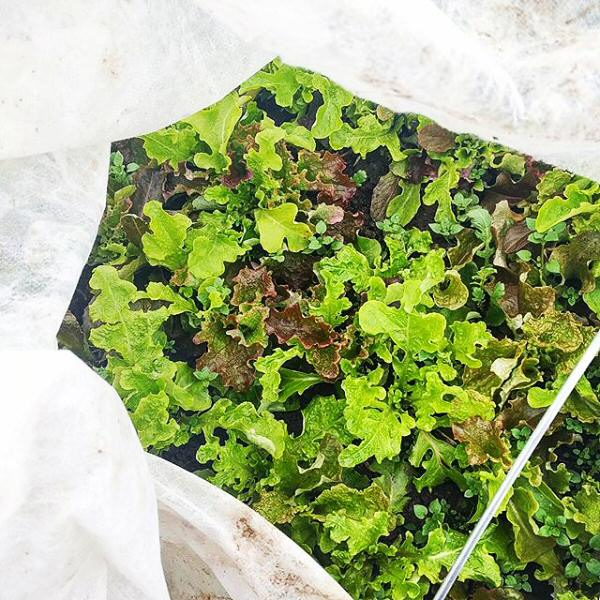
Transplanting lettuce into the unheated greenhouse, filling it out in small sections to work around wetter areas. The seedlings, waiting for drier conditions, stayed a couple of weeks longer in trays than ideal—now they’re a little floppy and stretched, but I’m confident they’ll figure it out. This first spring, seeing how the ground dries in the new hoophouse is part of the learning curve. Tiny farming!

Winter salad

Over-wintered salad greens from unheated greenhouse

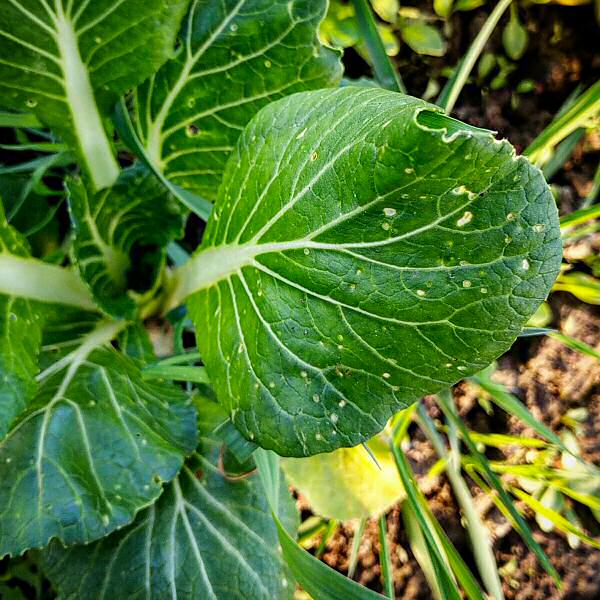
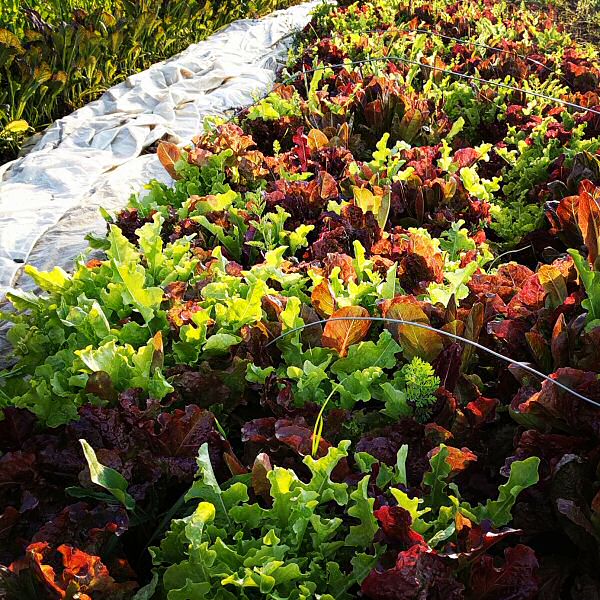
This bowl of lettuces and kale is the first cut of spring, taken from the unheated greenhouse while snow flurries whip around outside. With the help of 6 mils of plastic and some row cover, the salad easily survived three months of winter, with temperatures that went down to -30°C (-22°F). The texture and color are good, the taste, deliciously bold. Fantastic! The flowers are bok choi that managed to bolt in the alternating warmth and cold—on sunny days, the hoophouse temperature could easily reach 10-15°C (50-59°F), even when it was sub-zero outside. Interesting!

Excellent soil building book

Building Soils for Better Crops

A reminder: Building Soils for Better Crops: Sustainable Soil Management is an excellent, book about soil for growers, free to download, or you can buy a hard copy. Follow the link, or read a bit more where I posted about it quite a while ago. The image above is cropped from the cover, a very specific type of old school farm view and set-up, which happens to be the one I’m familiar with; where you are may be totally different, as may be the soil, but the idea of growing is the same, and chances are this book is useful!

Seed catalog, 2016

Seed catalog 2016

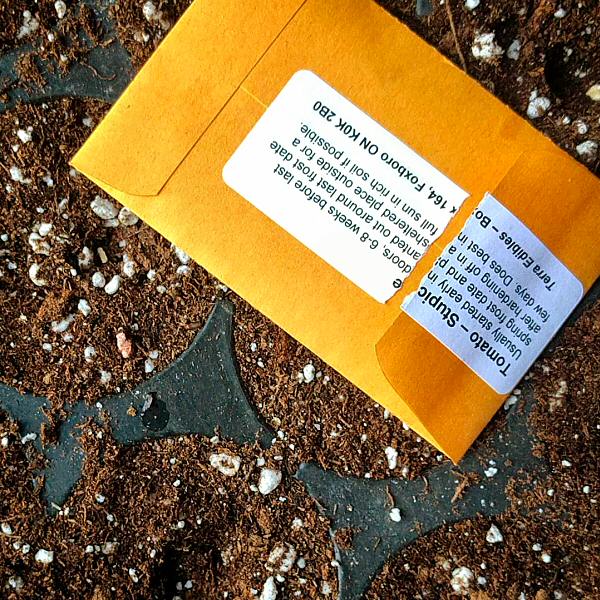
Here’s my main seed catalog for this year. Once again, unlike several seasons ago, when I’d receive a dozen catalogs, order from two main suppliers, and pick up a few things from two or three others, lately, I’ve simplified and get everything in one place. This year, though, and for the second year in a row, there was a crop failure on a variety of mustard that I grow, and no close substitute, so I had to look elsewhere. Which, of course, opened up a world I’d kinda forgotten, the wonderful world of price comparison shopping.

The puzzling thing about pricing is the seemingly bizarre differences in price for the same items between different sources (it’s the same in seed as everywhere else). Some suppliers are clearly overall more expensive than others, so if quality and service are fine, it’s easy to go with the savings. But then, on any one item, prices can vary quite dramatically either way.  For example, I found the same variety of mustard at $10 and $17 a pound, and something similar at $50, at three different places, and  that’s expected. Less so is that, for just one common variety of lettuce, it’s $33 at my usual place, where the same amount is only $19 at a usually more expensive other supplier.

Yep, I could’ve gone on and on like this, with multiple lists and endless tabs of online catalog pages, like a full-on coupon clipper, looking for the ultimate bottom line big score. Instead, though, I ordered my mustard and stopped! Maybe not the best every-last-penny business thinking for a tiny farm, and tiny farm definitely does not equal big budget, but sometimes at least, for a few bucks, life is too short! :)

Great gloves get a little better!

Good fieldwork gloves for fall and winter

How excited can you get about a pair of gloves that you use to work in the field? Quite! Although enthusiastic may be the better word. This style of glove I’ve used for a while, for fall and winter, in cold weather. I wrote about their many fine features a while back—this particular version is the best yet, with the grippy, waterproof coating extending just far enough down the back so that they don’t get wet during normal handling of soggy stuff, while allowing enough open, breathable area so your hands don’t sweat. What more can I say?!