All clear…

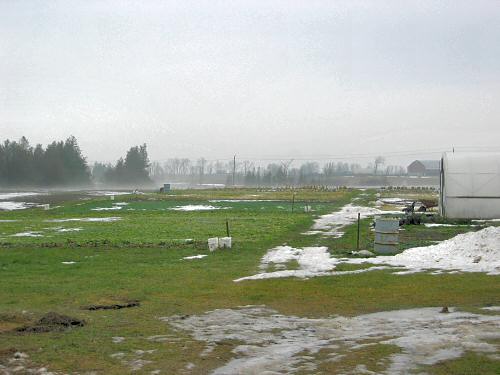
January and the field’s all clear

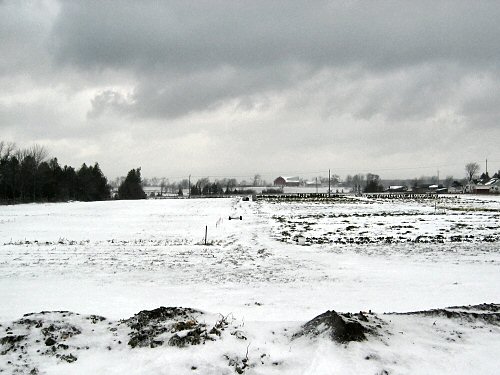
After a night of rain and 50°F (10°C) warmth, the field is just about clear. What a difference a couple of days can make… I took a walk. The ground isn’t even frozen—with the odd way all that snow came before a real cooling down period, the ground was insulated by the snow and didn’t freeze too deeply. It’s quite strange. Usually, during the March end-of-winter melt-off, the clayey soil is wet, sticky, mucky, sucking, and the drainage is slower as the frozen ground thaws out, but now, some areas are dry enough to till! The scene also looks quite differen—greener!—than in previous years, because I’ve left a lot of cover crops (oats, bit of rye), and there were quite of few beds of late harvest veggies caught in the first snow. There’s potentially good stuff out there: huge carrots, beets, spinach. They may be too cold-damaged to be worth a harvest, I’ll check ’em out tomorrow. And the unmulched garlic is doing fine!
Read more

First day of winter

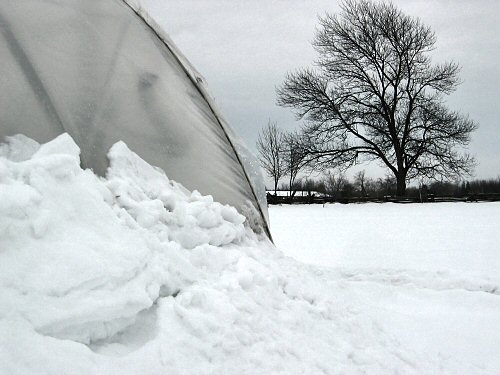
Winter: today, it’s official… Every day I head out to the field to take a look, even if it’s only for a few minutes. I check the greenhouse, and…look around. There’s not much to see. The snow is now about 3′ (91cm) high on the sides of the hoophouse. I don’t bother clearing it off, it seems to do fine. It may not be obvious from the pics, but the side walls are double layers of plastic, inflated by electric fan with about six inches of air between (electricity for the fan is run out from the drive shed). You can see the hose for the fan on the inside, right near the curved rib (the fan and hose are on the left of this shot). This keeps the sides rigid enough to stop the snow from pushing in. And the trees are bare… And the days are now getting longer! :)

Official: the garden season really is over

Snow-covered field means the garden season's over!

OK, so this garden is really over for the season! Called due to extremely cold, snowy conditions that don’t seem likely to let up any time soon. I’d been counting on one more melt-off, but it’s only been freezing cold and more snow since the fall that covered it all eight days ago. And there’s no let-up in the 15-day forecast… So, I got caught out a bit. There are still carrots under there, that I might not see until spring, and I didn’t finish mulching the garlic (I think I was unconsciously pushing for a side-by-side test of mulch and no mulch, against prudent practice, and now I have one—it will be interesting…). The big experiment (and possibly, gamble) is with leaving the green manure cover crops—oats, rye—over winter, to be tilled in in spring. In the pic, you can see it’s smooth to the left of the main path, and rough on the right (at the very bottom is the composting windrow where the last of the leftovers go). The left side (plus eight sections across the north end, out of sight at the top) is fully prepped and ready to seed as soon as the ground dries out in spring (peas first!). To the right, I’ll have to wait until it’s dry enough to till with the Kubota compact tractor—determined by the weather, this could hold me back a couple of weeks. Or more. After that, again weather-dependent, there’s the minimum wait of a week or two after tilling for the cover crops to break down. But, with two-thirds of the field ready, however the weather goes, it’ll be fine!

Spreading grass mulch

Spreading grass-alfalfa mulch on garlic

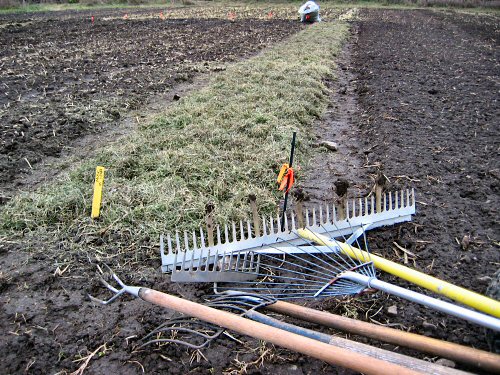
Today, I took advantage of a one-day reprieve from the cold—it was a pleasant 9°C (48°F)—to test the new grass-alfalfa mulch on a bed of garlic. I suspected spreading the light, loosely clumped mix would be more of a chore than tossing around straw, and it was. I first tried dumping it out, but the big clumps took forever to break up and spread, so I switched to pulling it apart by hand. The large bags of mulch weigh next to nothing, so that wasn’t hard, but you wouldn’t want to do it in the wind. Next, spreading it evenly. This proved to be a bit of a puzzle. I started with a hay rake, with three widely spaced tines, but this just slid through the grass, not catching enough to move it around. Out came an unlikely array of other hand tools to try: the compost fork (dark tines, right at the bottom of the pic), the 3-tine cultivator, a regular rake, and a leaf rake with round tines (the wide landscape rake was for marking rows in another bed). None of these worked well. Closely-spaced tines caught too much and cleared areas rather than covering them. I eventually used a combo of the 3-tine cultivator to break up the clumps, then skimming with the small rake to even it out. The results were pretty good, with a fluffy 2-3″ layer down the 50′. But it was delicate, picky work as the grass is very light. There are five more beds to go to refine my method (basically, figure out a better way)! I also planted a final 50’x5-row bed, using up the last of my seed reserve, bringing the garlic total to about 3,000…

Cleaning up

Fall field

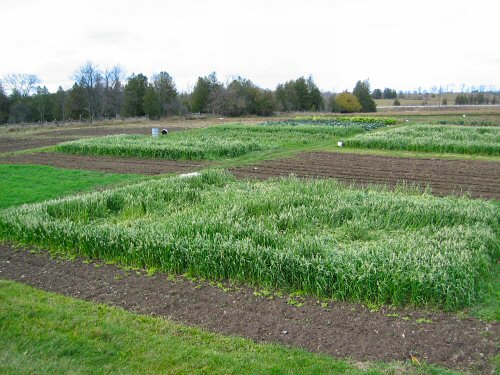
Here’s a look to the north from my new favorite photo spot, on top of the farm stand. We’re down to mainly brassicas, oats and rye (that’s the low, darker green section poking in on the left). The oats has started to die off and topple over, leaving collapsed areas that look as if animals had bedded down… The days lately have mainly been overcast and quite cold, just above 0°F, with a fair bit of rain that leaves the ground mucky. My hours a day spent in the field are winding down, a two or three hour job at a time, weather permitting. Elsewhere, there’s lots of putting in order and stowing away, and clean-up in the Extended Milkhouse where all kinds of junk accumulates over the year. Getting set for winter.

Turn to the left and here’s the view over the greenhouse. The grass-alfalfa mulch is still inside, along with stacked rolls of row cover.

All clear

Tilled field

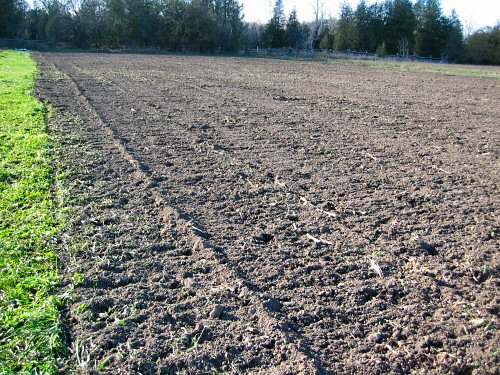
The new section at the north end of the garden, all clear after yesterday’s rototilling. The area is 120’x200′, about half an acre. Although it looks light and crumbly after drying for a few hours in a stiff breeze, the clayey soil is pretty heavy and moist. It never really dries out after mid-October or so, it only gets wetter until it freezes… A low cover crop, to winter-kill and then be tilled under in spring, would be great. I’m working on it, and this is the next best thing: no weeds!!