
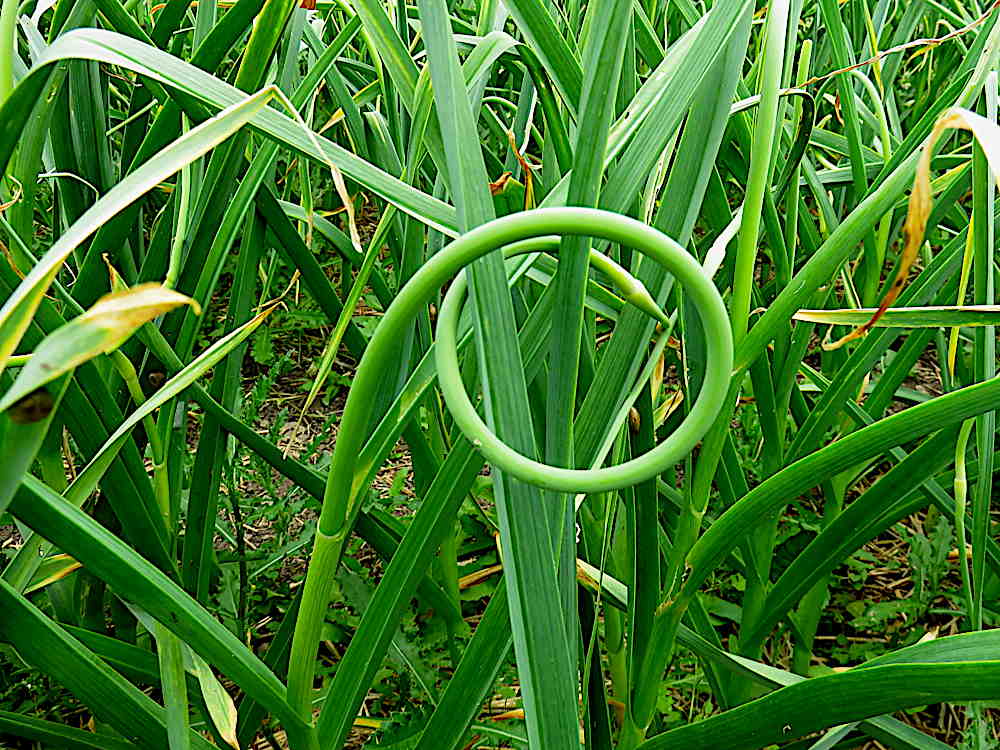
Here we are, a week after leek moths invaded the garlic, gazing at a healthy scape. If you’re not familiar, scapes are the curling tips that emerge as the garlic gets close to harvest. They’re also clearly a favorite target of the moth larvae: they chew their way in and start tunneling down. All of the attacked scapes had to be snapped off, right as they were emerging. Happily, many also survived. Snipped when tender—they get woody if left too long—scapes are filled with a full, delicious garlic flavor, a preview of the garlic to come. Let your imagination decide how to use them! (It’s also said that removing the scapes directs more plant energy to making the bulbs bigger, though I haven’t seen that for myself.) As for the bulbs and the leek moths, this is my first encounter, so we’ll only know for sure if all that hand-picking and scape snipping worked when the garlic comes out next month.
Fieldwork
Tomatoes just want to root
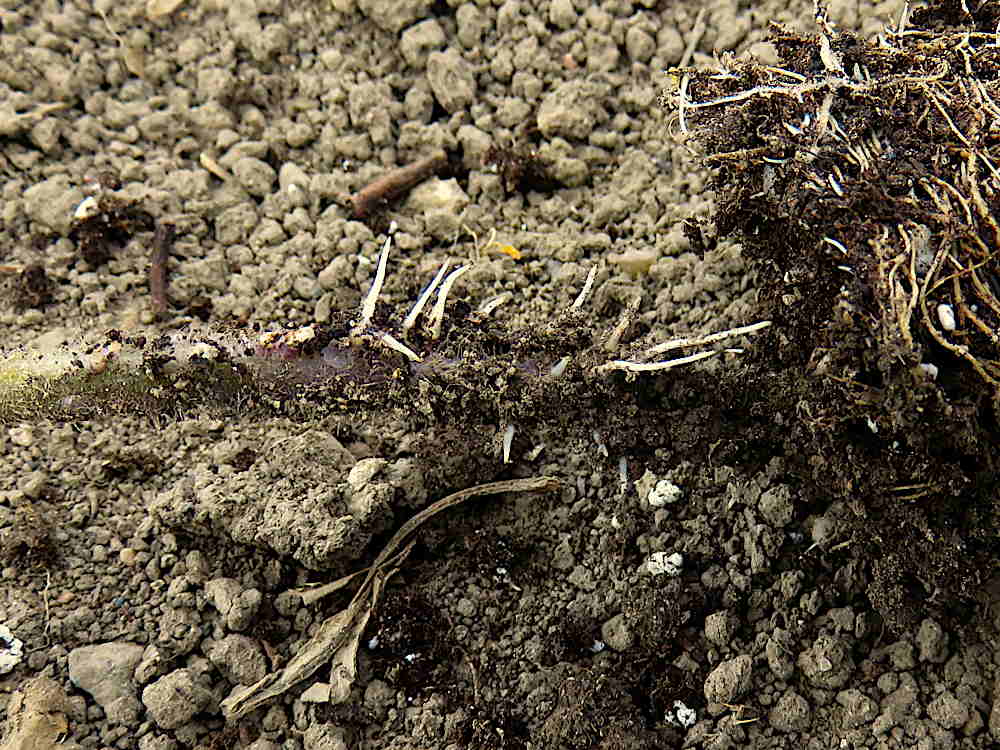
Most of us don’t spend much time at all looking at plant roots. Meanwhile, the things going on underground are quite wondrous. Take this humble tomato seedling, demonstrating a special power: adventitious rooting—a catchy way of saying they can grow new roots from their stems. Tomatoes, potatoes and peppers, all relatives from the nightshade family, have this ability. And? Well, if you have leggy tomato transplants, stretched from too much time indoors in tiny plug sheet cells, this ability allows for a neat trick. You can dig a little trench instead of a hole and lay the seedling on its side. Then, bury the root ball and most of the stem, gently curving up the last bit. Ta-da, a sturdy little transplant. I did this for a few leftover tomatoes two days ago. Today, I found one snapped off—wind? rabbit?—so I pulled it, revealing roots that had already started pushing out. It’s just another little bit of all that goes on in the hidden part of the garden!
Garden vs the hungry hordes

Much of veggie farming is playing garden defense. Yesterday’s garlic surprise attack was handled as an immediate emergency action, by hand-picking larvae before they could really tunnel in. The other no-chemicals approach is row cover, which seems to be laid out on more crops as each season. (More words to follow.)
Attack of the leek moth
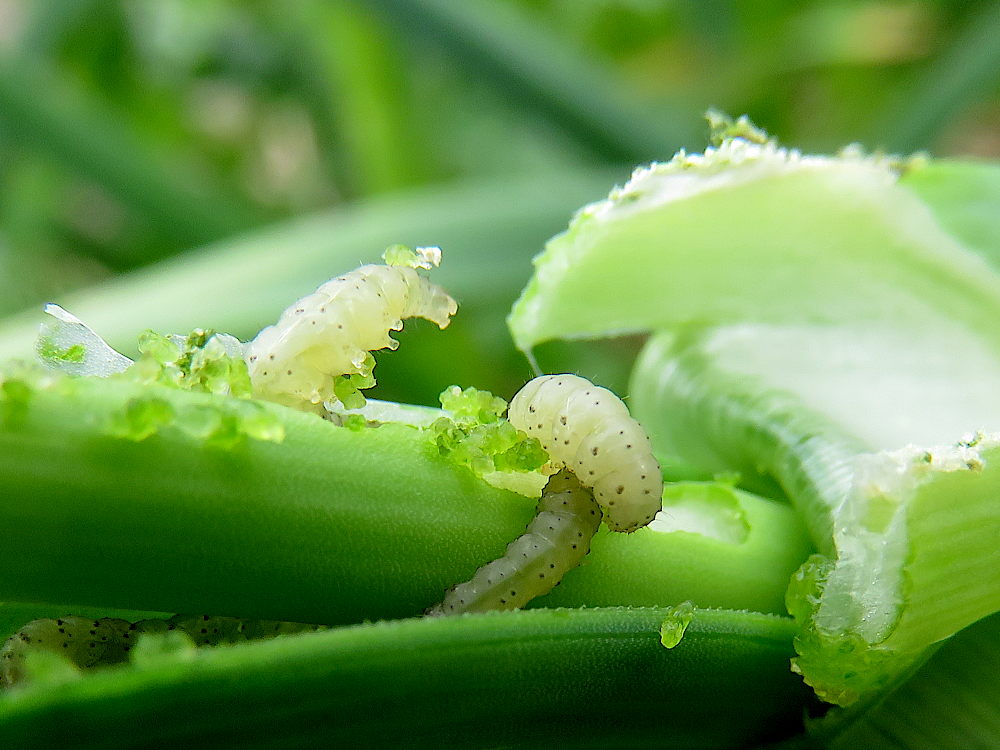
Checking for scapes today, only a couple of days after the last all-good garlic check-in, and found absolute carnage thanks to a leek moth invasion. For years, I’ve heard about these voracious leaf devourers ravaging alliums—garlic, onions, leeks—in the general region, but they’d never shown up here. Until now. After hours of hand picking and squishing, the situation may be somewhat under control.
FACT-FINDING: I did a bit of quick research to get the bigger picture. Leek moths (Acrolepiopsis assectella) are nocturnal, operating in full darkness. They overwinter in plant debris, emerge and mate when the temperature gets up to around 50°F/10°C. There are usually three generations a year, around here in mid-May, June and July. The first generation grows up (fast, in around 3 weeks) and starts laying another round, and so on.T hat means, in unusually warm or cold weather, there could be more generations per year, or less. Each female has around 100 eggs, lays them singly not in clusters, usually on the underside of leaves near the base of the plant (but, naturally, look EVERYWHERE!). There’s of course lots more, but that’s what I need to know for veg protection—garlic under row cover (and it would be pretty safe to uncover them during the day).
Plug sheet gamble, part 2
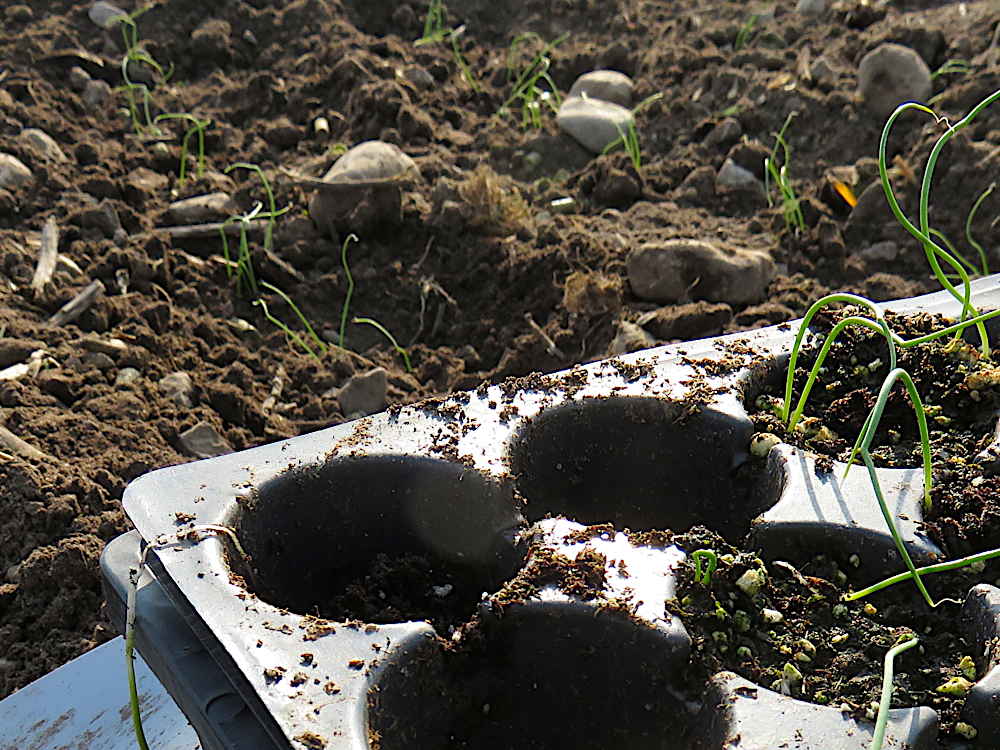
Only a few days after these green onions emerged, they’re in the field and heading into the ground. Haha, there’s no doubt this is a lot more labor intensive than using a seeder. Unless the weather conditions are really extreme, like a long, hot drought with scorching daily temperature and bone dry ground, it’s hard to argue for the plug sheet approach. But not impossible. Let’s see how they do…
IN THE PHOTO: A sharp and critical eye will notice that the seedlings in the tray seem pushed up against one side, instead of satisfyingly centered. This was my error, watering them in with a spouted can, along with a bunch of other seedling trays sitting outside. Onions don’t quickly put out lots of secondary roots that spread through the seedling mix and hold it together. Instead, at first there’s mostly just the radicle, that long white root that comes out of veg seed, heads down and, for most other vegetables, also branches out. So the plugs got kind of soupy and the force of the water pushed the onions to one side. You can see one hanging over the edge because it stuck more to the drainage hole in the cell than to the plug of seedling mix. Details! I should have remembered to use a shower.
Wheel hoe underdog challenge!
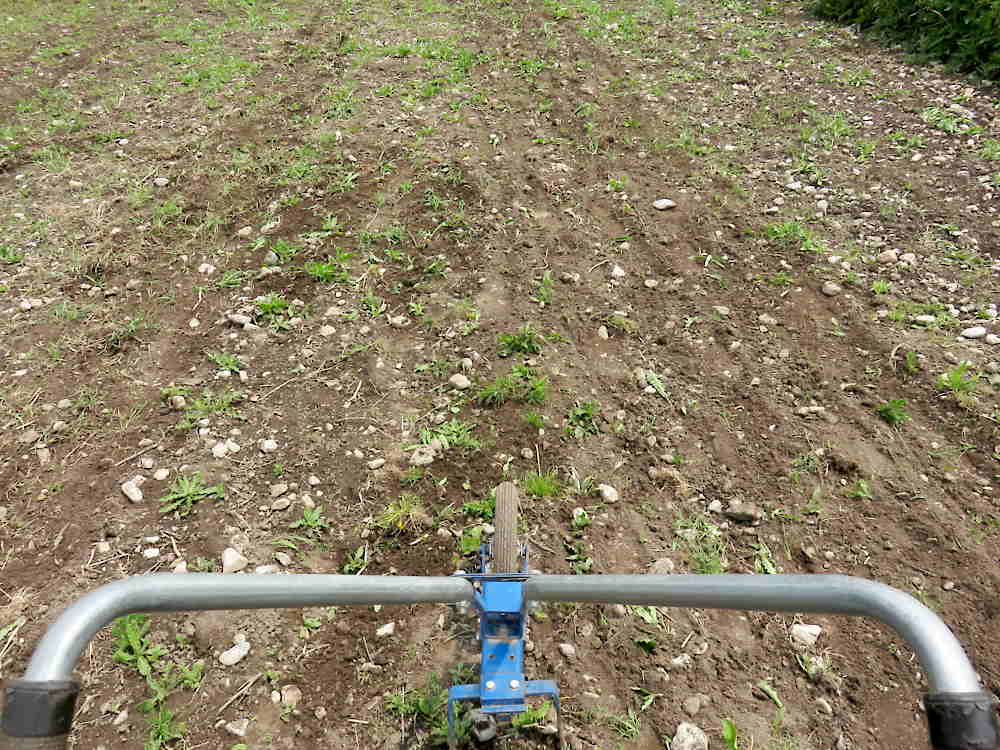
It doesn’t sound like a fair contest, the wheel hoe going up against the tiny tractor, but that’s the experiment underway this season. With all the rain recently, weeds are primed to surge. So far, it’s mostly thistle and clumps of grass itching to expand, with pigweed, lamb’s quarter and a couple of other regulars starting to emerge. This area, not yet planted out, has already been hoed, but that haze of green won’t stay down for long. A matter of days… With the 48″ rototiller on the tiny tractor turned by diesel horsepower rumbling like a tiny tank, it’s easy to put things off a bit. The tiller will churn up whatever’s in its way in no time. This fine wheel hoe has instead only an 8″ blade and a lone human…pushing. Every little bit of growth makes the going harder. The time to get in is early, when the blade can more or less glide smoothly and evenly, and you can move travel up and down with fair ease. There are other things to consider here—time, fuel, effect on the soil…more on all that as the experiment goes on—but timing is number one!
IN THE PHOTO: The wheel hoe is facing a strip that has just been walked. It’s hard to see the line between hoed and unhoed, especially compared to the cleanly erased path left by a rototiller. The weeds are sliced just beneath the soil—like cut flowers, they still look fine. Give ’em a day, especially a sunny, hot day, to dry out, and the difference becomes clear. Weeds, gone!
Cloning potatoes
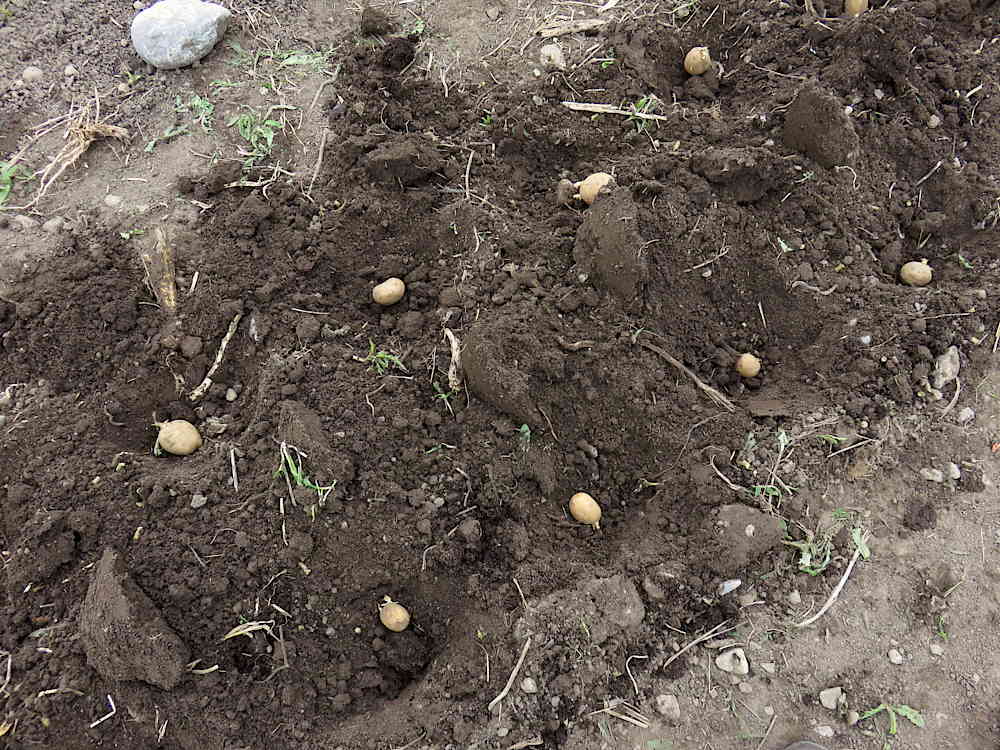
What a difference a word makes. Planting potatoes sounds so normal, wholesome, so farm and garden. Call it cloning potatoes, and now it sounds…weird. Really, it’s nothing special, just another word for the same old thing. Of the common garden veggies around here, potatoes and garlic are cloned: no seeds, no bees and flowers and pollination, instead, plant a piece of the original. Put a potato in the ground and it’s off to the races: vegetative propagation, direct multiplication—so simple!
In the photo: Yukon Gold seed potatoes. They’re regular potatoes, just smaller, and they haven’t been sprayed with sprout inhibitors (unlike many/most/all supermarket potatoes sold through the winter and till the next potato harvests).