
Veggie variety is great: different tastes, textures, shapes, colors… From the start, it seemed only natural to grow several varieties of each crop rather than just the most “efficient” one. This has worked out to at least a couple per crop (this year, two types of spinach so far, three potato, two corn…) to many (at the extreme end, 50+ varieties of tomato). The biggest difference is quite often in maturity date: crops fairly similar in taste and appearance can be two or three weeks or more apart in maturing for harvest. Sometimes the difference is only skin deep. The Red Baron spring onions in the pic are only red for a couple of layers, but they look great when you get ’em. The Golden Detroit beets taste a little different from red varieties, but the fun (for me, at least) is mainly in the striking and unusual golden-orange flesh. Look before you eat!
Harvest
Freshly dug garlic
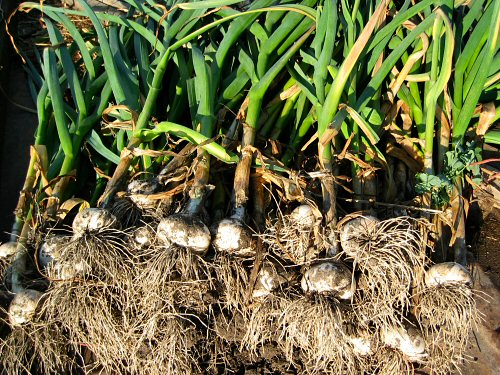
To add variety to this week’s CSA shares, I dug up 50 garlic a little ahead of the main harvest in a week or two. It’s looking great. Uncured garlic doesn’t store as well, but how long are you gonna let a single bulb of garlic hang around?! Really, there’s no such thing as too much garlic!
Sort, bundle, bag
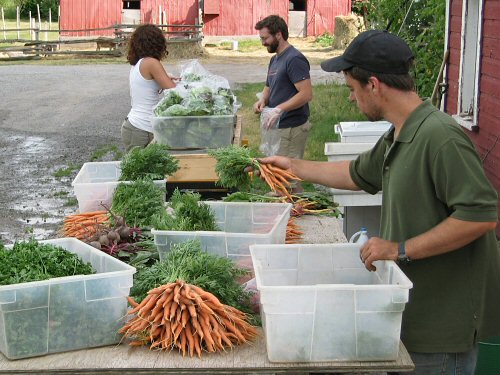
Fridays put this tiny farming system to the test, if we don’t get everything done for market and CSA shares, things would simply…CRUMBLE!!! Rain or shine, Friday is the main day for bringing in the weekly harvest, when we have to pick, sort, rinse, and bundle or bag 60-80 of everything that’s ready for the Saturday farmers’ market (about half of the CSA shareholders also pick up at the market). This week, the veggie selection is still small: beets, carrots, shell peas, green onions, mesclun, parsley. Here, at 6 pm, the picking, digging and pulling part is mostly finished and it’s mainly post-harvest action in the shade of the barn: Erin and Mike (not me, another Mike) bag and weigh just-rinsed mesclun, while Conall bundles baby carrots.
First carrots plus beets!
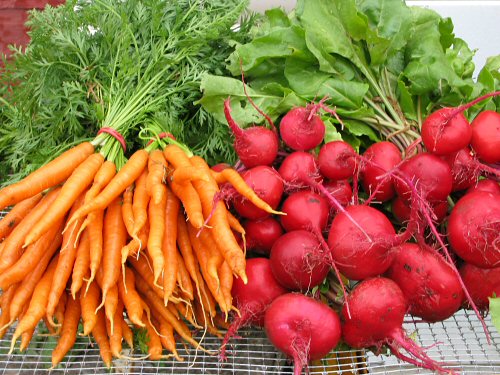
Today we harvested the first carrots of the year (baby Nelsons), along with baby Chioggia beets, for a small custom order. Veggies seen outdoors, especially when wet, are impossibly colorful in their own particular way, quite unlike…other colorful things! I’m still and forever surprised at how deeply pleasing and satisfying it can be to simply gaze at fresh veggies in sunlight (especially after harvesting them, and on overcast, diffuse light days!). Leafy greens are great, but the time for MORE is upon us once again!
Spin cycle
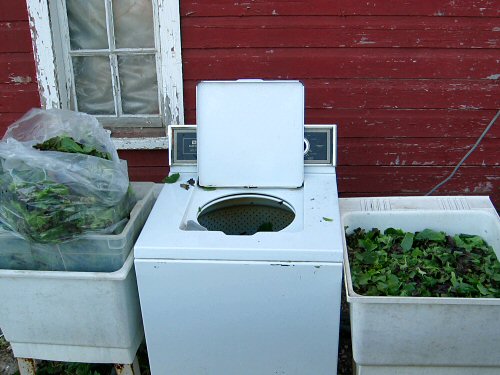
Here’s an important piece of the post-harvest station, the trusty washing machine-turned-salad spinner, flanked by laundry sinks, working on Sunday CSA harvest. The washer idea I read about someplace. When the washer here on the farm started doing odd things to clothes and was heading for the scrap heap, I intercepted it and pressed it into veggie service. With the agitator removed, it’s used on the spin cycle. Good ol’ centrifugal force! The trick to preventing leaves from getting crushed—either shredded (spinach) or veiny (lettuce, other light leaves)—is not to load too much at a time.
The sinks contain cold well water. For the most part, rinsing greens is done to quickly cool them down after being cut in warm conditions (like…a hot afternoon, you can’t always pick your moment). Sometimes, it’s also to wash off dirt splashed up by rain. Rinsing greens for one reason or another happens about 75% of the time during late spring through midsummer. Once the days start getting shorter (yuck…), greens harvests can usually be timed for the cooler evening, and rinsing happens less often. The sinks are also used to rinse other crops when they need it!
Simple, effective!!
Late June harvest
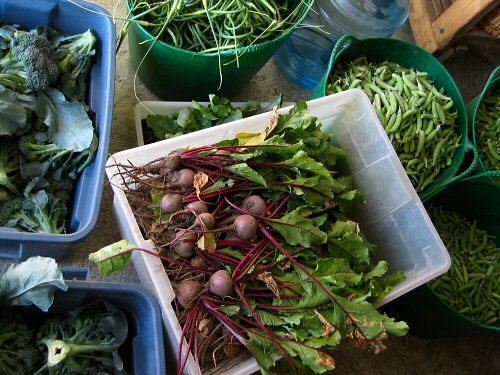
The harvest is still small: snap peas, broccoli, mesclun, the last of the garlic scapes and spring spinach, beet greens, the first few, baby beets. With 50 CSA shares to fill this year (around double from last year), plus the farmers’ market, a couple of local outlets, and the farm stand, I’ve really upped the ante. Even with PEOPLE at work in the field, I’m concerned about quantity. Where bad germination and losses from pest damage here and there have been no real worry so far, now every little setback seems…dire. Probably, most of this is in my head, endless millions of small farmers have done it before and are doing it now. Still, staying tiny and diversified at my particular scale seems tougher than before. It’ll work out, and for now, any uncertainty keeps the adrenaline on a steady slow drip! :)
Packing station
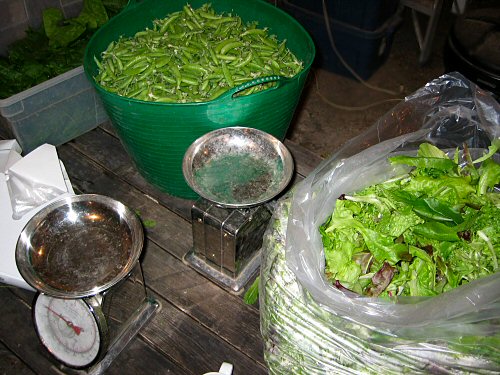
The post-harvest is a simple, straightforward process that has to be done fast since we don’t have a cooler. The set-up is manual and basic. Today, we packed indoors to get out of a stiff breeze that would’ve taken the salad greens sailing (usually, we do everything outside, in the shade of the barn; the indoor option is part of the new luxury of the Extended Milkhouse). There are a couple of 2 kg kitchen scales for the snap peas and lettuce mix. Everything is sold by bunch and bag, not weight, but the scales are useful for keeping things consistent. It’s quite easy to get the right amount by eye, so it’s into plastic bags and pop onto the scale for a quick check. If it’s underweight, add more, otherwise, somewhat over is just fine!