
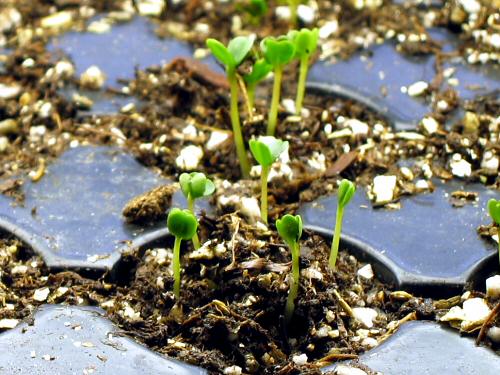
That was quick! Early morning, and the arugula (and Granada lettuce) has popped up in barely two days. Air temperature in the Milkhouse where the grow racks are stays mostly in the 60-65°F (15-17°C) range. Around the plugsheets, the close fluorescents warm things up an extra 5°F or so, and the clear plastic over the trays creates a little greenhouse effect that adds at least a couple more degrees. Altogether, ideal germination temperature! It’s kinda fun to think you’re in control of precisely what’s going on, but in any case, however they pulled it off, the first seedlings of the year are good to see! :)
Veggies
Extreme farming…
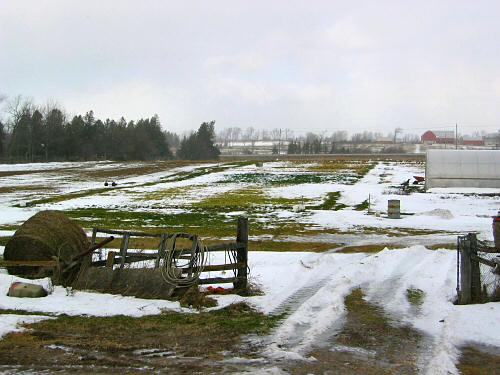
Yesterday, the temperature decided to climb up to just over 40°F (5°C) and stay there for the day…and well into the night. Around midnight, it began to rain. By the time I peeked out this morning, it was back to bitter cold and frozen ground, but not before most of the snow had melted away. This seems really unusual, even for the weather extremes we’ve been having the last five years. It’s the second meltoff so far where the ground actually thawed out. Bob, who has an old school farmer’s memory of conditions going back a good 40 farming years, says THIS is the single weirdest winter he can recall…and it’s only half through. I’m not shocked. As I often (kinda… cheerfully) say to people, having started into this growing life exactly five seasons ago, crazy weather is all I’ve known! Before that, notable weather events were absolutely discrete, novelty items in my mind, there was no practical reason to connect one to the other and maintain any sort of continuous memory of conditions over the years…like farmers and gardeners do. Now that I do have a short bit of weather memory to work with, what it tells me is that, in the field, you really can’t count on ANYTHING at all, from one month to the next, and even less so from year to year. “Gone completely haywire” comes to mind. Garden accordingly… It really is tiny farming as an extreme sport!
Getting started
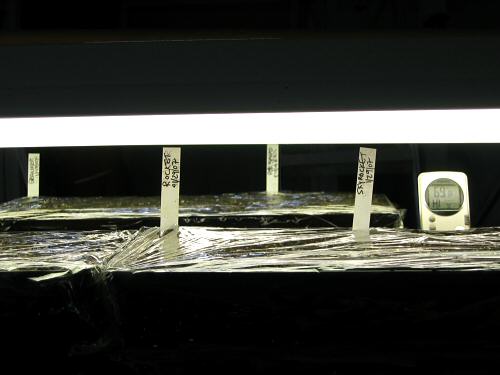
Started the first seeds of the year today: lettuce and arugula. At night, the grow racks remind me of a lab experiment, with the plugsheets in trays, carefully labelled and sheathed in plastic under the intense white light (fluorescents up close are pretty bright). And there’s the digital min/max thermometer, keeping score. The whole set-up looks like what it is. It’s great! In the beginning, I kind of obsessively (and largely unnecessarily) check every few hours to make sure the soil mix is sufficiently moist, the temperature is above 60°F, to see if anything’s emerged and it’s time to take off the plastic. Maybe after another five or 10 years, it will become simply routine, but for now, every single plant to emerge is still cool and exciting… For this, the earliest lettuce attempt yet, I’ve started five varieties, all with maturity dates of 50 days or less. There’s Simpson Elite (a really fast 40-day) and Two Stars, both green leaf, Granada and Red Salad Bowl, both red, and Sierra, which is red tinged. As a salad mix in any combination or all together, they’re a great blend of colors, textures and tastes. The arugula, Rocket and Skyrocket, intended for the mix, is faster growing than lettuce, but I felt like starting some now (I’ll start some more, later). If all goes well, these will hit the unheated greenhouse in the beginning of March, a good three weeks ahead of last year!
Quite white
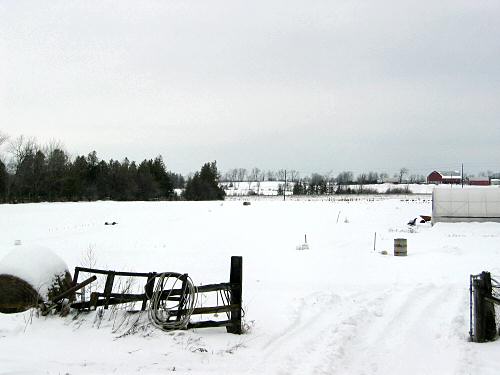
Hard to believe that three weeks ago, after nearly two months of looking like this, it all melted off and stayed clear for a whole week. Well, winter seems to be back for good, although there’s a little bit of warming in the forecast. Snow in a field is interesting for a minute, but…nothing changes. Right about now, it’d be great to have an unheated production-sized greenhouse (at least 24’x60′) , filled with carrots, spinach, leek, some parsley and kale,… One day soon. Until then, it’s this!
Snow plowing…
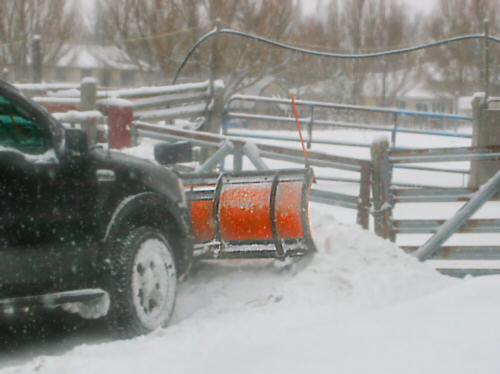
I suppose you could call these the dog days of winter! Our freakish week of warmth and melt-off are already faint memories, and this year, it seems like snow and cold have been around forever. January is an odd time for me on the tiny farm. Five years have gone by, and I’m still cruising on the original discovery that this is incredibly absorbing FUN, and there’s still a ways to go before the start-up is really done. Heading south for sun isn’t even at the back of mind. Ice fishing is only vaguely tempting. From what I’ve picked up, farming used to be a full-time, day-in-day-out kinda thing. Old school farmers generally had animals, which meant getting away from the farm was not really practical at any time. Of course, in recent decades, working off the farm became a necessity just to pay the bills. And now, the original farmers have all but vanished. Which leaves the new farmers, who I imagine are usually smaller and more specialized, and can treat farming as a seasonal thing if they like. For me, sticking to the farm seems only natural. Right now, I’m buried in bits of paperwork, reading, clipboards of jotted ideas, lists, notes, and it’s now time to set up the grow racks and start the first of the new seedlings. If the clouds and whiteness everywhere do get a little trying, here and there, well, it’s all part of farm living! And spring IS just around the corner!!
Sun and silo
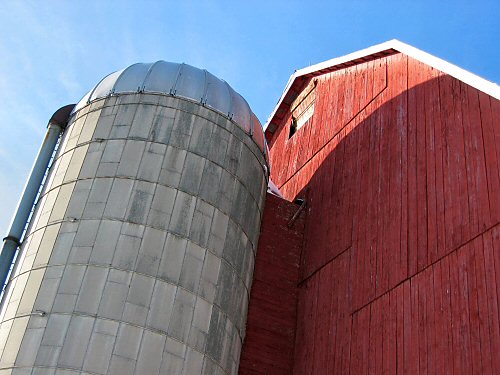
We haven’t had much sun lately, but it came out for the top half of the day today. What a difference sunshine makes, if you have any choice at all, you certainly can’t stay indoors (especially in front of a computer!). In my slow and steady exploration of all the many parts of the barn not used in tiny farming, I snapped a shot of the silo at the south end, looking quite imposing in the bright light, kinda industrial, and still in good shape. This is an old concrete silo, about 40′ (12m) high, used mainly for silage (partially fermented crops used for livestock feed). It was last filled around 15 years ago, when this was a full-fledged dairy operation. Field corn was chopped up and blown up the tube on the left. Packed in, the corn would start to ferment, which helps preserve it for winter feed. Cows apparently love silage! At times, the silo was also used to store dried corn (the kernels) for feed. Hmmm, wonder how to reuse a silo…
More carrots…
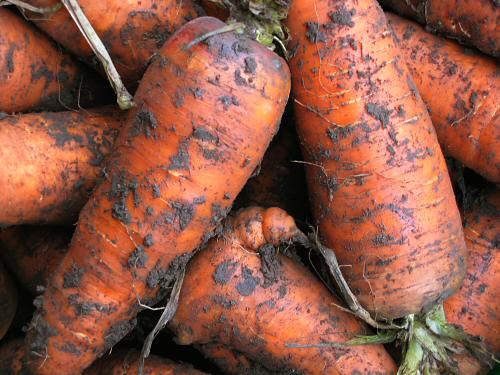
A good stretch in the field today. Harvested a bushel and a half of carrots (huge Danvers Half Long, enough to last through the winter) and a bushel of beets, a mix of red, golden and the Chioggia striped. Mulched another garlic bed, leaving just one uncovered. Did some clean-up with the compact tractor, moving empty barrels, turning crop remains into one end of the compost windrow. Took a trip down to the pond: it’s unfrozen, with only a layer of ice on top…
The pond is as full as it gets. Normal level is several feet lower, after the winter runoff evaporates, usually sometime in June. The barrel is a float that keeps the end of the uptake hose that leads to the pump suspended above the bottom.