
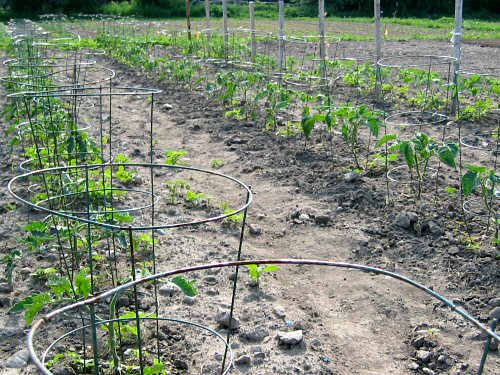
Prune, sucker, stake and cage—there’s a lot of (brutal-sounding!) stuff to do with tomatoes. On the other hand, as I’ve done in past years, simply by not having enough time to support them all, you can let ’em sprawl. I’ve always wanted to have the toms neatly assisted by the basket-weave method. This involves pounding in stakes every second plant (maybe every third would also work), then weaving twine in and out, in front then behind every other plant in one direction, then back again, weaving the opposite way, this done every 12″ or so of growth. This way, each plant is then supported by twine on both sides. You also have to prune and sucker (remove the shoots that grow at the intersection of new branch and stem), so that you have one main stem. This year, we should have several beds set up this way. There are also around 250 home garden-style tomato cages, which are quick, but don’t provide that much support when the plants get heavy. An advantage of caging: you don’t have to be as strict with the suckering. For at least a few plants, I’d also like to try caging with cylinders made of 6″ mesh concrete reinforcing wire, a heavy duty (and fairly expensive) approach… This year’s mix of methods is underway. More as it happens!
Tools
New view
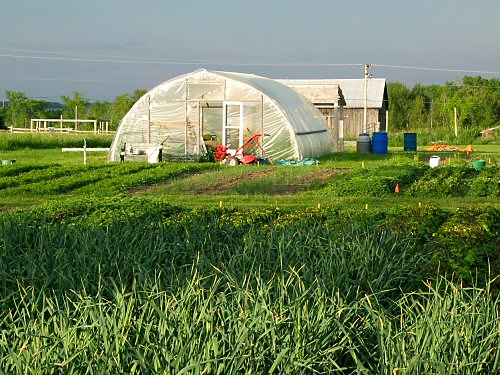
Here’s a view of the lower part of the field, from an angle that I don’t check out too often, looking over the garlic, past mesclun, carrots, green onions, beets, to the greenhouse, and you can see the veggie stand—it’s still roofless—tucked away behind. (Normally, only the mesclun would be in this area, with the root crops at the top of the field, but because the new section wasn’t ready in time for putting in fine seed—too much sod to break up—I’ve had to move things around a bit.) And so, it’s nearing the end of another hot and sunshiny day of weeding, seeding, more weeding…and so forth. We started pruning, staking and caging tomatoes, before they got too far carried away—it’s good to be on time!
Wheel Hoe Day
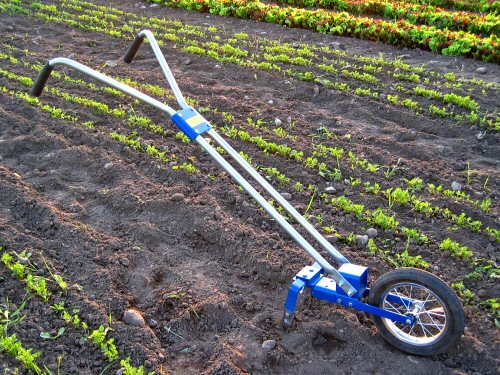
Finally, the new wheel hoe arrived today from the Valley Oak Tool Company in California! This simple and amazing garden tool is so little known in these parts, I had to order it from another country… I hadn’t used one before, but I had a very clear idea of how it should work, and it didn’t disappoint. You walk it along, pushing with minimal force, and the blade slices through the soil, beheading all weeds in its path. With ease. A slight arm adjustment translates into precise depth control, and the double-edged 8″ blade works on a back-pull as well. Even fist-sized rocks (a constant feature in this field) don’t phase it, they simply slip through the hoop. It’s at least 3-4 times faster than hand hoeing, and it matches the Horse walking rototiller for path clearing, minus the noise and gas. Amazing! (In the numerous shipping documents, I liked the note to Customs from the toolmaker, an organic veggie farmer himself: “Please let this package be delivered ASAP. There is a farmer awaiting his new tool.”)
First day at the farmers’ market!
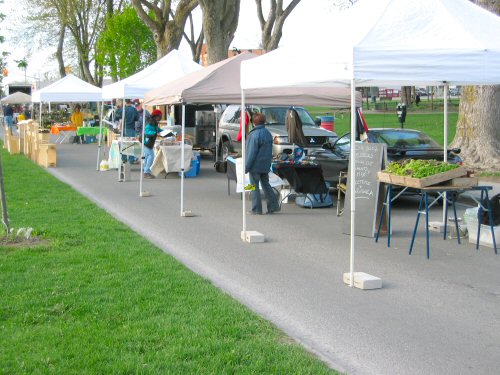
Up at 5 am, in the greenhouse at 5:30 to harvest more early lettuce and arugula. On the road by 6:30. Set up right at the 7 am opening. The photo is OK, though I find farmers’ market snapshots tend to look so stark and literal, they usually don’t capture the FEELING. Markets are fun because of the goods, you don’t expect a slick and snappy shopping mall presentation, your focus is on the food and crafts, and chatting with people. In pics, you see the mish-mash of basic tabletop presentation, but you don’t get the…experience. This one is a small market, 7 am-1 pm Saturdays, around 25 vendors, a dozen with fresh veggies, and usually about three hours of fairly packed traffic during the summer. Not like a big city market. I’m the only “certified organic” guy, and only one other stand has salad greens and a good selection of veggies beyond the standards. My stand is first on the right of the pic, with the newly repainted chalkboard and sharp new collapsing metal sawhorses debuting this season. I like the really basic display and circus-on-the-road feeling of setting up at 7, gone by 1:30. It was a good day, I was there mainly to show up, with only about 30lbs of the five-lettuce-and-arugula mix to sell (the first field crops won’t be ready for another couple of weeks). It was quiet, the cloudy, chilly weather didn’t help. Chatted with lots of regular customers, handed out some CSA flyers, and sold out by around 11… Fun!
Sorting
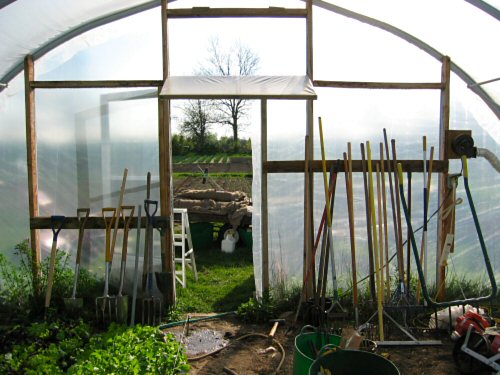
Tiny farming requires lots of bits and pieces, gear inevitably gets jumbled and misplaced, and the whole show can start to slow down as things get in your way and you spend time searching for this or that. Sorting things out is an on ongoing, neverending process. Last year, it seemed like a fine idea to stick all the hand tools in a 55-gallon barrel, so that nothing would be leaning against the hoophouse plastic. What a bad idea. Everything got tangled up, I began leaning my most used stuff against the barrel, and this year, when other people also started using the tools, it got completely out of control. Today, I screwed a couple of boards across the studs in the end wall—instant (if temporary) relief, and it got the barrel out of there, making it easier to move around the seedling tables. A place for everything and everything in its place—here, that often annoying recommendation does make sense!
Flea beetles
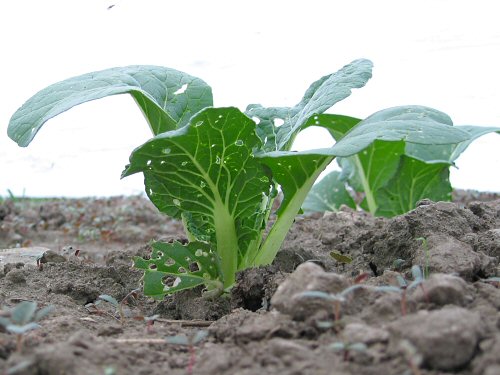
All of the brassicas, except for radishes, start out under floating row cover. It’s the only way they’ll survive the flea beetles. Around here, the FBs are a clear and present menace to the cabbage family. They chew little holes in tender baby leaves until nothing but stems and dried out leaf skeletons remain. It’s awful. I could use organic sprays, like rotenone or pyrethrin, but although they’re “approved” and from natural sources (other plants), it seems to me a slippery slope, or at least habit-forming. I haven’t sprayed so far. I did try a garlic blender concoction as a repellent once, but it was like cooking for the FBs, they hopped off and hopped back on once the spraying stopped: salad dressing! Anyhow, this is bok choi (pak choi). FBs eventually managed to get under the edges and do a bit of damage, but that’ll be outgrown, bok choi grows fast (as do radishes). Once the leaves get a bit more substantial, the FBs can’t as easily chomp on ’em. Cauliflower and broccoli, under this same 14′ wide sheet of row cover, are untouched. FBs REALLY like bok choi!
O, the luxury!
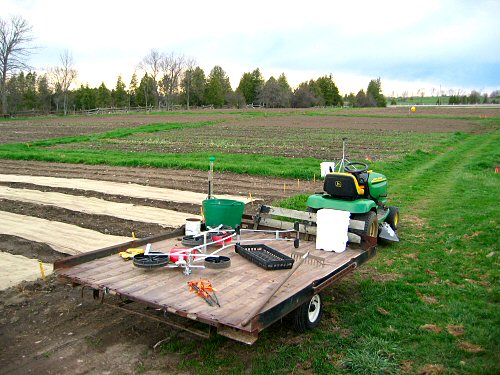
No sooner fixed than in the field! This combo of little riding mower and old snowmobile trailer is possibly my favorite tiny farming tool, a decadent* alternative to walking up and down the garden plot.
Around here, you can walk miles in a day, especially if you forget things and have to go back—although, walking around, taking different routes each time to check stuff out, is one of the big pleasures, too… What a simple life. :)
Anyhow, after trying a couple of different garden utility belts, overalls with 50 pockets, and a pull-along garden cart, nothing has come close to being able to toss all the stuff you need onto the trailer and go.
I use it whenever there’s too much to carry. Here, I’ve just finished the second seeding of mesclun and spinach, four beds each (on the trailer: Earthway seeders with plates in the coffee can, my most used rake, measuring tape and stakes for marking new beds, a pail for rocks, and seed in the green trug; the empty trays just happen to be there).
Up until I took this pic, it was a gloriously sunny day, after three days or so of cloud and drizzle (which added up to 20cm of rain). Little luxuries.
*The mower is actually pretty energy efficient: it uses maybe 30 gallons (114 l) of gas in an entire season, and that includes mowing paths and hauling harvests.