
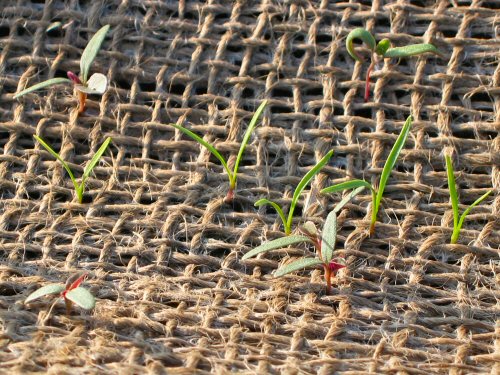
From the last carrot planting of the year, a new development in the burlap method! The variety is Nelson, and germination in less than a week was so vigorous, the seedlings came right up through the fabric, where in all previous seedings, they remained scrunched under. I’m not sure whether the burlap wearing down and loosening up helped this effect, or that there may have been less of a gap between burlap and soil due to a shallower seed furrow. In any case, it’s working better than ever! Rolling up the burlap, the seedlings slip through with ease, while most of the little pigweed emerging alongside get yanked by their aggressive leaf growth. Perfect!! (Clearly, I have carrots and pigweed on my mind…)
Tools
Equipment for large-scale agriculture is too big or too expensive, and many home gardening tools don’t work efficiently on larger jobs or break easily. Tiny farming on plots up to two or three acres requires its own special gear…
Making stakes
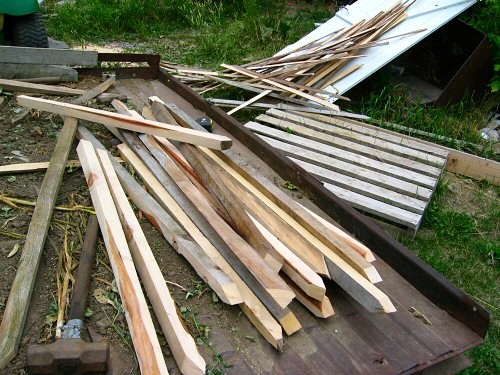
In the building and fixing department, there’s always a queue. Jobs are usually one of three degrees of urgency: Right Away (fix it or we can’t go on!), It Would Be Really Good To Have This Done Soon, and When There’s A Little Extra Time (and that’s often, all the way to Fall). Today, it’s finishing a Right Away job: making up more wooden stakes for the tomatoes. Last year, I bought for very cheap a pile of scrap wood, 10-12′ lengths, rough cut to around 2″ square, from a local sawmill. This year, we found pounding stakes made from this stuff a foot or so into the ground took an insane amount of sledgehammer effort, especially when driving into dry soil. Cutting them down just a bit made a HUGE difference. Using a table saw out in the barn yard, we shaved about 1/2″ lengthwise off each width, winding up with maybe 80 1-1/2″ square stakes. It took a couple of hours overall to save many more in the field, not to mention energy, sweat, frustration. The little things do indeed make all the difference! (Also in the pic, painted white, an old door scrapped during the Milkhouse Extension, and a nice, solid pallet (probably from the seed potato delivery), both to be reused in the composting toilet enclosure, an IWBRGTHTDS project.)
Pounding stakes
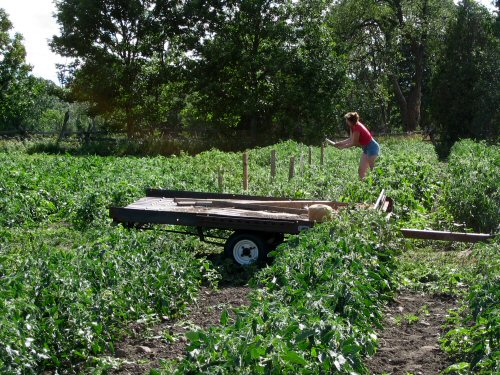
Jo pounds in wooden stakes for a somewhat catch-up version of tomato staking. I think of it as the Modified Sprawl. There are about 600 plants, with maybe 250 in home-style tomato cages. The rest are so far on their own. The cages work great, until a mighty wind comes along and blows a bunch over—they’re not really rugged field gear. It’s too late for proper basket weaving support, so it’s on to my previously tried and OK version, pulling the plants up with twine on both sides, to stakes set every three plants apart, with a bit of pruning and suckering as we go…
This is the point in the season where we start playing catch-up as a million different things need handling. It can get a little frantic, depending greatly on how it went earlier in the year. To add to the…decision-making puzzle, it’s last call, and even very iffy last call, for planting many crops (60 day maturity and under), with day length shortening and frost risk building to a significant consideration just 6-8 weeks down the road. So, thin here, or weed or seed there, or water elsewhere, you can’t do everything at once! It’s all in the timing, with much of the schedule in the hands of Ma Nature (where’s that RAIN!?!). Gambling, yes! Still and all, quite FUN.
Burlap method strikes again!
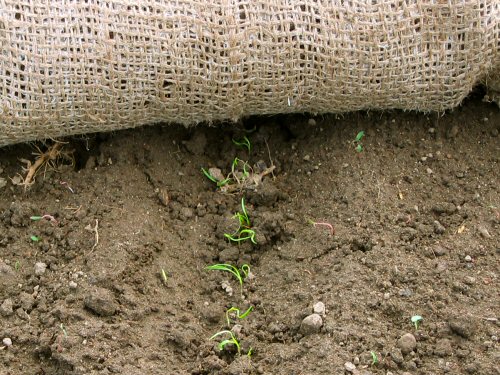
The carrots-under-burlap germination method is now 3 for 4, with this fine performance: solid rows and almost no weeds! The third attempt failed miserably with three different varieties, mainly due to underwatering (the extra drying effect of a very windy week wasn’t given proper respect) combined with using the Earthway seeder’s light carrot plate, which puts down much less seed (what a bad idea, I fall for the allure of little or no thinning every few plantings…). Anyhow, it was back to the regular seed plate and proper checking and watering, and now, a new 800′ of Nelson and Touchon is on its way (although, something’s been munching on carrot seedlings lately). Never dull! :)
Water work
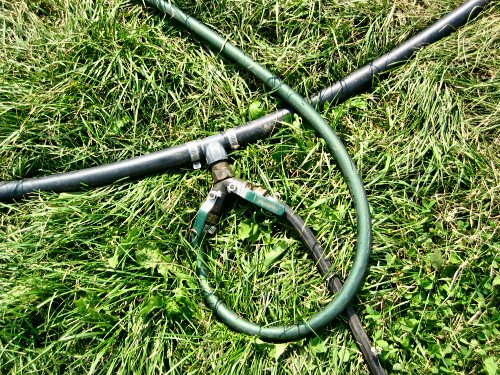
We’ve been watering heavily (well, as heavily as our gear allows) for what seems like weeks. Rain has been teasing us, 5mm a few days ago after an impressive, all-day cloud build-up; last night, 2mm following a brilliant extended lightning show and promising bit of a shower that soon faded away. It’s terrible. Conall has been honing his newly acquired hose rigging and sprinkler positioning skills. For heavier watering, the set-up begins at the pond and continues along a 1″ pipe (a little small, but it’s what I have from Year 1, intended for the much lower capacity barn well) that runs the length of the field. Water arrives through a series of shutoff Y-valves and from the valve of the moment snakes through up to 500′ of 5/8″ garden hose. (Fluid dynamics is something I should apparently be studying, to get a grip on the water-reducing effects of our often convoluted hose, valve and quick coupler combinations.) The hose leads to sprinklers (never too efficient, and quite a waste with anything above a hint of a breeze) and soaker hoses (MUCH better, but a pain to run up and down beds and then move again). The pump can deliver only so much, so it’s a multi-day rotation of gear to get around the entire field. The golden upside: WATER to the crops!! It’s amazing how much energy half an hour of heavy rain can save…!
Pond and pump
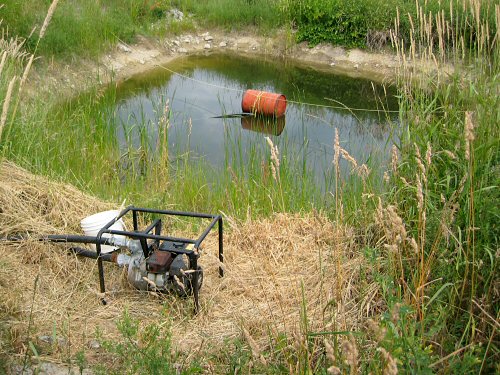
With only a little over an inch (25mm) of rain for most of June, and a near constant breeze on top of sun and heat to help dry things out quicker, we’ve had to hit the pond. Full irrigation here is a time-consuming process, involving dragging around and repositioning a network of hoses, soaker hoses, and sprinklers, and making trips every couple of hours to refill the pump set-up by the pond (see also “Pond and barrel”). The pond was dug out a couple of years ago, is ground-fed, drops level at an alarming rate (it starts the season full to the top of the photo), and replenishes slowly. If you look closely at the perimeter, the darker strip just above the water shows the level drop just for today. Still, it was used quite heavily last year and I’ve yet to see bottom! Meanwhile, I’m visualizing RAIN!
Spin cycle
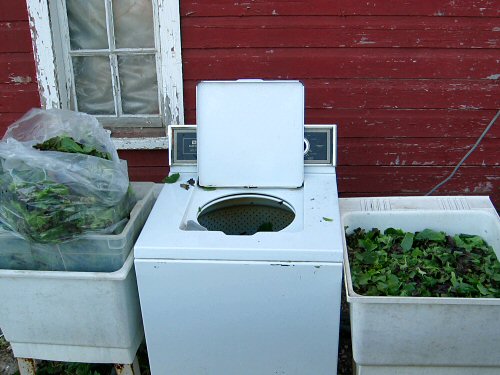
Here’s an important piece of the post-harvest station, the trusty washing machine-turned-salad spinner, flanked by laundry sinks, working on Sunday CSA harvest. The washer idea I read about someplace. When the washer here on the farm started doing odd things to clothes and was heading for the scrap heap, I intercepted it and pressed it into veggie service. With the agitator removed, it’s used on the spin cycle. Good ol’ centrifugal force! The trick to preventing leaves from getting crushed—either shredded (spinach) or veiny (lettuce, other light leaves)—is not to load too much at a time.
The sinks contain cold well water. For the most part, rinsing greens is done to quickly cool them down after being cut in warm conditions (like…a hot afternoon, you can’t always pick your moment). Sometimes, it’s also to wash off dirt splashed up by rain. Rinsing greens for one reason or another happens about 75% of the time during late spring through midsummer. Once the days start getting shorter (yuck…), greens harvests can usually be timed for the cooler evening, and rinsing happens less often. The sinks are also used to rinse other crops when they need it!
Simple, effective!!