
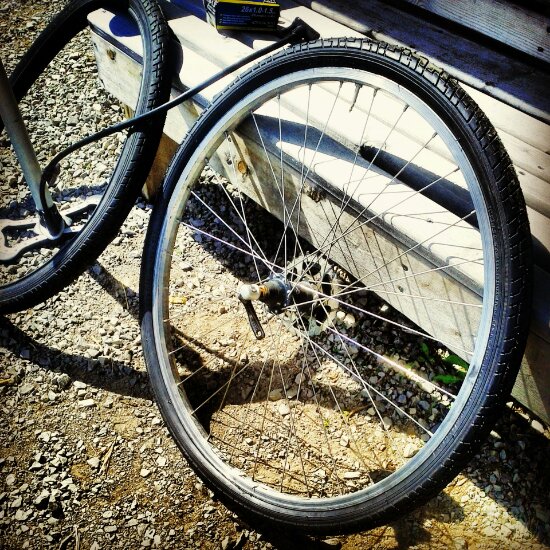
Yeah, my bicycle. Since I don’t drive (except for the compact tractor, and the occasional riding mower and ATV), it’s one of the ways I regularly get to the field (from the farm where I live, down the road to the farm where I farm). The bike is a major means of transportation for me, and for that reason, I consider it essential farm equipment. Here, changing a tube and tire took only 10 minutes… Nice!
Tools
Equipment for large-scale agriculture is too big or too expensive, and many home gardening tools don’t work efficiently on larger jobs or break easily. Tiny farming on plots up to two or three acres requires its own special gear…
Shrouded against the cold
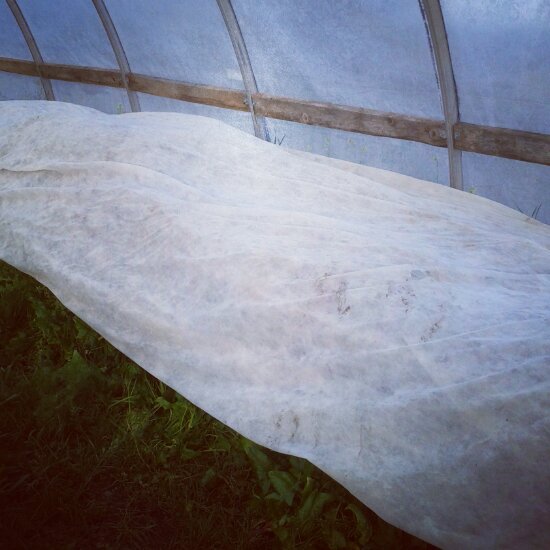
Shrouded against the cold: Not much to look at, but nice for the tomatoes, peppers and other seedlings on the tables underneath. It’s a double layer of medium weight floating row cover, tried and true, a familiar spring sight in the unheated greenhouse, good for a few degrees of protection in the forecast overnight near-freeze. Three days of chilly nights, they say.
Working on water
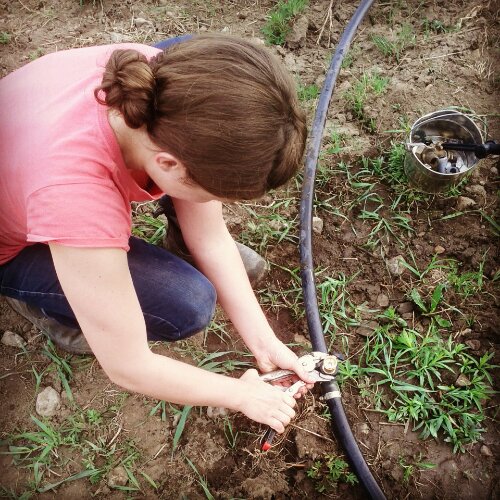
At work on water: Rochelle changes an shutoff valve—a tap!—to the 1″ header pipe that runs from the well through the field. Not exactly a big pipe by irrigation standards, OK for our low volume use. You could call it a hybrid setup, a mix of commercial and home garden gear, with a healthy amount of manual labor thrown in to make it all go (dragging around hoses to where they’re needed and the like, hand watering from 55-gal barrels when necessary). Full drip irrigation has been on the to-do list for years, all the gear has been here, but I’ve never quite got round to it, which sounds odd, I’m sure, but we’ve done well relying on rain, and working with minimal gear when the rains don’t come. Kinda…satisfying! :)
Rock, pebble, stone
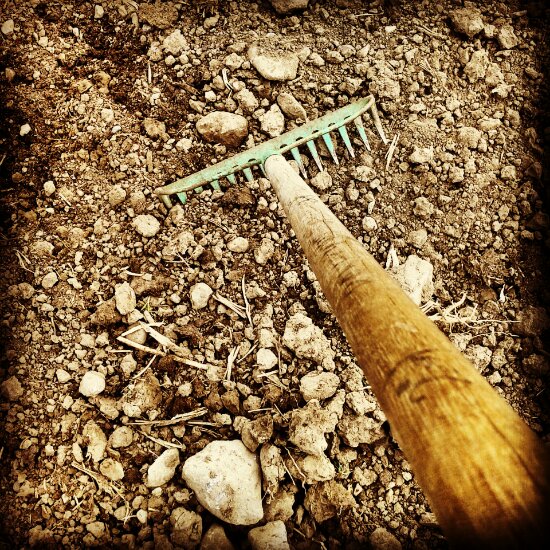
Imagine a world of soil without stones… In the three farming locations I’ve fully worked, they’ve been everywhere and in all sizes. You get used to them: collecting heavier, smoother specimens for weighting row cover, moving even bigger ones to avoid breaking tines on the rototillers, piling up the grapefruit and orange-sized rocks by the tractor bucket load, and raking the smallest out of the way of the seeders. I have experimented a bit with how much I can leave and still have the seeders not bounce around and lay down seed unevenly. Raking as the last step of bed preparation is still the way we go.
Toothpick timekeeping!
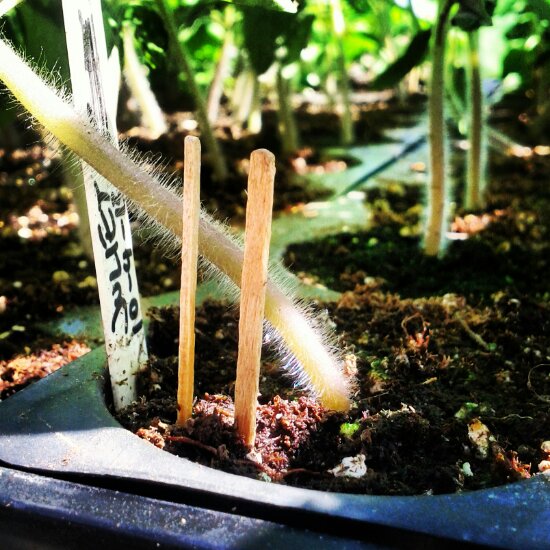
A toothpick tracking system. Before heading out to be transplanted in the field, so they don’t bet burned, seedlings growing under lights first have to be introduced to the sun. They go out in the day, get a toothpick, and come back in for the night. Each day of hardening off is marked by a toothpick—two or three days and they’ll be fine. Simple and sustainable—reuse your toothpicks and a single box could probably be made to last a lifetime.
Tape time!
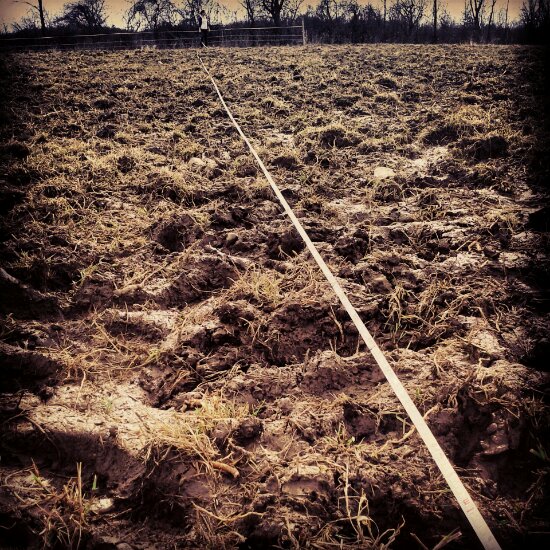
Tape time again, measuring out this year’s market garden. I’ve come up with various schemes to do away with this step as an annual thing, but end up wanting to move things around, or accidentally tilling under a critical stake or two left from the year before. The method is pretty primitive: walk around with a 200′ reel tape measure, trying to keep things square (the 3-4-5 trick!), staking an outline that can be used later to easily line up smaller sections as needed. That’s Rochelle at the other end, doing this two-person is the preferred way to go. The eventual result: a new garden map.