
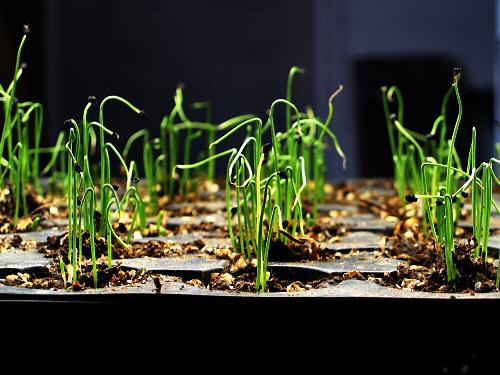
The leeks are thriving, all straight up and down. Ten days from seeding, and some of ’em are nearly 3″ (7.5cm) tall. Clearly, the seed was more viable than expected, looks like practically every one popped up. The first parsley just appeared, and a second set of arugula is already blowing in the wind. Things are slowly getting…busier.
Exploring down below…
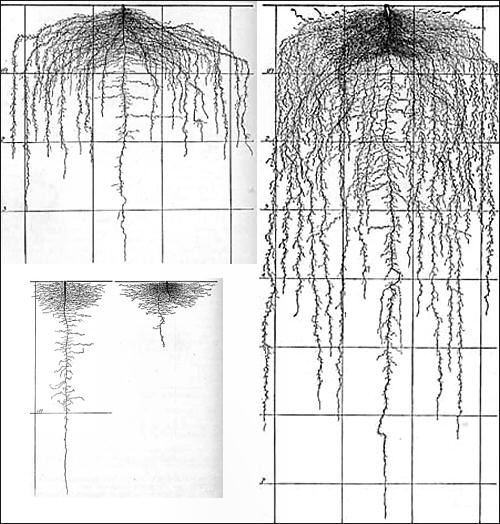
These technical drawings of a lettuce root system are from Root Development of Vegetable Crops*, first published in 1927 and now in the public domain. This is an incredible book that I just discovered. The text is like a complete gardening course delivered from underground. Over 30 North American common garden veggies are covered, a chapter each. The drawings record direct observation, the result of years of root excavation.
I can hardly describe how satisfying and…enlightening it is to simply look at page after page of painstakingly drawn root systems! Here, the top two pictures are lettuce at two months and then at three months and flowering. Each square in the grid is one foot. The little side-by-side illustratation shows 3-week-old seedlings, grown on the left in loose soil (nearly 2′ down!!), on the right in compacted soil (and to think, I have 3-week seedlings in tiny plug sheet cells, 2-1/2″ deep!). One look at this and your mind expands!
*I downloaded it from the fantastic Soil & Health Holistic Agriculture Library, an online repository for numerous excellent books, mostly from 1910-1960, and all entirely free—there are many organic farming classics, tons of great, practical stuff!
Lettuce-watching
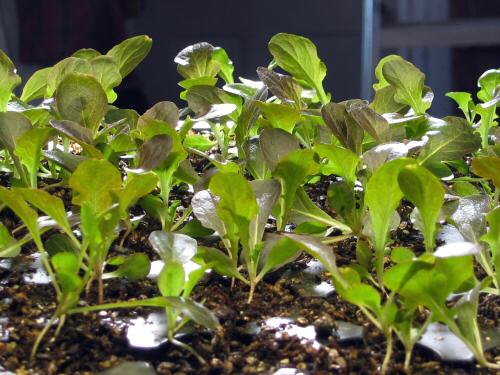
Tiny farming is in a mid-winter slow motion state right now, kinda like the calm before the storm. I don’t have daily livestock chores—I don’t have animals, yet!—and as far as garden activity, I’m waiting. About the only thing visual going on, besides lots of reading and staring at one screen or another, are the early seedlings. Here, the Granada is rapidly putting on color on its way to deep red… Lettuce-watching. Not that there’s little to do. There’s a new grow rack to build, lots of organizing in the Milkhouse and drive shed, materials to source and order, tons of stuff, actually. I could even get an early start on tax-time bookkeeping… Instead, I’m pushing it a bit, savoring leisurely reading for a few days, when there’s a little time!
Still snow…

The snow hasn’t gone anywhere in the last week, and there’s not much to see or do out there. The greenhouse needs to be cleaned up and made ready for an early March opening. That’ll be a day’s work next week, I still have to purchase a heater (indoor kerosene, I think it’ll be). And that’s it for now for gardening outdoors…
Leeks appear
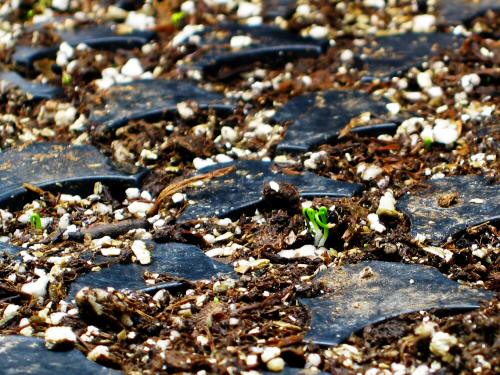
That was quick! After barely four days, the Jolant 75-day early leeks are poking up quite vigorously (there are early leeks and long season one’s that’re usually 100 days+ and more cold hardy). I used a mix of seed from last year and three years ago. Seed from the onion family has a short shelf life, it’s usually rated good for only a year, and I’ve noticed a pretty big drop in germination rate (I tested 2-year-old green onion seed, and it went from 88% germination to around 50%). Anyhow, because of that, I was pretty generous, dropping in maybe 6-8 seeds per, which will be thinned down to one or two. Anyhow, these guys are just raring to go…!
Little lettuce
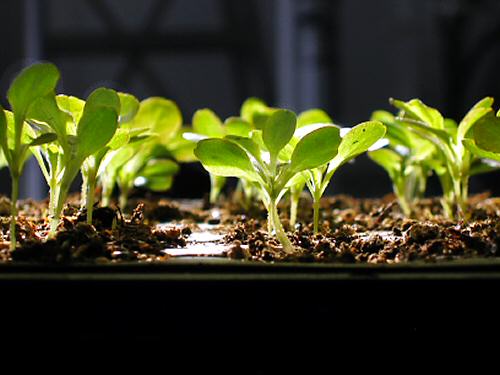
The year’s first lettuce is beginning to put on its true leaves. Here, Granada that will turn an intense burgundy, is just barely showing a tinge of red around the edges. The seedlings are still looking sharp: stocky and upright. Under the relatively weak fluorescents, they’ll inevitably stretch, but that’s OK, it’s…expected. Mid-February and it’s quiet and calm around here, the spring rush remains just around the corner, there’s still plenty of time to stop and gaze at the seedlings…
Seedling treatment
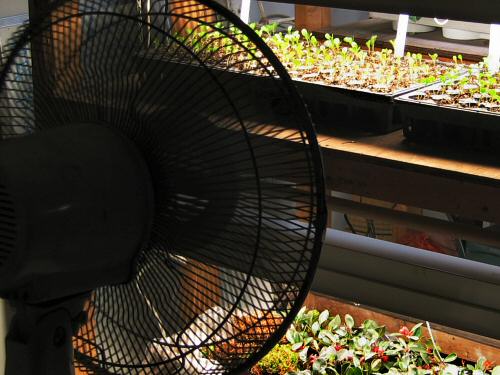
The fan is oscillating and the grow racks are slowly filling up. Parsley—curly and flat-leaf—are underway, and there’s more lettuce and some herbs…
Fanning the seedlings is particularly satisfying because it does a lot for such a simple thing. I forget where I heard about it, probably from a book, and I’ve been doing it since Year 1 or 2.
The idea is that plants develop differently when they have to deal with wind, or rain, or otherwise being pushed about. Seedlings raised indoors lead an extremely sheltered life; providing a bit of a breeze toughens them up, and this sort of mechanical stimulation (brushing is another approach) also encourages stockier growth instead of stretching.
It makes sense to me—seedlings definitely wouldn’t be so coddled growing out in the field! There’s even a term for this: thigmomorphogenesis! While hunting down the word, I found an interesting article about mechanical stimulation of seedlings as well (and here’s another).
I don’t follow a particular schedule, just give ’em at least an hour or two a day, sometimes more, turn the fan on and move it around every once in a while (I also make sure the seedlings are properly watered, since wind is great for drying out plants).
All in all, it’s easy, sounds good, hasn’t hurt! The fanning also dries the soil surface, which helps prevent damping-off, so you can’t lose!