Organic certification…

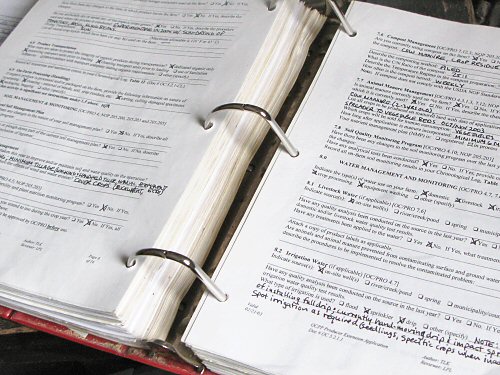
While Obama gets sworn in before the eyes of the world (mine included, on a one-day return to the news), I’m contemplating the stack of paper that leads to organic certification. No connection, today just happened to feel like the day to do it…

We’ve been discussing for a while whether to certify the new farm. The old farm has been certified for six years, right from the start. Back then, I did it because it seemed like the thing to do. Right now, I’m a lot less certain of its value to the truly tiny farm.

In the end, if you’re providing organically-grown local food directly to real, live people—field-to-fork, face-to-face—why would you need a whole bureaucracy and set of regulations and a CERTIFICATE, to assure folks of what they can see for themselves by visiting the farm in person?

If only the world were that simple and straightforward.

We’re getting certified because possessing the right paper does have its advantages, it’s a way to show you are what you say you are, to people who don’t know you first-hand… It may come in handy! That’s our reason for now.

So it’s filling out time. The main application is 25 pages of questions, and there are a couple of extra forms, lists and farm layout maps to include.

Some questions are multiple choice, others are open-ended, and while there are no real “right” answers, answers either do or do not comply with the organic production rules. Compliance is what counts.

The actual production standard is pretty cool, it covers every aspect of organic growing and marketing in great detail—being able to fill out the application means you’ve gotta know some things! :)

The binder is full of previous applications and responses, inspector’s reports, the 60 pages or so of the Canadian organic standard, the US organic standard, in case we want to certify to that, too (they’re pretty much the same on the basics), and various bulletins and notices. Lots of paper.

It looks like a fair bit. In fact, once you’re certified, unless there are big changes in your farming, each year’s renewal application is mainly copying everything from last application and sending a check. After that, an inspector will show up, look around, check your records—you have to keep track of fieldwork, harvests, things like that, also, keep invoices for seed and anything else mentioned the application, like fertilizer and cleaning products—ask some questions, and a couple hours later, it’s done.

Anyhow, here’s to getting the paperwork done and in the mail!

(PS: I do like the grassroots, no-cost, farmer-to-farmer Certified Naturally Grown program, which we started also certifying with last season and intend to continue with! I donated $100 to CNG for 2008, and also bought some signage and stickers. Organic certification costs about $400-500 a year for a tiny farm in Canada.)
Chickens on egg

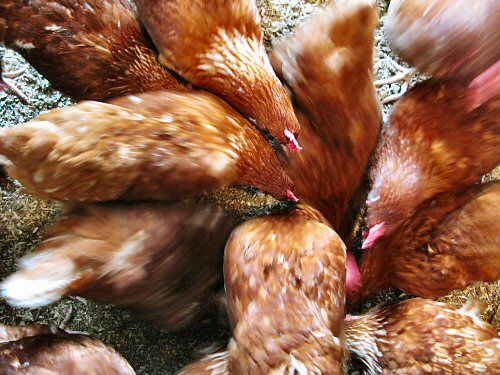
Another (quiet) farm day, another fine distraction from the chickens’ bag of entertaining tricks: swarming on stuff! This happened to be a piece of a semi-frozen egg that I found in the deep litter. The egg had probably been buried since yesterday, insulated, frozen to the point of cracking, but not yet hard as rock. I broke it open to take a look, and accidentally dropped a big chunk. BAM, the girls were on it in a  mad rush, a totally focussed frenzy, like nothing else in the world even existed. If it was anything but the wee friendly girls, that sort of swarming would be kinda scary. As it is, it was fun to watch. Crazy chickens.

Tiny farming in January

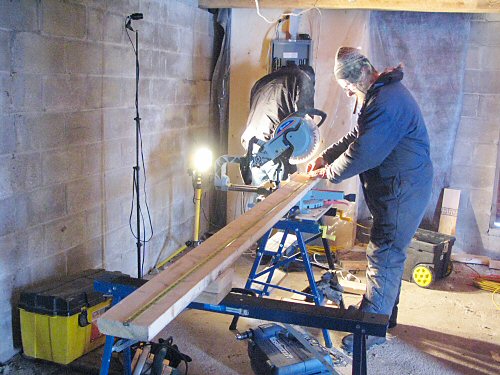
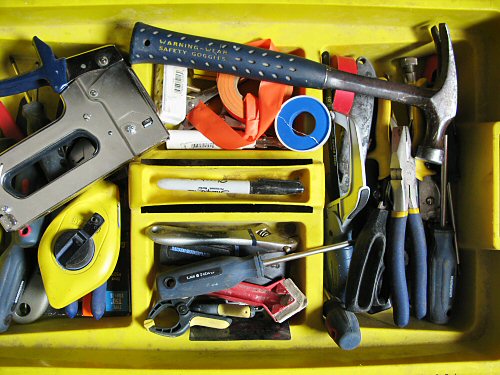
If I happened to be looking for monthly tiny farming themes, this particular January is clearly all about chickens and tools (and thinking about stuff!). It’s not the usual January routine around here. Normally, I’d be hanging the lights back on the light racks, checking out my seed starting gear—plug sheets, trays and the like get hit by a certain amount of damage and destruction each year—and generally cleaning up and rearranging the Milkhouse for seedling production. This year, with the move to the new farm, there’s nothing much to do on this end, until the new seedling room is built. So, it’s been back and forth—this weekend was there. The tools in the photo, a fairly small part of my ever-expanding collection of essential farm maintenance gear, aren’t what’s mostly being used, it’s mainly the chop saw, sawzall, cordless drill, and a lot of measuring and marking as we frame and insulate the lower barn space. But I’ve been lugging this chest each way, just in case I need tools at either end… As for the chickens, well, it’s water, feed and eggs every day!

Winter light

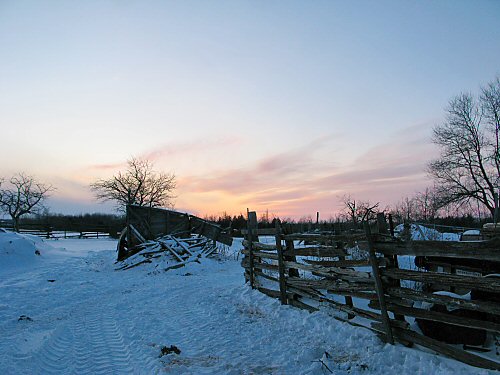
Mid-January, 5pm and still light out. This is the view to the west, with the big barn just out of frame to the left, looking past the loafing barn yard to the second, 11-acre pasture—the 9-acre field where the market garden lives is directly to the right—and then the trees. At the end of the rail fence in the foreground is the gate where the cows come home at night. It’s bitterly cold, my fingers are going numb after only a couple of minutes on the camera, but I’m enjoying the sunset, out here in the deep freeze, thinking about all the work ahead for the new-farm market garden season. It’s crazy. Cool!

Your veg is in the mail

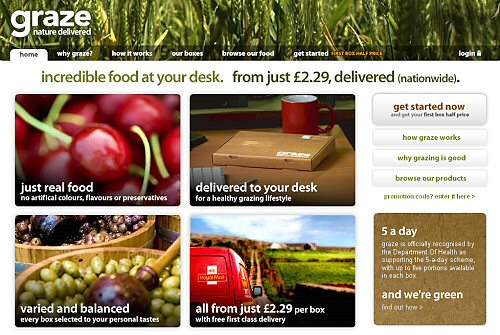
In comparison with just about everything else, tiny farming is so…basic. A friend sent me a link to Graze with the only comment: “Remember our chat about healthy food + convenience?” So I clicked it. I don’t know what to say. After reading through the site, I was kinda, literally, almost speechless—the service is summed up in the home page snapshot above: Graze mails healthy snacks to you at work. The UK business is based on the British National Health Service’s 5-a-day campaign that says you should eat five servings of fruit and veggies daily. Graze aims to help.

This is seamlessly intense green marketing. Every base is covered. Probably my favorite piece on the whole site is their description of how precisely-sized servings are shipped to you: 

Our box is thin, strong & uses the least material possible. What’s more, it’s from a sustainable forest, biodegradable & 100% recyclable. We source our food locally wherever possible, and prepare everything in our own kitchen, keeping food miles to a minimum. We hate waste so we buy all our fresh produce on the day we send it, and any leftovers go to our local farm. And best of all, the postman delivers it, so we don’t need any vans or energy guzzling shops. We are always seeking ways to be even greener.

Fascinating! Puts direct-to-market tiny farming well in perspective! :)

More cold-weather construction

A fairly productive Saturday of building out the new seedling room in the freezing cold (-15°C/5°F), with Michael and Bob (he dropped by to help for the day). By sundown, we had about half of the framing done, slow going with the cold, and the joists in the ceiling to work around. The propane space heater I used to use for emergency greenhouse heat barely made a difference with all of the drafts around the old barn doors and windows.  This winter work is nowhere near as fun as rough carpentry in warm weather, but it felt good to get stuff done.  And we’re still on schedule—seedlings soon have to start!

Checking on the beef

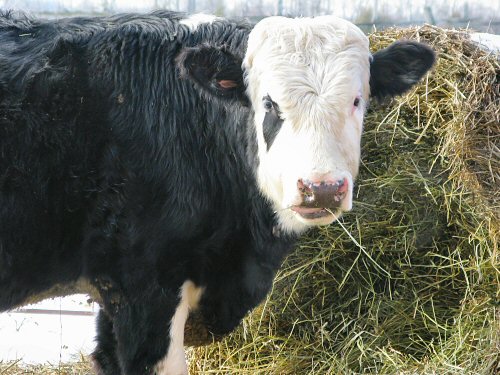
Sammy the Steer, born at 4am in the freezing cold barn last January, is healthy and hefty at around 800lbs (360kg), and approaching the end of his arc as a provider of tasty, mainly grass-fed beef. He and his three pals will likely go off to auction in March. They’re heavier than they’d normally be on a mostly grass diet (supplemented with some grain), because Bob didn’t wean them from their mothers for an extra couple of months. Mother’s milk is good. I’ll miss cows on the new farm. Although I’ve never been involved in their day-to-day, they’ve been close neighbors. My real connection with them is through MANURE, tons and tons of 6- to 12-month-old, air-dried, partially-composted, nutrient-rich goodness in a constant, convenient heap, there for the taking. I don’t see cattle in my near farming future. I hope to get to them eventually, meanwhile, putting some animals in the new tiny farm food chain sooner than later is on my mind. Perhaps goats?

1 71 72 73 74 75 168