
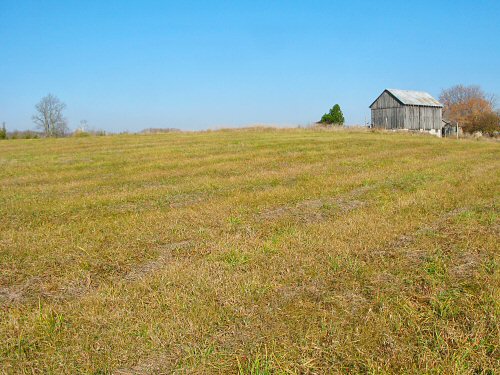
A third trip to the new farm, with more tiny farming conversation and checking things out. The weather: beautiful once again. The view in the pic: a perfectly south-facing slope (when you’re thinking about growing, pictures of promising farmland never fail to excite!). The benefits of a gentle SFS are well-known, and they’re particularly precious in a climate like ours, with harsh, snow-bound winters and a relatively short summer growing season. A slope facing south receives sunlight much more directly than flat land, so the snowpack is much lighter during winter, and more quickly melted off in spring. Then, the soil warms up more quickly, and gravity does its thing, providing better drainage, allowing the ground to dry out more quickly. All around, this simple incline could provide a couple of weeks of spring headstart, compared to flat land right beside. How well this actually pans out will be fun to see!
barn
Trimming garlic
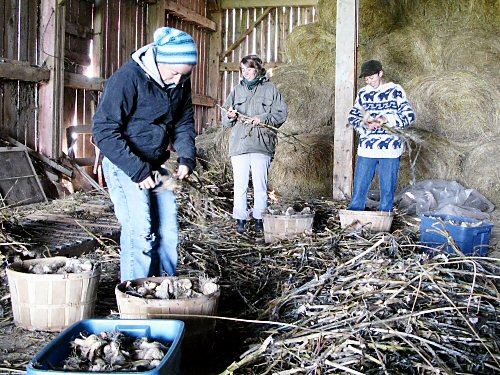
From the long stack of garlic drying in the barn, we’ve been taking out about a bushel a week since harvest began in late July. Today, we finished preparing the rest of the harvest. Lynn, Raechelle and Mel snipped the stems and sorted at the same time. (The roots weren’t trimmed; that can be done for some as we go through the bins and baskets each week for CSA shares and the farmers’ market.) In past years, the sorting was for size: dividing the mostly medium and large bulbs, and putting aside the very few tiny and damaged ones. Garlic does best with a dry final month of growth—this time, coming out of ground that had remained quite wet all summer, the harvest wasn’t in as good shape…
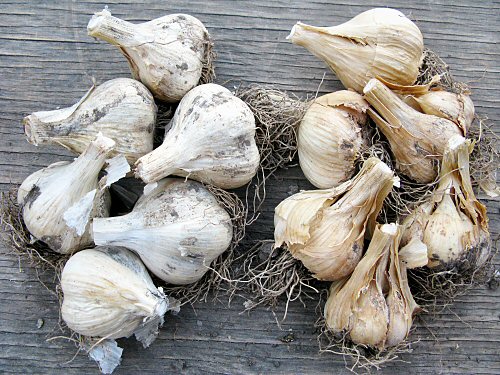
Sizing evened out, with most bulbs about what I call “medium” (this is the most useful size for cooking, but the big ones are so…impressive, everyone loves ’em). A little over half dried not to the usual tight, white skin, instead, to a tan color, wrinkled and split. So, we sorted into “good” and “not so good”… There was also a much higher proportion of really damaged bulbs, maybe 10% compared to a usual couple per hundred. Still, the taste is great, and the cloves themselves are fine. Only appearance and storage life are affected. We’re selling the less pretty, less storable bulbs at a couple of dollars less per pound. They’re good for immediate use (within 3-4 weeks, maybe a little longer) and as seed garlic for fall planting. Overall yield was great, although I’m not sure whether the hugely reduced number of large bulbs was due to weather, or to the more intensive 5-across planting we tried for the first time. As usual, more to observe and learn from. All in all, given the poor garlic weather, it all worked out quite well!
Chickenhouse inspection
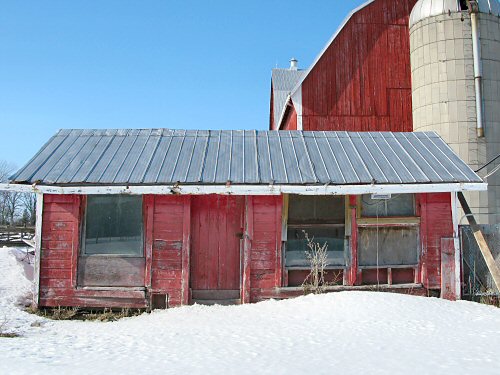
Checked out the chickenhouse today to make up a materials list for the renovation. Here’s a view of the south-facing side (the usual daily view is from the barnyard to the east; the barn and silo are to the north, and hidden behind them is the market garden). From this side, it has that ramshackle cabin-in-the-woods look. I quite like it: 200 sq. ft. of open-plan living, big windows for lots of natural light, electricity, running water…instant home! Like most things on the farm, it has its history. The structure is 80-90 years old, purchased 50 years ago from the farm that used to be across the road (now a village subdivision with a bunch of houses, and untended fields), dragged over by tractor, and set on a concrete pad. It was used as a pony barn for a while; harnesses are still hanging on the wall. For the last 15-20 years, it’s housed a few chickens and turkeys, or been unused. Now, it’s back! There’s not much to do, besides a good cleaning: banging in a defensive baseboard (in the pic below, that’s a GNAWED not-so-little hole under the window), a window to fix, nests to build for the layers, and a coat of lime to disinfect and whitewash (that’ll be interesting). Outside, T-bars and chicken wire to fence in yards, and that should be it. Most of the materials we can salvage on-farm: the fencing stuff, lime, and plywood should be all that requires cash! There are even a bunch of feeders lying around. All these bits from the past, unused and still in place after years and decades, would be a little creepy, if we weren’t coming across them on the way to getting new things started!
Cows and calves
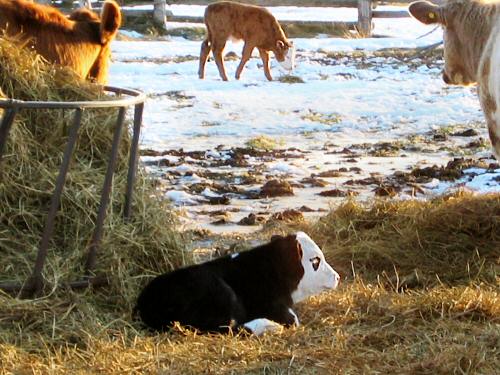
After being there for their birth nine days ago, I couldn’t not keep track of these guys. For about a week now, during the days, they’ve been in one of the yards just outside the barn, eating, resting and ambling around, exploring. They do grow up fast. It was sunny, but icy cold today, with a bitter wind, but the cows seem unconcerned.
New cows!
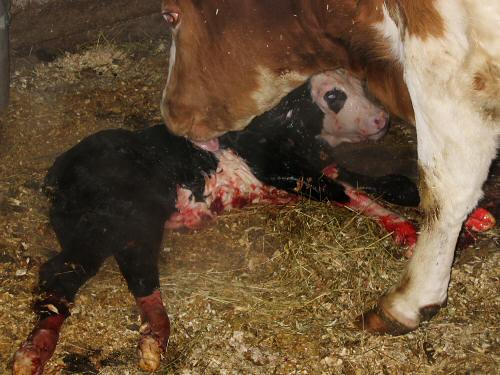
There was action in the barn in the wee hours today. A couple of the cows gave birth. Here’s the first new one, around five minutes after his 4 am delivery into the cold barn.
This is the second time I’ve watched the whole thing unfold. The first was maybe a year ago. In both cases, human intervention was required, which consisted of Bob with a length of chain wrapped around a pair of calf’s feet, pulling.
Last time, he explained it was a dry birth, where the embryonic sac breaks too soon, the head dries out, and, less lubricated, it sticks on the way out. A little feet-planted-firmly tug-o-war type pulling and…a new cow!
This time was a little more complicated, a breech birth, with the calf turned right around so its back end was aiming out instead of the head. Particularly with first-time births, the mothers aren’t relaxed enough to let the bigger back end out first.
To help things along, the stainless steel calving chain was wrapped around the hind legs and attached to a cable with a ratchet, in turn attached to a steel fence post set in concrete.
The long-handled ratchet allows the cable to be pulled with more force than a person alone could manage, as long as the cow stays put and sets herself against the pull (which she seems to do, since I guess she too wants the baby out!).
After some minutes of pulling, out popped the calf. It’s a boy!
There’s lots of bloody fluid and trailing bits, and the calf lies there at first like a limp, wet, bloody corpse. But the mother is right on it, licking away, and within minutes its head is up and peering around, and if all’s well, it’ll awkwardly stagger to its feet in under half an hour. Pretty cool!
The second mother gave birth around four hours later. The first time watching all this was interesting, a little sensational with all the bloody fluid. The second time, it was simply satisfying, another really basic part of life that most of us in the modern world just plain miss (we eat meat and drink milk, don’t we…well, a lot us do)?
I’m not sure about the breeding timing or anything like that, like, Why calves now? With Bob’s cows, I’m an observer, sometime consumer, occasional chaser.
Here’s the second calf, three hours after an 8am arrival, up and tottering around! Sturdy!! It’s fascinating to watch them rapidly get used to their legs, steadier by the hour.
Sun and silo
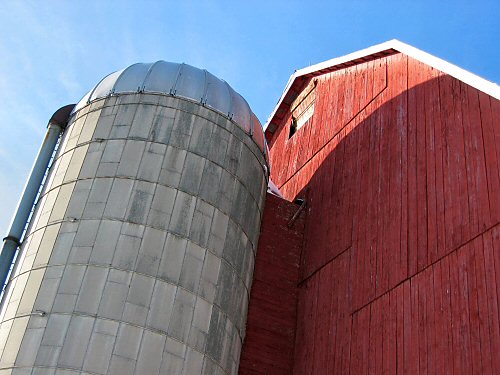
We haven’t had much sun lately, but it came out for the top half of the day today. What a difference sunshine makes, if you have any choice at all, you certainly can’t stay indoors (especially in front of a computer!). In my slow and steady exploration of all the many parts of the barn not used in tiny farming, I snapped a shot of the silo at the south end, looking quite imposing in the bright light, kinda industrial, and still in good shape. This is an old concrete silo, about 40′ (12m) high, used mainly for silage (partially fermented crops used for livestock feed). It was last filled around 15 years ago, when this was a full-fledged dairy operation. Field corn was chopped up and blown up the tube on the left. Packed in, the corn would start to ferment, which helps preserve it for winter feed. Cows apparently love silage! At times, the silo was also used to store dried corn (the kernels) for feed. Hmmm, wonder how to reuse a silo…
Barn, Milkhouse, snow load
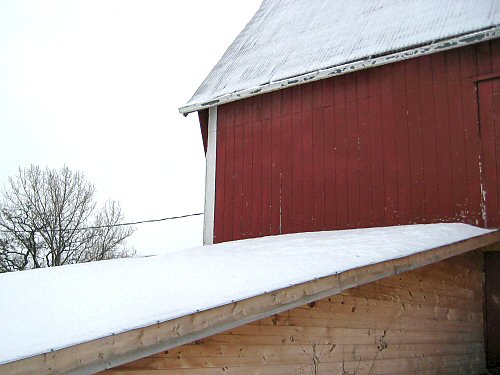
Not a big concern, but part of my rounds is keeping an eye on the snow load on the Milkhouse roof. It’s that shallow angle. This pic makes the potential problem clear: big, steep upper roof, unloading onto not-so-sloped lower roof. Luckily, with the wind and angle, there is seldom upper roof build-up. Although the weather’s been relatively warm recently (it did drop drastically last night), and there’s melt-off, it’s also been snowing in regular spurts, dumping an inch or so at a time. So, I keep an eye out… (If not for apparent global warming—shorter, less snowy winters in general, for whatever reason—we might have gone steeper when building last year. It seems we’re already casually adapting to visions of a freakish weather future, which IS human nature but still…weird!)