
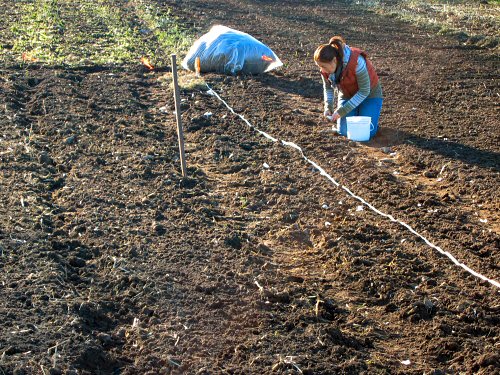
A perfect moment in tiny farming time as the first garlic goes in for next season’s harvest! It’s all Music (that’s the hardneck variety), and for the first time it’s 100% my own seed stock (last year, I had to buy some to add to what was set aside). The new garlic plot should be the best so far, with oats green manure and year old cow manure tilled in. Lynn and Conall dropped by to help. The row set-up is new. Previously, I’d done two double rows per 5′ (1.5m) bed, each double row spaced 6″ (15cm) in-row and between, with about 18″ (46cm) between the doubles. This year, a more intensive approach: five rows with 6″ spacing both ways, in a 4′ (1.2m) bed. What does all that mean? 500 garlic in 4’x50′ instead of 400 in 5’x50′. It should make mulching, watering and weeding that much easier! I tilled up the bed a couple of days ago to allow pushing in the cloves by hand (the moist, clayey soil gets pretty dense this time of year). The rows were marked out (you can just make out the lines in the soil), and we ran a measuring tape down the beds for quick checks on the in-row spacing, ’cause I’m a little concerned with crowding. They were planted about 4″ deep, from both sides, three and two rows, to avoid uncomfortable leaning (the greens machine was a little too narrow!). Afterwards, the beds were raked to fill in the holes. In the pic, there’s a bag of that new mulch, ready to go (although I ended up not spreading it today). The first 2,000 went in in three hours. I’ll add some more, another 500-1,000, a little later on!
bed preparation
Weed gone to seed
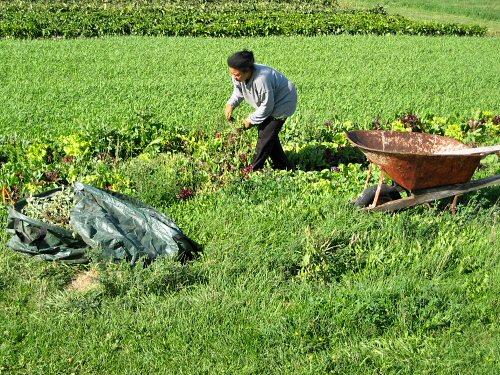
With more people in the field this year, end-of-season clean-up is already well underway. Here, Midori, visiting after moving to France a couple of years back, removes weeds that’ve gone to seed from three older beds of mesclun that’re waiting to be tilled in.
Ideally, finished beds would be promptly mowed down, spread with compost, tilled, and then seeded with a new veggie or cover crop a week or two later. Things aren’t usually that efficient, finished beds sometimes sit for weeks, weeds pop up in the interim, and if they go to seed, have to be removed before tilling so as not to add more seed to what’s already there…
Lying around: the green plastic garden totes are quite useful once the handles have been properly reinforced with rivets; the old builder’s wheelbarrow comes in handy for rocks, fallen tomatoes and the like.
The grass in front, in need of mowing, is part of a wide path on one side of the greenhouse, the grass beyond is the magnificent oats green manure cover crop.
Oh, no frost last night, as you can see from the happy peppers at the top of the pic!
Horse back in action…

The Troy-Bilt Horse walking rototiller is back in action for the first day of tilling in the field. I prepped a 50’x50′ section for snap peas. The Horse is noisy and uses a fair (though not unreasonable) share of gas, but it’s also a very handy machine for larger areas (in fact, I would’ve used the rototiller on the tractor, but the ground is still too wet to take the weight). All things in moderation on the way to becoming a fully-rounded, taking-it-slow, hand-laboring farmer! (Gear note: This Horse is c. 1995, from the original Troy-Bilt line, before the company was gobbled up by a bigger one and the construction got more lightweight. I bought it used, at half the price of new, and in near mint condition. It should last a long, long time—in my first farming year, I borrowed a rusty 30-year-old Horse that did just fine.)