
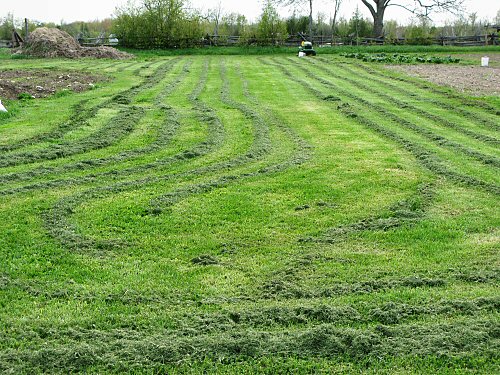
The grass seemed just long enough for a productive mulch cut without overloading the John Deere riding mower, so today was the day to start season 2 in the grass mulch experiment. This is just one part of the total mowing area: including the field perimeter and another big area behind where I’m standing to take the photo, there’s maybe four times that much (this area is being kept clear for the eventual bigger greenhouse). The JD’s deflector forms those nice mini-windrows instead of scattering the cut, making raking it up much quicker. I’m still not sure if the time it takes to mow, hand-rake and bag will be worth it on a larger scale: will the work be offset by savings in irrigation and weeding, and maybe better yield, for the crops that’ll be mulched? It takes a lot of big, packed leaf bags to properly mulch just a few beds… Well, we’ll soon find out!
grass
Green day
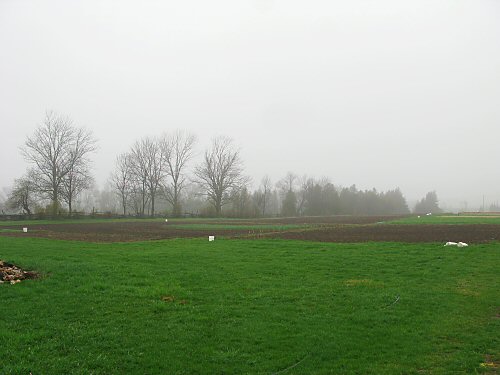
It’s a gray day today, as it’s been for most of the last few, but out in the field, it feels green. We’re at about 1.5″ (37cm) of rain in total, and the ground is nicely soaked (and a little too wet to work). The grass surrounding the garden is looking particularly inviting this year, since today’s lush green carpet is tomorrow’s GRASS MULCH. The temperature is up as well, and some sunshine is on the way (no doubt…). All in all, everything’s a little delayed, but looking pretty good!
Plugging away in the greenhouse

Taking advantage of the cloudy weather, I moved all of the lettuce out to the greenhouse for some rapid hardening off, and started prepping more ground for transplanting. At the edges, there’s lots of dead grass, and I’ve already pulled out a fair tangle of well-established live grass runners. The grass grows in from outside; the runners are incredibly busy and invasive, and can build up underground and, from what I’ve seen, seem able to noticeably sap resources from the plants above, even when the grass itself hasn’t broken through. This is an observation in progress (more on this later as I prep the field with its grassy paths). For now, I’m slicing deep with an edger right by the boards (if I get the chance sometime during the year, I’ll clear a grass-free strip around the outside of the hoophouse). Anyhow, lettuce will soon be in!
A little fieldwork
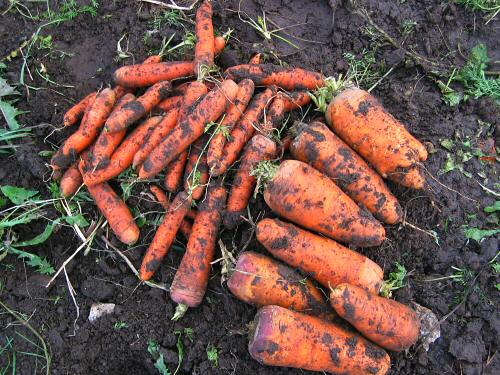
Spent about four hours out in the field. The feeling of calm satisfaction as you head in after doing some work in the garden never fails! I dug up about half a bushel of carrots to see how they’ve done. These are, I think, Nelson and Danvers Half Long (the BIG ones)—the label stakes were out, so I couldn’t immediately check the varieties, it’s not necessarily that easy to tell! They’re mostly in fine shape. On a few, the inch or two exposed above-ground had frozen and thawed, leaving the top tips spongy and mushy, but this didn’t affect too many. I can probably get a couple of bushels! This mid-January harvest is actually consistent with last year, except for the extra 6-7 weeks of RealWinter… I also mulched the garlic, leaving a couple of beds clear as a test (I’m not sure how useful an experiment that is, since I’ll mulch them for moisture and against weeds first thing in spring…). Anyhow, a bit of winter fieldwork…
Spreading grass mulch
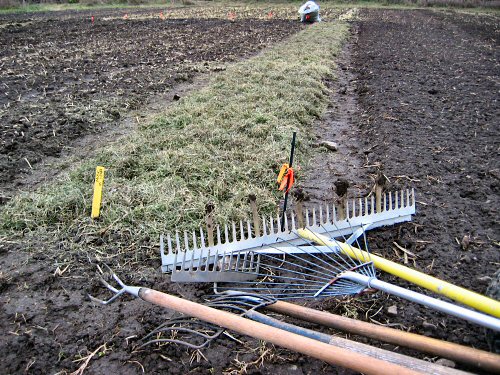
Today, I took advantage of a one-day reprieve from the cold—it was a pleasant 9°C (48°F)—to test the new grass-alfalfa mulch on a bed of garlic. I suspected spreading the light, loosely clumped mix would be more of a chore than tossing around straw, and it was. I first tried dumping it out, but the big clumps took forever to break up and spread, so I switched to pulling it apart by hand. The large bags of mulch weigh next to nothing, so that wasn’t hard, but you wouldn’t want to do it in the wind. Next, spreading it evenly. This proved to be a bit of a puzzle. I started with a hay rake, with three widely spaced tines, but this just slid through the grass, not catching enough to move it around. Out came an unlikely array of other hand tools to try: the compost fork (dark tines, right at the bottom of the pic), the 3-tine cultivator, a regular rake, and a leaf rake with round tines (the wide landscape rake was for marking rows in another bed). None of these worked well. Closely-spaced tines caught too much and cleared areas rather than covering them. I eventually used a combo of the 3-tine cultivator to break up the clumps, then skimming with the small rake to even it out. The results were pretty good, with a fluffy 2-3″ layer down the 50′. But it was delicate, picky work as the grass is very light. There are five more beds to go to refine my method (basically, figure out a better way)! I also planted a final 50’x5-row bed, using up the last of my seed reserve, bringing the garlic total to about 3,000…
View from the other end
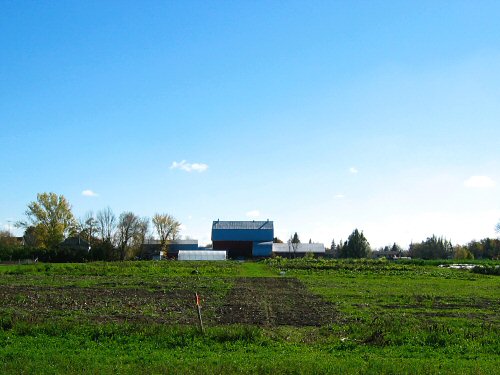
A view from the north end of the market garden field, the reverse angle of a couple of days ago and a relatively rare perspective for me. Although the crops are on a 7-year rotation that marches them from here towards the barn, I still tend to spend more time down around the greenhouse-Milkhouse end, no matter what’s growing where. Today, I’m once again checking things out as fall clean-up proceeds in pieces. The nearest section is the new addition, recently cleared of squash, pumpkins, cucumbers and melons, and the raccoon-fated corn just out of sight on the left. After one season, it’s a little overgrown with grass, but not bad. Next year, this will be beans!
Making mulch, part 3
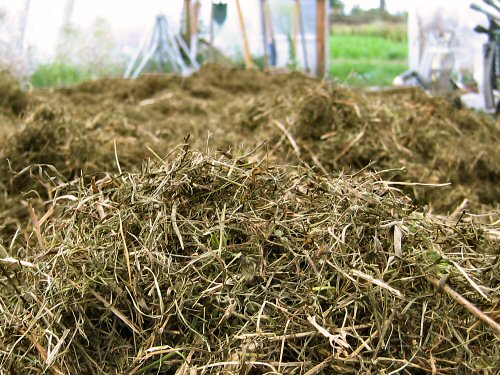
The grass and alfalfa mix spread in the greenhouse a few days ago is drying nicely—it’s almost done! It was a tad touch and go at first, the rows in the field were starting to turn black and decompose, and no sun in sight. So I turned it a couple of times a day for the first couple of days, doors wide open on both ends let through lots of air…and things worked out! Seems like a nice mix, with good bulk, not too fine. Then again, my mulch experience is in its early days, so we’ll see. Rough calculation: there should be enough to spread a fluffy 3″ (7.5 cm) over the new garlic plot. This experiment so far: not too labor-intensive, room for easy improvement to the process, seems like it would scale well (for covering larger areas), and RELAXING (some fieldwork is particularly enjoyable)… Grass-and-alfalfa mulch may have a big tiny farm future!