
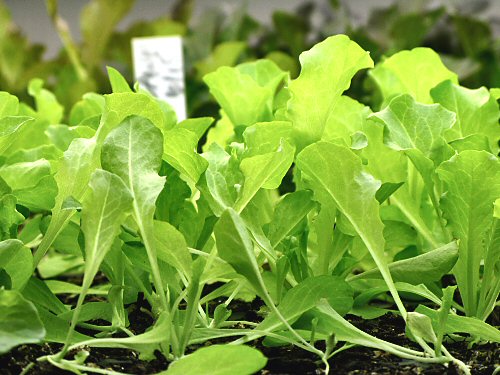
More early lettuce. This is Simpson Elite, an improved variety of Black Seeded Simpson, which is a really fast, reliable heirloom from the 1800’s. I grow both. They have thin, delicate, pale green leaves, but they’ve proven tough in heat, drought and cold. And they’re 40-45 days! These seedlings are now about 3-1/2 weeks old. I still haven’t thinned them from two per cell—all the lettuce looks so…pretty, densely bunch in their trays, and they’re stretching a bit, but just this side of really crowding each other. Anyhow, it’s the super-early lettuce…mostly for fun! (This is also my first tryout of the latest new farm tool, a Canon G9…a sturdy, field-ready bit of gear… :)
lettuce
Welcome to KeroWorld
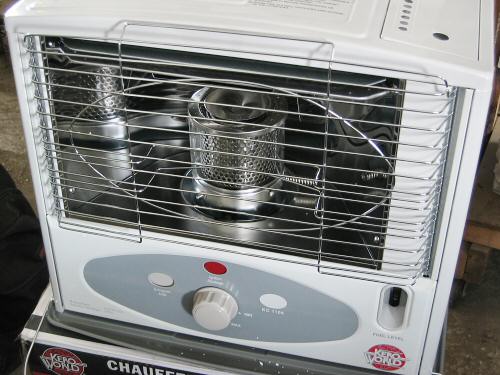
What an odd thought, what image comes to mind: the world of kerosene… And now I’m in it! Purchased new today, at a healthy 35% discount, this small, rather inexpensive, KeroWorld-brand indoor kerosene heater is the core technology in the extended-spring greenhouse plan. The idea is to turn the unheated hoophouse into a barely heated one, by warming it at night so that it stays above 38°F (4°C). That way, I can put out seedlings weeks early, instead of crowding them under scarce indoor lighting until it warms up in April. It should also give the earlier-than-ever lettuce, going into the ground in the greenhouse, a smoother start. This heater is low-powered—10,000 BTU, recommended for 420 sq ft, it’s 640 sq ft out there—but only a wee bit of heat is required. I think. Last year’s propane space heater was quite efficient, but burned too much gas for every-night use, it often went out by itself, and it required lots of ventilation. Plus, I don’t really like relying on pressurized tanks. This heater will hopefully burn low and steady, and it’s pour-to-fill! Aided by a fan to keep the air moving, and row cover on the coldest nights, it should get the job done. This all reminds me of Patrick of Bifurcated Carrots’ comment a while ago about the line between good and bad technology. It seems a personal decision as much as anything. Why don’t I dream about full-blown winter greenhouses, with high-intensity lighting and industrial-strength heating and ventilation, I wonder? Dunno. I just don’t. But an extra growing month in the strengthening sun, and a little less reliance on indoor lights, traded off against some kerosene, well, THAT would be cool!
Exploring down below…
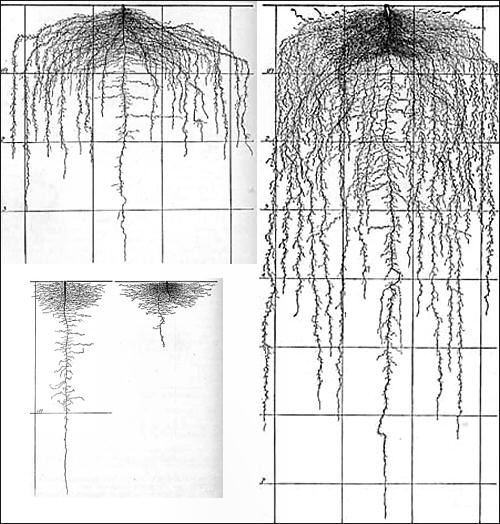
These technical drawings of a lettuce root system are from Root Development of Vegetable Crops*, first published in 1927 and now in the public domain. This is an incredible book that I just discovered. The text is like a complete gardening course delivered from underground. Over 30 North American common garden veggies are covered, a chapter each. The drawings record direct observation, the result of years of root excavation.
I can hardly describe how satisfying and…enlightening it is to simply look at page after page of painstakingly drawn root systems! Here, the top two pictures are lettuce at two months and then at three months and flowering. Each square in the grid is one foot. The little side-by-side illustratation shows 3-week-old seedlings, grown on the left in loose soil (nearly 2′ down!!), on the right in compacted soil (and to think, I have 3-week seedlings in tiny plug sheet cells, 2-1/2″ deep!). One look at this and your mind expands!
*I downloaded it from the fantastic Soil & Health Holistic Agriculture Library, an online repository for numerous excellent books, mostly from 1910-1960, and all entirely free—there are many organic farming classics, tons of great, practical stuff!
Lettuce-watching
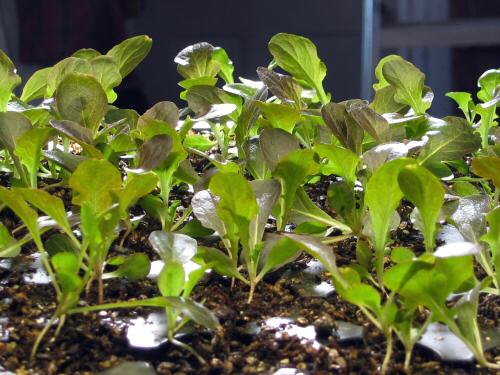
Tiny farming is in a mid-winter slow motion state right now, kinda like the calm before the storm. I don’t have daily livestock chores—I don’t have animals, yet!—and as far as garden activity, I’m waiting. About the only thing visual going on, besides lots of reading and staring at one screen or another, are the early seedlings. Here, the Granada is rapidly putting on color on its way to deep red… Lettuce-watching. Not that there’s little to do. There’s a new grow rack to build, lots of organizing in the Milkhouse and drive shed, materials to source and order, tons of stuff, actually. I could even get an early start on tax-time bookkeeping… Instead, I’m pushing it a bit, savoring leisurely reading for a few days, when there’s a little time!
Little lettuce
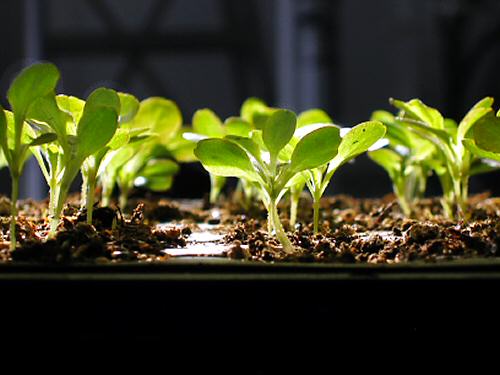
The year’s first lettuce is beginning to put on its true leaves. Here, Granada that will turn an intense burgundy, is just barely showing a tinge of red around the edges. The seedlings are still looking sharp: stocky and upright. Under the relatively weak fluorescents, they’ll inevitably stretch, but that’s OK, it’s…expected. Mid-February and it’s quiet and calm around here, the spring rush remains just around the corner, there’s still plenty of time to stop and gaze at the seedlings…
First cuts
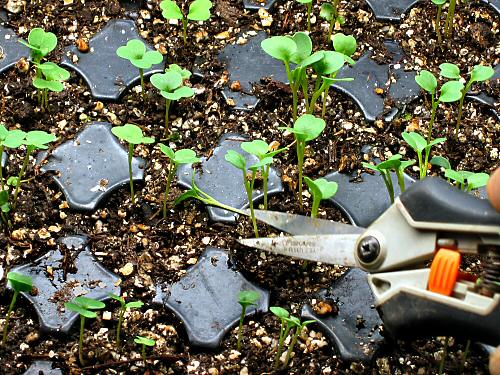
Time to thin out the lettuce and arugula. Between the seven varieties, some of the seed I used was up to four years old, so to be safe, I was quite generous, maybe 4-5 seeds per cell for the arugula, and a bit more for the lettuce (that tiny seed can get away from you, though with new seed, I try to go lighter). Germination was good, and the little seedlings are already shading out each other as they push for the light. I’m still getting used to timely, to-the-point thinning, both in the trays and in the field. I usually have the urge to leave ’em a while longer, but almost always, this ends up being not the best thing to’ve done. Give the best ones the biggest break as early on as possible, which means, kill off the rest. This also takes some timing experience, but in general, it’s hard to go wrong by not waiting around. Sounds brutal, but that’s about it! The lettuce will eventually be one per cell, although for now I’ll leave a couple per. Starting arugula indoors is a first for me, I usually direct-seed, so I’m figuring things out this time around. I’ll leave two per cell, and plant them out two together at 6″ (15cm) spacing and see how that works out. Here, I’m snipping arugula at the soil level with wickedly pointy little shears…
Arugula emerges
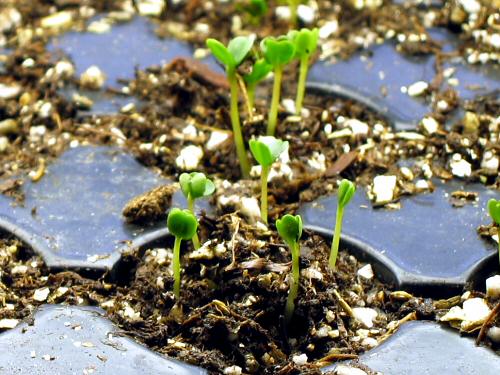
That was quick! Early morning, and the arugula (and Granada lettuce) has popped up in barely two days. Air temperature in the Milkhouse where the grow racks are stays mostly in the 60-65°F (15-17°C) range. Around the plugsheets, the close fluorescents warm things up an extra 5°F or so, and the clear plastic over the trays creates a little greenhouse effect that adds at least a couple more degrees. Altogether, ideal germination temperature! It’s kinda fun to think you’re in control of precisely what’s going on, but in any case, however they pulled it off, the first seedlings of the year are good to see! :)