
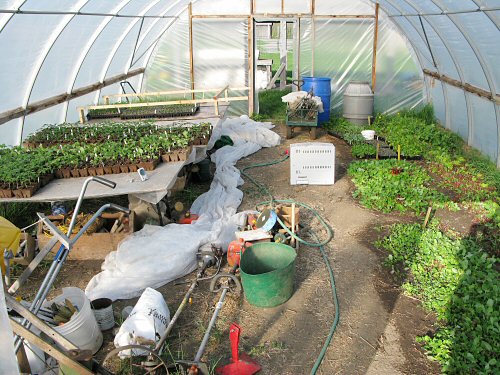
Moved the first wave of tender seedlings—100 tomatoes, plus eggplant and sweet peppers—to the greenhouse yesterday, with zero (32°F) predicted for the overnight. There’s just no more waiting, with all of the light space in the Milkhouse…taken. It’s a long way from the ambitious barely-heated greenhouse plan of February, but there’s row cover, and the new KeroWorld heater is ready for action (it’s the white box in the middle)… That’s how some plans go when you’re dealing with the WEATHER. Elsewhere in the hoophouse, I’ve let the early lettuce and mesclun blend with volunteer lettuce and arugula from last year’s early stuff going to seed. It’s unruly, tasty, and growing fast. I don’t know how much of it will make it to the farmers’ market: since there’s too much to do around here, I’m not aiming to go extra early this year (yesterday was the first market day), but one way or another, the greenhouse greens will get eaten!
lettuce
This year’s early lettuce…
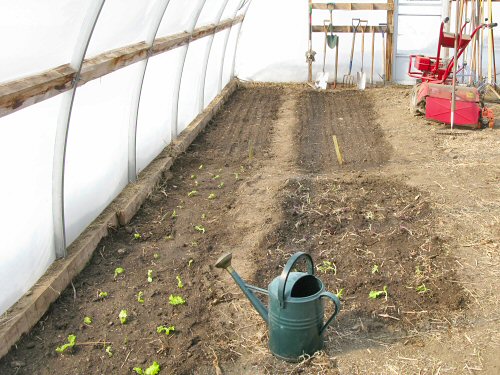
The end-of-March scene in the greenhouse is a lot different than last year, when the growing area was neatly filled with early lettuce. This time around, the early effort has turned into a much more spotty affair. The lettuce started WAY early at the end of January, and held back because of extreme cold earlier in the month, grew and REALLY stretched in the trays, and I only put about half in the ground, just to see what’ll happen. Filling in, there are a couple of beds of direct-seeded, all-lettuce mesclun. The idea of making it to the first market day (this year, it’s Saturday, May 3) is fine if everything else is humming along, but given the slow-leaving winter this year, chances are I’d rather be in the field or doing some other outdoor stuff on the farm at that point than spending a good part of a May day at market with a small quantity of greens, just for show. With this year’s early lettuce and the weather, I’m no longer in such a rush!
New gardener
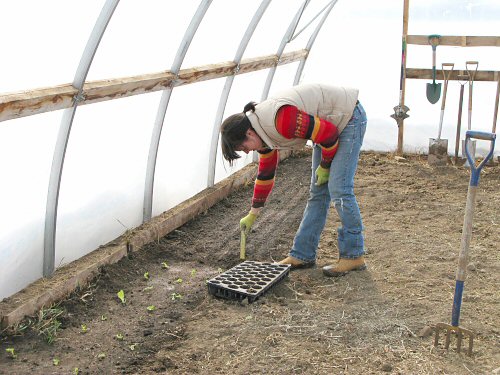
Hannah dropped by today to check things out. She’d gotten in touch through the farm web site, wanted to volunteer for a day or two every week through the season, to learn about small-scale farming and how to grow stuff. No garden experience. We spoke briefly on the phone, but the only way to see is to meet in the field and get hands dirty! It’s amazing how easily people can take to tiny farming when given the chance to dive in. So, a quick tour, and then, to work. She weeded, forked and raked a bed in the greenhouse, transplanted a couple of dozen lettuce, seeded a bed of all-lettuce mesclun using the Earthway seeder (tightly spaced rows), tried out the mini-cultivator (a rototiller attachment on a heavy duty weed eater), drove the Kubota compact tractor and worked the bucket on a big snow bank, trimmed a couple of trays of onion seedlings, checked out the production standards and paperwork for organic certification, and seemed fine with my mildly intense stream of background info and general microfarming explanation. All in three hours. Everything for the first time. She did great, no problem! Just as important, at least for this tiny farm, she seemed to have FUN, had a cool energy, and didn’t make me WONDER when handling machinery, tools and plants! After last year’s great crew, standards are pretty high. Will this season of people in the field go as well or even better? There’s no real advertising or recruiting plan, I’m trusting that, through general word of mouth (and maybe, good karmic energy!), things will…pleasantly unfold. We shall see!
Plugging away in the greenhouse

Taking advantage of the cloudy weather, I moved all of the lettuce out to the greenhouse for some rapid hardening off, and started prepping more ground for transplanting. At the edges, there’s lots of dead grass, and I’ve already pulled out a fair tangle of well-established live grass runners. The grass grows in from outside; the runners are incredibly busy and invasive, and can build up underground and, from what I’ve seen, seem able to noticeably sap resources from the plants above, even when the grass itself hasn’t broken through. This is an observation in progress (more on this later as I prep the field with its grassy paths). For now, I’m slicing deep with an edger right by the boards (if I get the chance sometime during the year, I’ll clear a grass-free strip around the outside of the hoophouse). Anyhow, lettuce will soon be in!
Seasonal salad
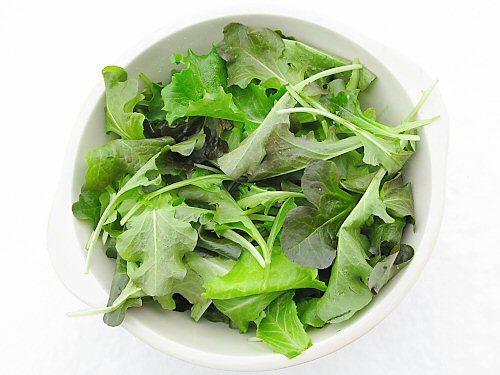
The first harvested dish of the year here usually comes from early lettuce, but not usually from lettuce still in plug sheets. With my ambitious early salad greens timing, and the way colder than hoped for weather, transplanting to the greenhouse was delayed by a couple of weeks, and the lettuce seedlings stayed in trays and went crazy. Today, I started thinning them heavily for the move, and ended up with a healthy portion of baby leaf salad! This is a mix of Simpson Elite, Granada, and Two Stars. The colors are still indoors pale, the taste and texture delicate. With a simple olive oil and lemon juice, salt and pepper dressing…delicious! And still a couple more bowls to go…
Making water
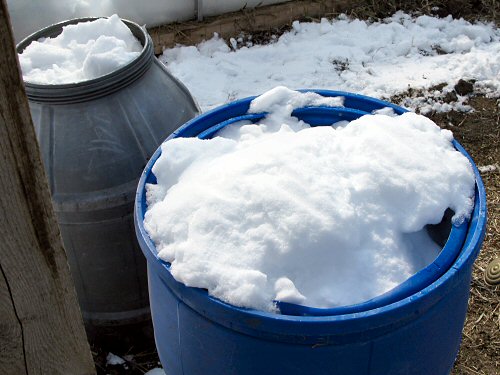
As far as winter irrigation in the greenhouse goes, melting snow in big barrels is the next best thing to a really long hose, a well and an electric pump. Fill ’em up, cover with clear plastic, wait a day (even on a dull, cloudy day, it gets up to 60°F in the hoophouse). Repeat a couple of times, and you have 50 gallons of rainwater in a barrel! The alternative is dragging 200′ of hose through deep snow from the barn to the greenhouse, then reeling it in and draining it, every couple of days. The weather has put the kibosh on the early-March, barely heated greenhouse plan, the happy prospect until March actually came around. The nights have been regularly plunging to 10°F (-12°C), so it’s really not worthwhile to heat things up by 25°F. No worries. Adjusting expectations and schedules more or less by the day is all part of the fun… It’s never boring!
More fun with lettuce
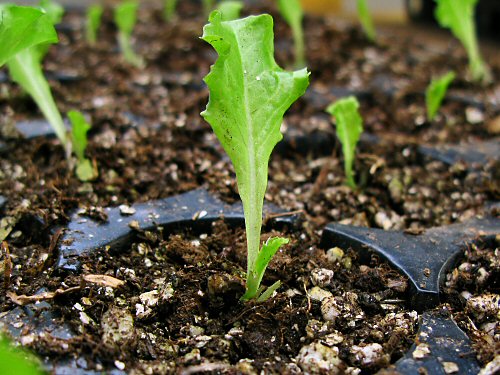
Some of the early lettuce I ended up leaving two to a cell, to see how they’d do. Now, I divided a bunch of those and potted them up singly to a much roomier 38-cell plug sheet (up from 72), and trimmed off all their leaves (and ate them). After the shock of transplanting straight from indoors to the greenhouse, the lettuce seedlings usually lose their bigger leaves anyway, so why not give them a head start?! It’s extremely time-consuming, all of this careful repotting and trimming—not practical for the market garden at all. But I know I’ll be closely watching the results of this early, cold-hoophouse planting, so I’ll see if they do better than the regular plugs. Later on in the season, I intend to keep experimenting in more practical ways, but time and many other things to do have their way with the best laid plans… (Hint: As a rule, it’s best to start seedlings in the biggest and DEEPEST container that you have room for in good light, and avoid potting up. The less you disturb roots, and the more room you give them to grow (especially, down), the better they seem to do when transplanted.)