
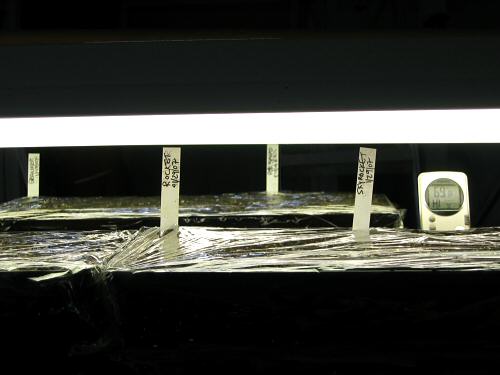
Started the first seeds of the year today: lettuce and arugula. At night, the grow racks remind me of a lab experiment, with the plugsheets in trays, carefully labelled and sheathed in plastic under the intense white light (fluorescents up close are pretty bright). And there’s the digital min/max thermometer, keeping score. The whole set-up looks like what it is. It’s great! In the beginning, I kind of obsessively (and largely unnecessarily) check every few hours to make sure the soil mix is sufficiently moist, the temperature is above 60°F, to see if anything’s emerged and it’s time to take off the plastic. Maybe after another five or 10 years, it will become simply routine, but for now, every single plant to emerge is still cool and exciting… For this, the earliest lettuce attempt yet, I’ve started five varieties, all with maturity dates of 50 days or less. There’s Simpson Elite (a really fast 40-day) and Two Stars, both green leaf, Granada and Red Salad Bowl, both red, and Sierra, which is red tinged. As a salad mix in any combination or all together, they’re a great blend of colors, textures and tastes. The arugula, Rocket and Skyrocket, intended for the mix, is faster growing than lettuce, but I felt like starting some now (I’ll start some more, later). If all goes well, these will hit the unheated greenhouse in the beginning of March, a good three weeks ahead of last year!
lettuce
Grow lights, on!
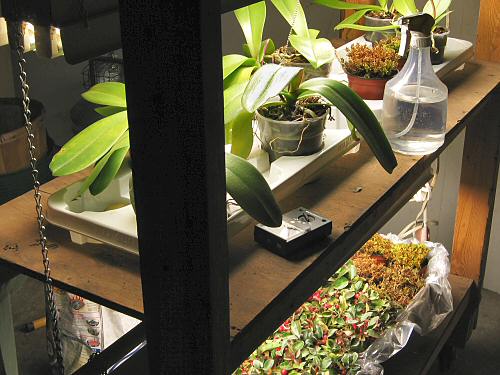
Grow rack lights went on today for the first time this season. They’re only for the rescued houseplants (orchids, wintergreen, heather)—I guess every plant deserves a place in the sun—but, I’ll be starting super-early lettuce soon, a month earlier than ever, for an experiment in planting them out to the greenhouse at the beginning of March. Getting the grow racks ready is another familiar routine. In early summer, I remove the fluorescent light fixtures and the chains and dowels they hang from and store ’em somewhere (last year, it was on the new Big Shelf). For spring, I dust them off, wipe them down, hang them, and a new seedling season begins!
The seed…
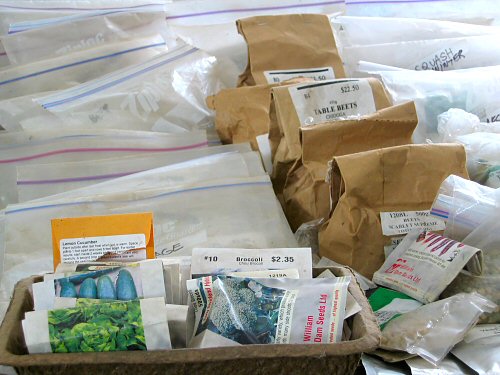
Keeping up with the early start, I got out the seed from its storage chest to take a look. With the tiny farm’s growing HISTORY (hey, Year 6, coming up!), keeping the seeds sorted for freshness is an ever more…serious consideration. Old seed won’t work, and there’s always lots of carryover from year to year. For this garden’s veggie selection, seed life in cool, dry storage conditions falls into three categories: nice and long (around 5 years, for brassicas, cucumber/squash family, lettuce, tomatoes,…), medium (around 3 years: beans, peas, carrots,…), and SHORT (1-2 years, for onions, corn, parsnip, parsley,…not too many here). Luckily, this is all book info, not gathered from painful personal experience! But I listen closely, ’cause one of my biggest garden nightmares is THINGS NOT GERMINATING… There are enough reasons why gazing happily on those newly seeded, semi-straight rows might be the greatest satisfaction they ever offer, and dead seed shouldn’t be one of ’em. My first germination test last year seemed to bear out the wisdom of others: normally-stored seed is not forever… So, it’s checking packs and taking dates!
Mesclun on my mind
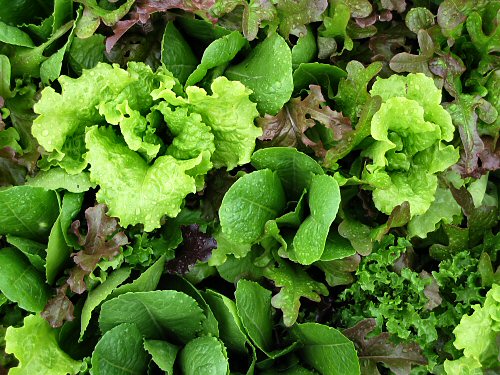
Mesclun remains the mainstay crop on this tiny farm. What I grow is perhaps not strictly “mesclun”, it’s nine varieties of lettuce with no other, more exotic greens—arugula, mizuna, and so forth—mixed in. Also, at times if it gets away a bit, the leaves can be kinda large, making it more of a basic salad mix. Still, it’s all mesclun around here, and this year particularly, we’ve grown LOTS. Salads are popular, and for no reason easily explained, the acceptable price at our farmers’ market is way higher than for any other crop (except, perhaps, blueberries?!). It’s a top seller on market day, it’s dead easy to grow, most of the time, and none of the other, larger local growers bother with it (only one other farm regularly has lettuce). So it’s an all-around winner. Then there’s the big BUT: hot, dry mid-summer weather, when the germination rate is usually terrible, the beds grow rapidly and are hard to time, and the heat can easily turn a fine, fresh-tasting crop into a messier, partially bolted bit of a nightmare. Simply seeding in many extra beds isn’t a solution, because the watering and weeding this would require would be insane. You simply have to keep planting moderately and frequently, and hope for nice weather breaks. Shortages are inevitable, and cut directly into customer satisfaction (expectations, expectations!!). For these reasons, at this time of year, mesclun is always on my mind. For the last couple of plantings, we’ve used…BURLAP for the first few days after seeding, which actually works, reducing watering in time and increasing the germination rate quite a bit. Next year, I intend to finally figure out an even better way…
Packing station
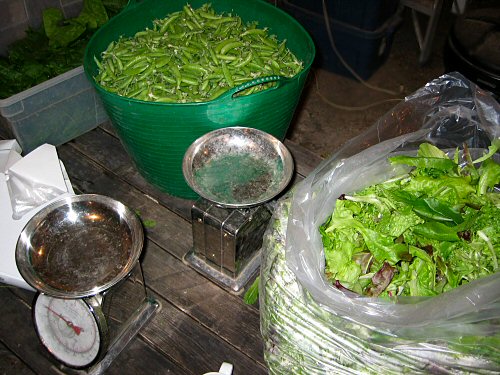
The post-harvest is a simple, straightforward process that has to be done fast since we don’t have a cooler. The set-up is manual and basic. Today, we packed indoors to get out of a stiff breeze that would’ve taken the salad greens sailing (usually, we do everything outside, in the shade of the barn; the indoor option is part of the new luxury of the Extended Milkhouse). There are a couple of 2 kg kitchen scales for the snap peas and lettuce mix. Everything is sold by bunch and bag, not weight, but the scales are useful for keeping things consistent. It’s quite easy to get the right amount by eye, so it’s into plastic bags and pop onto the scale for a quick check. If it’s underweight, add more, otherwise, somewhat over is just fine!
Evening harvest
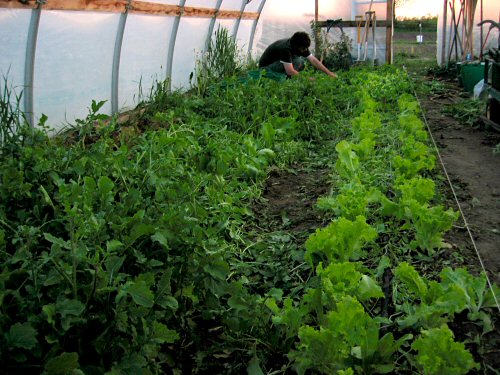
In the greenhouse, harvesting in the first and last couple of hours of the day is the only way to ensure tasty salad greens. Daytime harvest is near futile, as the leaves go limp and require serious rehydration. In the chilly evening weather, plants perk up, and it’s all right as rain! Here, cutting greens in the evening before market means clearing the arugula that bolted during the week and rapidly buried the lettuce. Out of arugula chaos comes delicious, garden-fresh salad mix! (On the tomato front, yesterday’s field transplants did well, only a few leaf burns where they touched the cover, this despite quite a hard frost. That’s good.)
Rabbit food
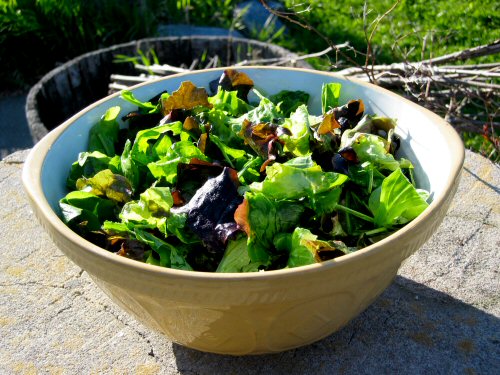
Around here, there is a definite segment of the population for whom salad greens, while accepted as possibly “good” for you, are not really considered proper human food. I might even think it’s an old school, meat-and-potatoes farmer thing, though I haven’t chatted with enough farmers to…generalize. In any case, I’m an all-new first generation farmer and to me, salads are great! This is the first dinner salad harvested this year, picked from the early lettuce aisles. It’s a mix of arugula and four lettuces: Simpson Elite, Granada, Red Salad Bowl, and Sierra, each with its own color, texture and flavor. Lots of fresh veggie variety is an excellent concept. :) Tastes good, too!