
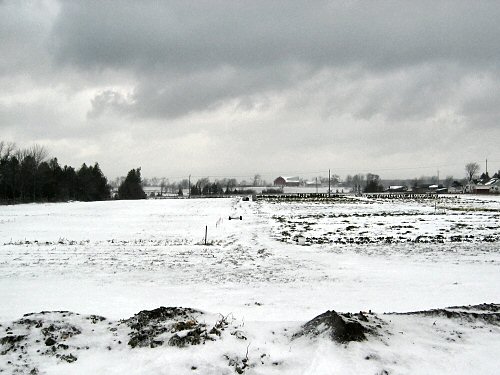
OK, so this garden is really over for the season! Called due to extremely cold, snowy conditions that don’t seem likely to let up any time soon. I’d been counting on one more melt-off, but it’s only been freezing cold and more snow since the fall that covered it all eight days ago. And there’s no let-up in the 15-day forecast… So, I got caught out a bit. There are still carrots under there, that I might not see until spring, and I didn’t finish mulching the garlic (I think I was unconsciously pushing for a side-by-side test of mulch and no mulch, against prudent practice, and now I have one—it will be interesting…). The big experiment (and possibly, gamble) is with leaving the green manure cover crops—oats, rye—over winter, to be tilled in in spring. In the pic, you can see it’s smooth to the left of the main path, and rough on the right (at the very bottom is the composting windrow where the last of the leftovers go). The left side (plus eight sections across the north end, out of sight at the top) is fully prepped and ready to seed as soon as the ground dries out in spring (peas first!). To the right, I’ll have to wait until it’s dry enough to till with the Kubota compact tractor—determined by the weather, this could hold me back a couple of weeks. Or more. After that, again weather-dependent, there’s the minimum wait of a week or two after tilling for the cover crops to break down. But, with two-thirds of the field ready, however the weather goes, it’ll be fine!
mulch
Buckets of snow
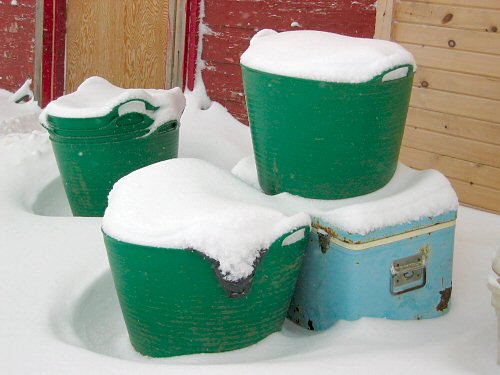
Woke up to a world of snow. Unlike the heavy dusting a few days ago, this was a serious snowfall, looked like 5-6″ (12.5-15 cm). This will stick around for a while. I didn’t finish mulching the garlic, and there are still carrots out there, but no worries, I’m SURE it’ll melt off in the next week or two, and meanwhile, snow is a great insulating mulch!
The goats have no problem with snow. It’s eating and looking out as usual!
Spreading grass mulch
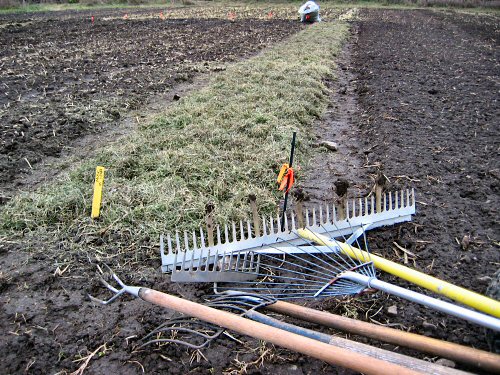
Today, I took advantage of a one-day reprieve from the cold—it was a pleasant 9°C (48°F)—to test the new grass-alfalfa mulch on a bed of garlic. I suspected spreading the light, loosely clumped mix would be more of a chore than tossing around straw, and it was. I first tried dumping it out, but the big clumps took forever to break up and spread, so I switched to pulling it apart by hand. The large bags of mulch weigh next to nothing, so that wasn’t hard, but you wouldn’t want to do it in the wind. Next, spreading it evenly. This proved to be a bit of a puzzle. I started with a hay rake, with three widely spaced tines, but this just slid through the grass, not catching enough to move it around. Out came an unlikely array of other hand tools to try: the compost fork (dark tines, right at the bottom of the pic), the 3-tine cultivator, a regular rake, and a leaf rake with round tines (the wide landscape rake was for marking rows in another bed). None of these worked well. Closely-spaced tines caught too much and cleared areas rather than covering them. I eventually used a combo of the 3-tine cultivator to break up the clumps, then skimming with the small rake to even it out. The results were pretty good, with a fluffy 2-3″ layer down the 50′. But it was delicate, picky work as the grass is very light. There are five more beds to go to refine my method (basically, figure out a better way)! I also planted a final 50’x5-row bed, using up the last of my seed reserve, bringing the garlic total to about 3,000…
Cleaning up
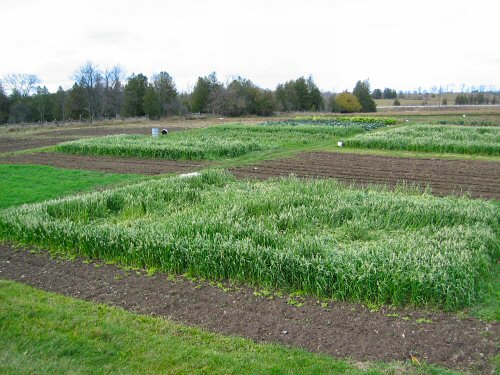
Here’s a look to the north from my new favorite photo spot, on top of the farm stand. We’re down to mainly brassicas, oats and rye (that’s the low, darker green section poking in on the left). The oats has started to die off and topple over, leaving collapsed areas that look as if animals had bedded down… The days lately have mainly been overcast and quite cold, just above 0°F, with a fair bit of rain that leaves the ground mucky. My hours a day spent in the field are winding down, a two or three hour job at a time, weather permitting. Elsewhere, there’s lots of putting in order and stowing away, and clean-up in the Extended Milkhouse where all kinds of junk accumulates over the year. Getting set for winter.
Turn to the left and here’s the view over the greenhouse. The grass-alfalfa mulch is still inside, along with stacked rolls of row cover.
The new year begins here!
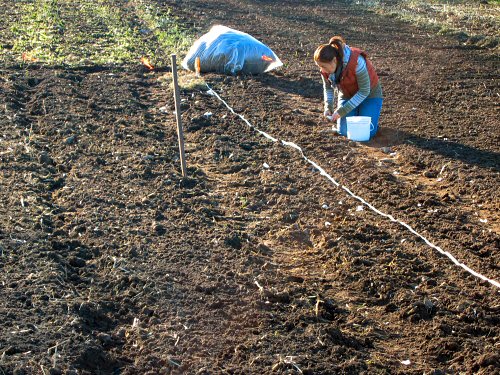
A perfect moment in tiny farming time as the first garlic goes in for next season’s harvest! It’s all Music (that’s the hardneck variety), and for the first time it’s 100% my own seed stock (last year, I had to buy some to add to what was set aside). The new garlic plot should be the best so far, with oats green manure and year old cow manure tilled in. Lynn and Conall dropped by to help. The row set-up is new. Previously, I’d done two double rows per 5′ (1.5m) bed, each double row spaced 6″ (15cm) in-row and between, with about 18″ (46cm) between the doubles. This year, a more intensive approach: five rows with 6″ spacing both ways, in a 4′ (1.2m) bed. What does all that mean? 500 garlic in 4’x50′ instead of 400 in 5’x50′. It should make mulching, watering and weeding that much easier! I tilled up the bed a couple of days ago to allow pushing in the cloves by hand (the moist, clayey soil gets pretty dense this time of year). The rows were marked out (you can just make out the lines in the soil), and we ran a measuring tape down the beds for quick checks on the in-row spacing, ’cause I’m a little concerned with crowding. They were planted about 4″ deep, from both sides, three and two rows, to avoid uncomfortable leaning (the greens machine was a little too narrow!). Afterwards, the beds were raked to fill in the holes. In the pic, there’s a bag of that new mulch, ready to go (although I ended up not spreading it today). The first 2,000 went in in three hours. I’ll add some more, another 500-1,000, a little later on!
Making mulch, part 4
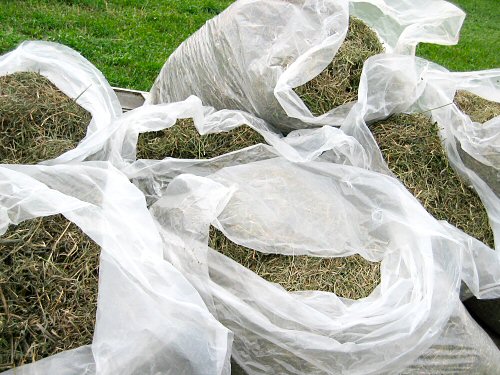
Fat bags of kinda fluffy grass-and-alfalfa mulch are the satisfying end of this little experiment (well, the real end comes next spring when we see how it does at sheltering the garlic for the winter). For this second batch, the bags are actually step 2, not part 4: I eliminated the greenhouse drying stage by letting the cut dry in the field and bagging it on the spot (which was always the plan—cut, wait, bag—the first time was just a bad weather thing). A small but to me really satisfying part is reusing those big clear leaf bags. We go through at least three or four new ones almost every week of the market season, for fresh cut spinach, mesclun, and other greens. They’re used once, and then I’ve been saving them for the last three years for JUST THIS PURPOSE! It’s great to see your plans materialize, right before your eyes!! Little things, big pleasure…
Making mulch, part 3
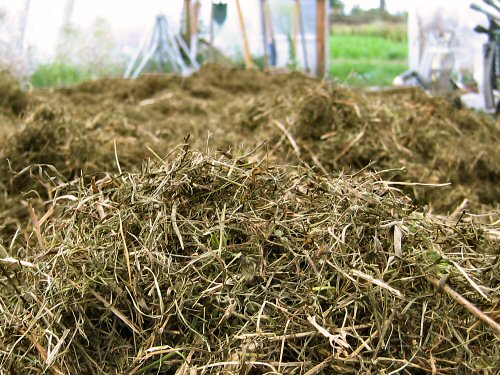
The grass and alfalfa mix spread in the greenhouse a few days ago is drying nicely—it’s almost done! It was a tad touch and go at first, the rows in the field were starting to turn black and decompose, and no sun in sight. So I turned it a couple of times a day for the first couple of days, doors wide open on both ends let through lots of air…and things worked out! Seems like a nice mix, with good bulk, not too fine. Then again, my mulch experience is in its early days, so we’ll see. Rough calculation: there should be enough to spread a fluffy 3″ (7.5 cm) over the new garlic plot. This experiment so far: not too labor-intensive, room for easy improvement to the process, seems like it would scale well (for covering larger areas), and RELAXING (some fieldwork is particularly enjoyable)… Grass-and-alfalfa mulch may have a big tiny farm future!