
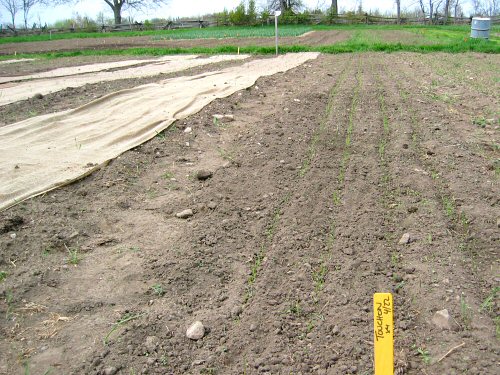
The carrot germination experiment worked like a…charm! They were coming up pretty good three days ago, conditions looked great under there (moist, airy, seedlings nice and green), so I left the burlap on a while longer to push the germination rate a bit more, and that worked as well. This bed just had a 10-minute clean-up of some grass and dandelion, and I test cultivated a few feet at this end for smaller weeds getting started. With the moist soil, it’s all easy. Now it’s off with the rest of the covers and time for a little irrigated rain (since Ma Nature is presently not obliging). Excellent!
weeding
Lettuce, peanut butter and mice
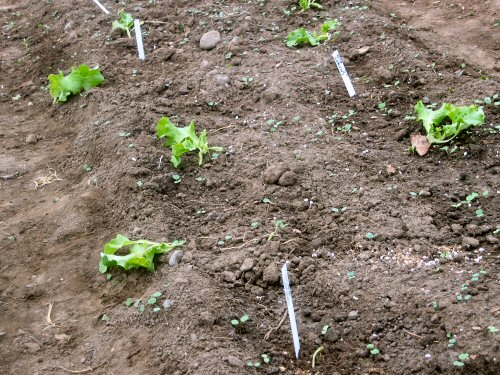
Day Two of lettuce under siege. The enterprising field mice were back overnight, munching down another half dozen seedlings (by the angled bite where the stems were severed I’m pretty sure it’s mice). I stuck in white markers yesterday to mark the spots, so it would be easy to see if they’d come back for more. This time, instead of eating them or dragging them off, they just left ’em lying there. That’s plain rude. Anyhow, they’ve had their tithe, a tenth of the early lettuce. I’m all for live and let live, but if it’s them or the lettuce killed for sport, well, it’s out with the peanut butter and mouse trap surprise. (The little emerging seedlings scattered around are from some of last year’s early lettuce left to go to seed…the crop becomes its own weed!)
Checking on the garlic
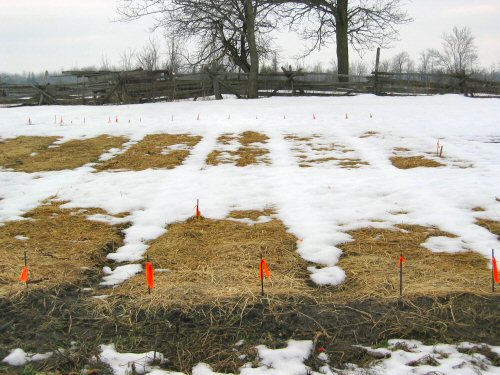
Today was the first walk around of the field of the year! The ground is still mostly frozen, but some spots have melted into a thick clayey muck that’ll take a while to dry out. So, you stick to the hard spots. Here, the fall-planted garlic beds are showing up. The row markers are there to prevent tilling accidents. The straw mulch is supposed to protect the cloves from heaving up during any quick freezing and thawing, by evening out the soil temperature (I doubt that would happen in this soil, it’s a just-in-case). The mulch does keep down weeds and hold in moisture during the spring and early summer, which alone is worth it. Garlic will be the first in-field veggie greenery of the season…if all has gone well.
Volunteers prep greenhouse!
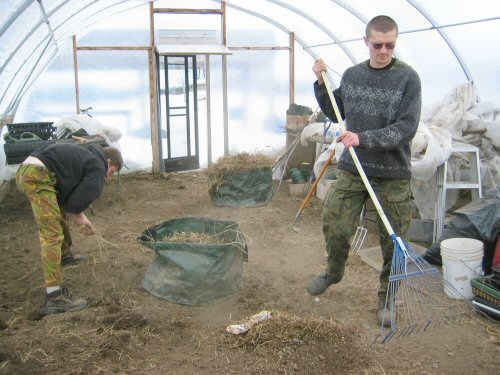
Looking a tad paramilitary, brothers I met at the market (they’re studying at the nearby environmental/forestry college) pitch in to clean out the greenhouse and loosen up the soil. The space, used for seedlings in spring and early summer, tends to fill up with odds and ends, and weeds, as the season progresses. Last spring, I tried growing early lettuce in here to get a jump on the weather. This year, an even earlier start is planned. Getting the place sorted and ready to go ahead of sked is great. On the tiny farm, nothing could be better for fieldwork than plentiful, like-minded labor. Especially, volunteers!
Beets and competition
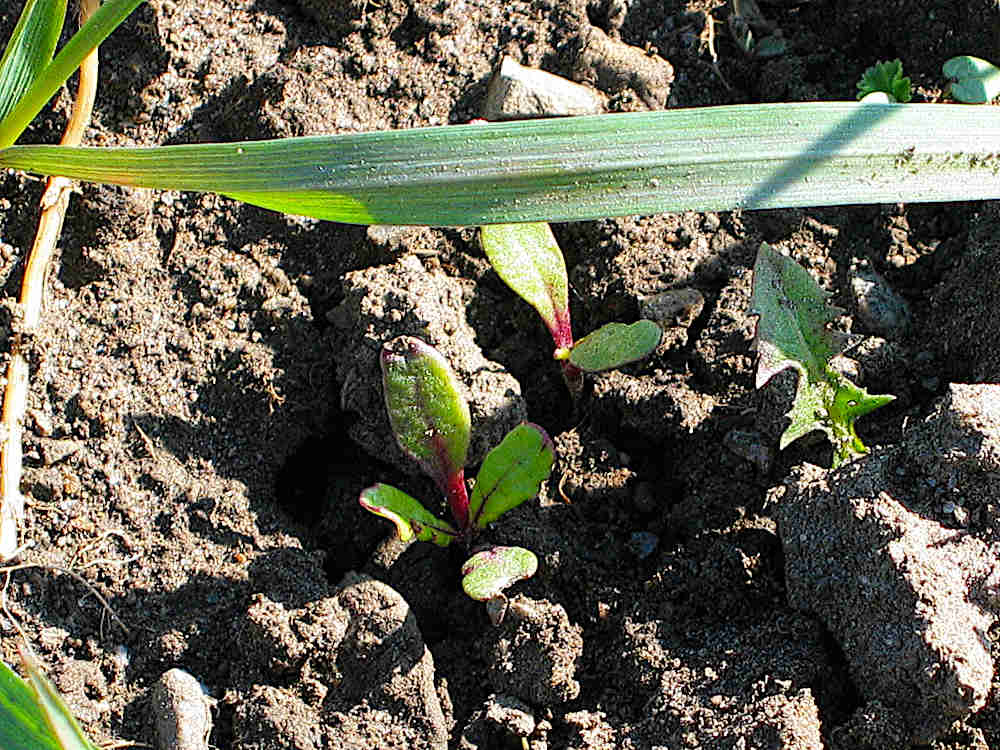
In the real world of this organic field, it’s not all close-up beauty shots of picture-perfect seedlings growing into pristine vegetables all in a row. Competition is the order of the day. Here, a couple of beet seedlings are surrounded by grass, dandelion, and round-leaf mallow (peeking out from behind the grass in the top right corner). It’s a motley assortment of weeds competing for water, food and even the sun (observe the grass shading out the baby beets). We call them weeds when we don’t want them to be there, yet they’re the ones perfectly suited to the conditions and able to grow fast. It can be a pitched battle when you’re not rooting for Nature to take its course!
Grass…
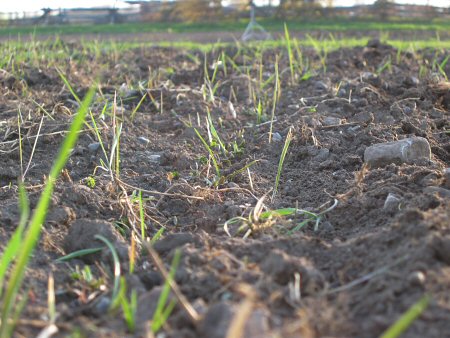
Grass is the worst weed, once it takes hold. It depends on the bed, what was in before, and how well it was cleaned up. The runners take off all over the place, and simply chopping off the blades is no guarantee that it’s gone. Pulling up longer runners works, but that can also dislodge tiny seedlings, and is incredibly time-consuming, labor-intensive. Oh well…
Thin green lines
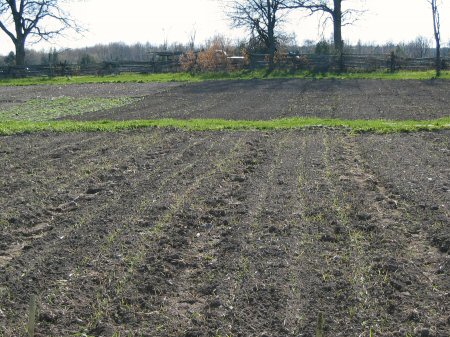
Notice those lovely, hazy green lines. The first signs of direct seeded crops is always on your mind. You can’t cultivate the soil for weeds until you know where your veggies are. If germination is slow—because of cool weather, dry conditions, or both—the weeds can easily get ahead of you before you’ve seen anything at all.