Working the new potatoes

Another installment in the crazily labor-intensive tiny farming techniques series: Andie and Jordan in action, hand-digging for new potatoes without uprooting the plants! This one is hard to top for stunningly low hours-to-yield ratio. It makes picking peas and beans seem like something that goes by quick. Of course, for all its slowness, it has its rewards: beautiful little, amazingly fresh and tasty, new potatoes…and the plants still get to grow some more! Plus, if you don’t have to do it forever, it’s a lot of fun…

The “technique” is simple (and well-suited to the home veggie garden, but not too scalable). Gently feel around the base of the plant for anything that’s golf ball-sized or bigger (this batch is golf ball to XL egg). Stick to the surface, don’t dig too deep, and try not to break the single roots connected to other, littler, potatoes (you’ll easily feel the stringy roots). When you’re done, hill up the earth you’ve moved aside, and it’s on to the next one. That’s our method. ;)

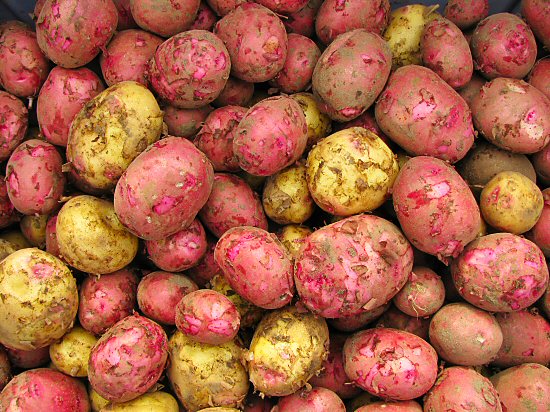
Yield today was pretty good, about 2-3 per plant, and about 40 lbs (18kg) in all. Won’t go into the time per plant and the weight per tater…because I didn’t. Maybe a peaceful hour or so, with three people. We only did this for a CSA share treat, because today it worked out that we had the time. There are red skin/white flesh Chieftan, and yellow-flesh, Yukon Gold-like Penta.

The only downside to the hand scrabbling method: the delicious, delicate skins get quite roughed up. We’ll soon start pulling whole plants for young potatoes, and that tends to leave the skins in better shape (and goes MUCH faster).

Anyhow, slow food, for sure. Tasty!
Weighing chickens

Weighing chickens

Booked a chicken processing date today: slaughterhouse day is July 29. They’ve been looking good all along, but now the White Rocks seem mighty…tasty. I keep remembering one of them hurrying by with a long worm trailing from his beak, then gulping it down. The last batch got nothing but feed. These guys have foraged for a varied diet, literally free-ranging (no fence!) for most of their lives. Feed plus bugs, plants, and whatnot. Should be a delicious combo.
 
On this, only my second flock of meat birds, I’ve noticed a new feeling for food animals. The first round was a novelty and a learning experience, now, it’s a comfortable routine. I observe the chickens with appreciation. I like them. I talk to them (although, not about much), hang out with them when I have time. I size them up as soon-to-be FOOD as I look out for their comfort, well-being and cheerfulness every day. There’s no pet-based sentimentality, instead I am grateful. The I-raise-you-then-eat-you feeling may sound harsh, but it feels…natural.
 
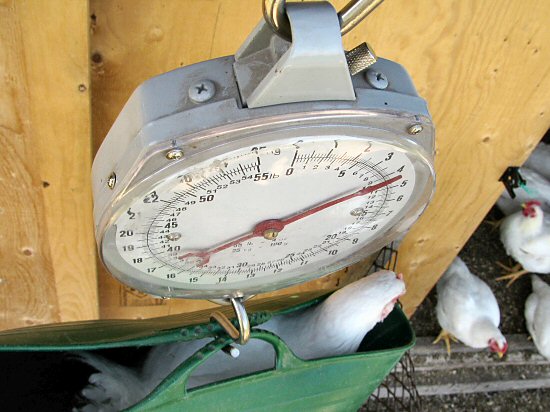
Weighed a few for the first time today, using a hanging scale and a trug (flexible plastic utility bucket). This can-do set-up works fine for spot checks. With the handles pulled together, the top of the trug is pretty well closed, so the chicken inside tends to sit still for a while before starting to look around…
 
At 9 weeks, most of them are around 7-8 lbs (3.6 kg). About 6-8 of the 39, like the one in the pic, are a little smaller. They’re around 6 lbs (if you’re checking the scale in the pic, the outer number is kgs, inner is lbs, and the trug = 2 lbs). All things considered, that seems good! According to the hatchery catalog, the White Rock average is 6.3 lbs (2.7 kg) at 7 weeks. I assume that’s with confinement and unlimited feed. These guys are out and about, exercising, and I let the feeders empty for 4-5 hours every day. The lighter weight seems to make sense. A couple more weeks and they should be White-Rock-plump, still healthy and happy, and…supertasty!

Carrot-burlap method gets a twist

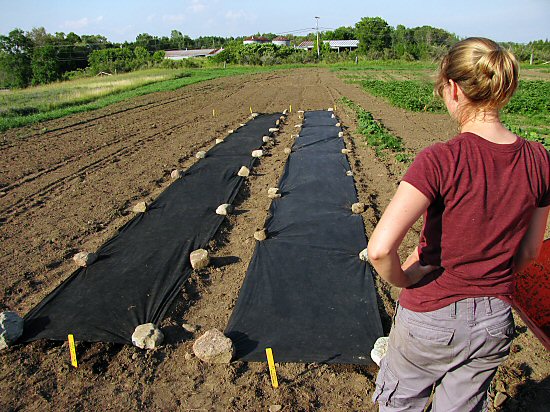
Here’s one of the more extreme displays of crazily labor-intensive tiny farming technique. Andie surveys our work, the result of deciding to try landscape fabric in place of burlap to help carrot seed germination. It’s actually a double experiment, because one of the beds is green onions.

The burlap method has been the way to start carrots around here for the last two seasons: tried and true. The main purpose is to preserve moisture in the seed drills, and the increase in heat helps as well.

After a good run, the first round of burlap expired, and I couldn’t find rolls of it in time for this season (I know it’s out there, somewhere). But, I spotted this gear, landscape fabric, a porous plastic mulch used to permanently suppress weeds in…landscaping. It’s light, and just wide enough (3’/30 cm) to cover 4 rows of carrots (that’s a little closer than usual for the bunching onions). I tried it on two beds earlier in the season, and it works fine!

One little problem: it tears easily, so how to hold it down? With the burlap, we made wire staples out of heavy gauge wire. Here, we placed a LOT of heavy rocks, close enough together that there’s no room for the wind to get under and start really pulling. This does the trick for now, but overall, it’s a little TOO intense. The hunt for burlap: still on!

Chickens: ranging too far

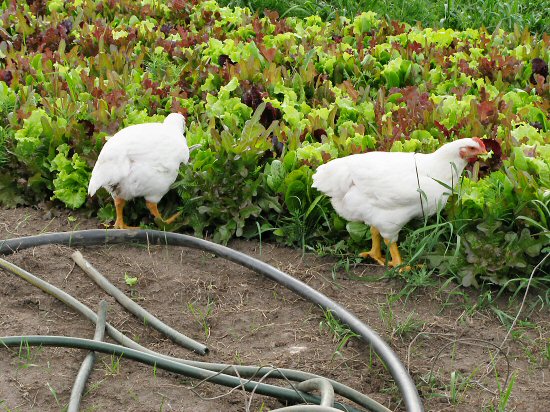
These guys, the White Rock Cornish X meat birds, have free-ranged too far, making it to the edge of the veggie garden in the big field. Luckily, although it looks good in the photo, this all-lettuce mesclun is done, cut at least twice and now too full of damaged and crowded, stretched leaves to make harvesting for market worthwhile. So, the chickens are actually putting it to good use. But  of course, they won’t stop here.

So far, they’ve been completely free to roam during the day. I count and shut ’em in out of harm’s way at night, and pop open the door soon after sunrise. If they found farm life dull, they could hit the road and head to town, just like that. Instead, they tend to wander further from home bit by bit.

I’ve been watching their circle of foraging territory gradually expand away from the chickenhouse. A few advance scouts lead the way, sometimes alone, or in twos or threes. Eventually, over a couple of days, more follow. It’s fun to watch the process, and they seem to appreciate the freedom (since they use it), but it’s still three weeks to Processing Day, and they’ll keep on exploring right into the garden. Time for some fencing action…

(In front, pieces of old hose and water pipe are being sorted out on a clear patch of ground.)

Another rainbow

It’s almost “yet another rainbow,” but not quite. We’ve seen a good collection so far this season, including quite spectacular horizon-to-horizon double rainbows two nights in a row. Which means there’s been lots of rain, and all the cloudiness that goes with it. It’s nowhere near as miserably wet as last season, though—rainfall this year has actually been great, averaging around the golden inch-a-week (2.5cm-a-week)—but 4-5 mainly cloudy days out of 7 is slowing things down.

How slow? The first summer squash that should’ve popped in size in a few sunny days, has been slowly expanding for well over a week. Root crops like beets, carrots, potatoes, aren’t affected as much, and seem to love the rain. But toms, peppers, eggplant and the whole cucurbit family (squash, melons, cucumber) are in slow motion, maybe a week or two from where they’d be with lots of sun.

Still, all in all, everything is growing along well enough, and we’re bound to hit a sunny stretch. Right?

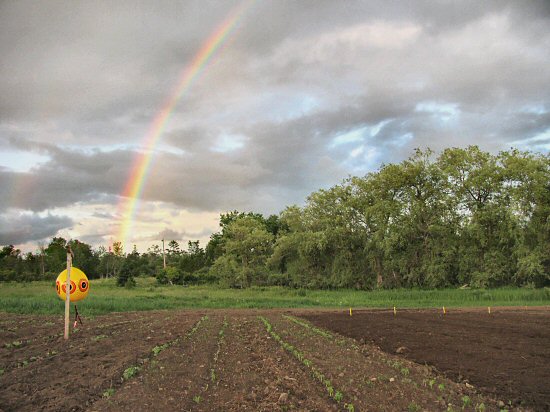
In the photo, a third planting of green and yellow snap beans, with scare ball in place to scare off birds (it seems to work). To the right, a freshly tilled section, waiting for a third planting of spinach… This weather’s great for summer spinach!

Early season harvest day

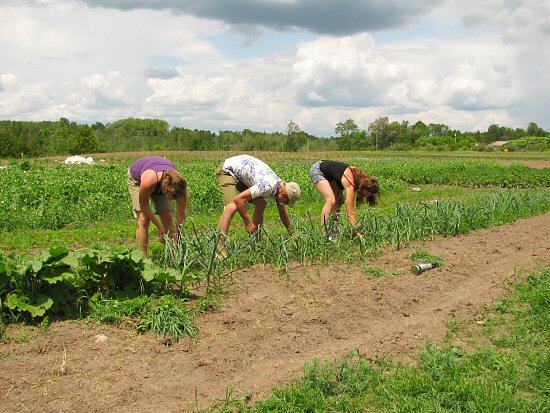
It’s a harvest Friday, second for the farmers’ market, and first for CSA, but the load is still light. After picking snap peas, we spent the day doing other field work. In the photo, Libby, Jordan and Michelle are hand-weeding the small strip of spring-planted garlic, and we spent some labor-intensive time thinning a 400′ (122m) of carrots, and several beds of beets (the thinnings were the beet greens harvest). In late afternoon, time to cut greens: spinach and mesclun. Plus a little parsley.

Checking back over the last four years, at this time, we had broccoli once, radishes usually, baby Swiss chard a couple of times. And, of course, garlic scapes. And, a couple of years, no peas yet. So, all in all, with the slightly slower planting schedule in this start-up this garden, and all the cloudy weather, we’re doing pretty well!

Last of the spring planting

It’s another week till the start of CSA shares and the first picking of peas, and at least 3 weeks until some of the heavier crops—broccoli, cauliflower, summer squash—are ready, so Friday’s are still about general fieldwork, not HARVEST. Just ahead of the end of spring, Lynn, Libby and Jordan planted out a last wave of winter squash and some fast-maturing (80-90) Neon pumpkins. That brings the spring planting to a close, a little later than usual, overall, but considering the first-year, start-up situation, really good!

We also put in one bed of melons under infrared-transmitting (IRT) plastic mulch (above).  For a couple of years, I planted 5-10 50′ beds under IRT mulch (more heat to the soil), but yield wasn’t worth the effort, including the extra watering (didn’t use drip tape under the plastic). This year, with one bed to focus on, it’s an experiment—we’ll try to give them extra special care!

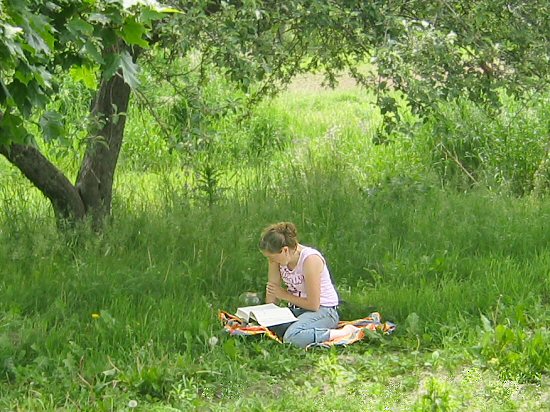
Lynn vanished early from lunch, only to be found reading her new herb book under a tree. This photo (below) doesn’t nearly capture the scene: it looked like an impossibly peaceful countryscape, from a simple, carefree world—fit for a postcard. We were laughing, and Jordan spontaneously got out his camera and took photos, too.  I asked her if she’d scouted the location for the setting (joking, but I can also be a bit of a cynic! :), she said it was just the best spot she could find for shade!