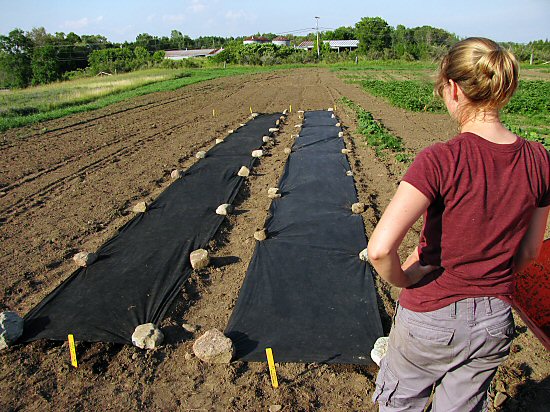
This year the antique Planet Jr. seeder finally took over from the Earthway, to handle most of the direct seeding. We’ve been using it for everything but tiny carrot and lettuce seed, where the lighter Earthway is easier to maneuver for closely spaced rows. Here, Lynn rolls out a third planting of beets, no problem. The PJ is heavy and initially hard to handle, but also more precise, uses way less seed than the Earthway, and lays down a well-packed row. And the choice of 60 or so seed holes, at first a pain, turns out to be a great way to appreciate variations in seed between varieties and fine tune seeding rates—we used three different openings to best fit three types of beet (Golden Detroit, Chioggia, Kestrel). It’s great. With this well-aged Planet Jr, old turns out to be our new and improved!
Fieldwork
Hand-tended
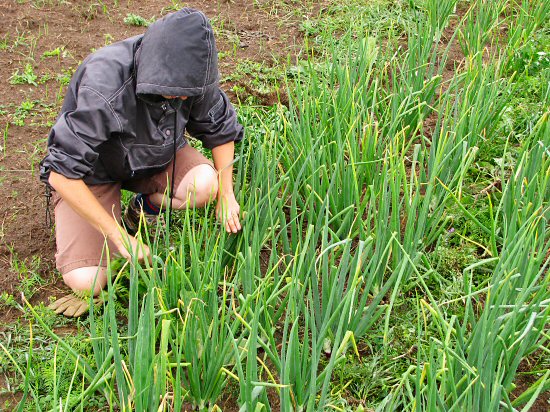
“Hand-tended” is one of the phrases that usually gets popped into the occasional bit of promotional writing about this market garden. Sounds good! If asked (hasn’t happened so far), I’d explain that we don’t use many machines, most of the garden work is done with hand tools, or just hands, as in, hand-weeding, or plucking off bugs…by hand. And lots of time is spent through the season, crouching and crawling around, checking out what’s going on with particular plantings of this or that. Which all seems pretty cool. :)
Today, Tara and I hand-transplanted two beds of early-maturing Neon pumpkins (above), along with a few more Snack Jack (tiny pumpkins bred for producing lots of tasty seed). The Neons are 70-80-day hybrid, kinda freakishly quick to mature (pumpkins are mostly 100+ days).
At this point in the season here, it’s getting kinda late for winter squash and pumpkins, but there are a few beds still to fill in, so a bunch of 70-85-day varieties, coming up in pots in the greenhouse, will be heading out to the field over the next week. With anything but the worst in cold and cloudy weather over the next three months, they should size up just fine!
Another hand-watering method
Another fine temporary measure this spring (and another of the many things the trusty Kubota compact tractor can do) is our new spot-watering method. Michelle waters in a last, experimentally late tray of onions with a slightly modified, inexpensive ($5) plastic watering can that holds about 2 gallons (8 l), and has big holes for fast, high-volume output. These cans we usually plunge into a rain barrel (or snow barrel) for filling, and to speed that up, I cut a squarish opening in the top (I always forget to cut the opening to the back, so water doesn’t escape from the top when pouring when full). The trick here is that the water comes from the Kubota’s bucket, maybe 30-40 gallons (110-150 l) of it, depending on how carefully the drive. You fill up, then head over to exactly where you want, like a movable rain barrel! The whole thing is quick and easy, good for watering in new seedings and transplants, until I hook up the field-long irrigation pipe. Quite the luxury, in a way, but the tractor’s already there, and we gotta keep things moving along! :)
Water pipe
A bonus this spring has been the steady rain, not too frequent, like, once a week or so, and somewhere around 1″ (2.5cm) each time. Perfect! Still, today, in the middle of a hot, sunny stretch, thoughts turned to water (not that it was ever far from mind). Out came the coils of 1″ water pipe. In our barebones spot irrigation system, there’s 1″ pipe and a bit of 2-1/2″ pipe, endless 5/8″ garden hose and 50′ sections of soaker hose, the gas-powered irrigation pump, and even 55-gallon barrels and watering cans. Not to mention, piles shut-off valves, quick connectors, and various hose fittings. For now, all that I’m looking to set up is one central line running from the well pump at the house, right down the length of the side-by-side fields, where it can feed the garden hoses. So, uncoiling we go…
50 feet!
Nice sun, but kinda cool and definitely windy. Michelle came by for a day of mostly organizing and arranging: managing seedlings, and measuring and staking out garden sections (now, according to the new garden map). We’re once again using 50′ (15.2m) squares as the basic garden unit. The 100′ (30.5m) reel-up vinyl measuring tape is the handiest tool for this, as we walk up and down and around, a person on each end of the tape, calling out measurements and planting fluorescent-flagged stakes… There’s a satisfying sense of order when a freshly tilled section is staked out. All those neat squares tell you, you are master of your garden, and things are well under control! :)
Filling the fields continues
More slow but steady planting out. Flat-leaf and curly parsley, started so long ago, finally hit the field by the hands of Libby and Lynn. Later in the afternoon, we started one section of potatoes. The timing this spring is…unusual. We’re still tilling and retilling sections to further break up sod, planting the same crop in two or three different spots, and staggering planting dates by waiting as long as possible, to get as much variation in conditions as we can. It’s hedging bets in a new market garden…
Compost spreading: another way…
When there’s a whole small section to cover, spreading compost with the Kubota compact tractor bucket is a lot faster and more efficient than the painstaking bed-by-bed method. This has been my usual approach for spot spreading, usually for 50’x50′ squares. Covered in reverse: the roughly distributed compost is quickly raked out (looks like a lot of work, but only takes 5-10 minutes!), before being rototilled in.
The real trick is backing up while dumping, rotating the bucket up and down. As long as the compost is flowing and not too clumped, this works great, gets a lot of the job done.
After a little experimentation, we came up with a simple debagging method, Lynn demonstrates: slit the bag in the bucket, then quickly flip it, pull up, and give it a couple of shakes. This compost is quite heavy (35% moisture, the label says?! expensive certified organic water…), so it quite easily tumbles out… And there we go, tiny methods for the tiny farm!