Extreme makeover

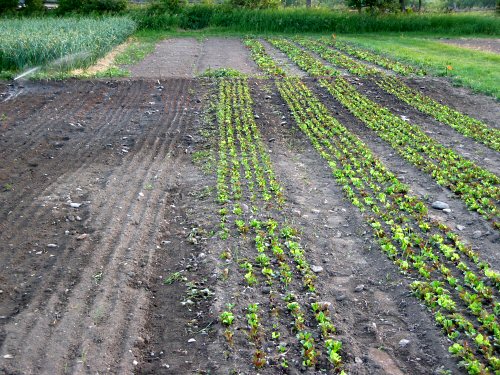
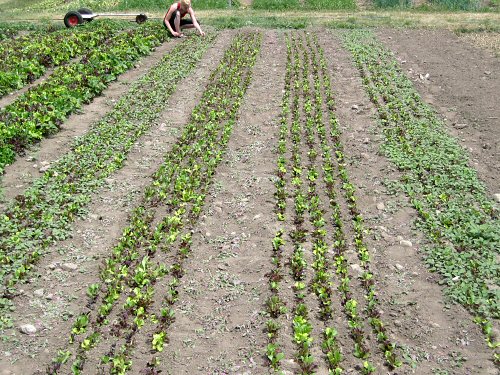
The one dark secret of this organic field, something you couldn’t really tell from selected photos, is the prevalence of pigweed (amaranth, mostly or all Amaranthus retroflexus if I’m ID-ing correctly). About two-thirds of the garden seems to be completely saturated with pigweed seed. Weeding two or three times for all-new outbreaks is common. In some spots, it’s literally as if some phantom planter is broadcasting new seed, thickly, every couple of weeks. And when it’s a closely space crop like the all-lettuce salad mix in the pic, this means painstaking fingertip weeding.

Here, Andrea and I spent about two and half hours clearing 200′ of 5-row beds, the entire latest succession planting. Luckily, conversation made the time transparent (thinking about all of the extra labor devoted just to de-pigweeding is a little painful). As best as I can figure, the pigweed came along with the two-year-old, not-fully-composted cow manure that we spread in the fall of Year 2 (three years ago). We put down I’m not sure how many, but many, tons on just over an acre—the ground was positively springy!—which was great. Except for the pigweed seed. Eventually, the vast store will be depleted (the seed is apparently viable for five years). Until then, it’s a lot of extra work… The pop quiz question: “What have those cows been eating?!”
Pond and pump

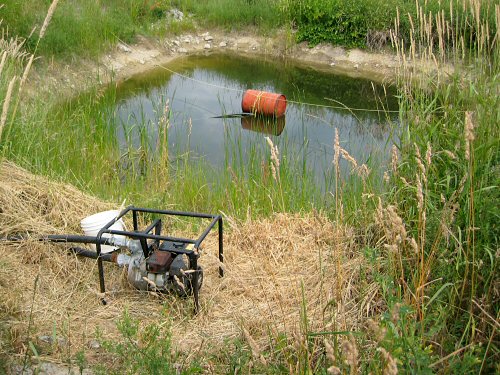
With only a little over an inch (25mm) of rain for most of June, and a near constant breeze on top of sun and heat to help dry things out quicker, we’ve had to hit the pond. Full irrigation here is a time-consuming process, involving dragging around and repositioning a network of hoses, soaker hoses, and sprinklers, and making trips every couple of hours to refill the pump set-up by the pond (see also “Pond and barrel”). The pond was dug out a couple of years ago, is ground-fed, drops level at an alarming rate (it starts the season full to the top of the photo), and replenishes slowly. If you look closely at the perimeter, the darker strip just above the water shows the level drop just for today. Still, it was used quite heavily last year and I’ve yet to see bottom! Meanwhile, I’m visualizing RAIN!

Doing the rounds

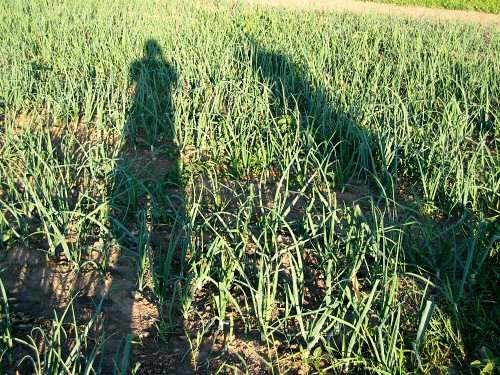
Since the start, the idea of a daily full garden inspection—”doing the rounds”—seemed to make sense. It sounds easy enough, but somehow, it doesn’t get fully done all that often, there’s almost always something that seems absolutely pressing to do early in the morning or in the evening when a stroll about is most practical and pleasant. But of course, I do get around to see everything every couple of days at least: checking for weeds alone insures that. Today, Conall and I managed to do a pretty full walk about. You look to see how things are doing in general, check for the start of new weeds and pests…it’s amazing how things can creep up and then jump out at you if you’re not watching closely. Here, we’re checking out the onions. So far, they’re doing well!

Three generations…

On the left, watering in the latest of six succession plantings of mesclun with a basic lawn sprinkler that’s quite efficient for shallow irrigation of newly seeded beds, when there’s no wind. Here you see the last three generations. I started planting four beds at a time, a week apart, and stretched that to nearly two weeks as the sun, heat and regular rain we’ve had so far made the growing fast. With the great weather, they’re catching up to each other—you can see the beds on the bottom right are moving up on the previous planting up top—and I’ll be tilling under a lot. This is absolutely strange for me, in past years, cutting every last bit of available salad greens every week was normal. But the people and planting expansion this year make this sort of abundance the new normal, production levels that assure harvests for all the CSA members, market and stand, even if conditions get tough. It’s not WASTED, I tell myself, it’s organic matter and even nutrients, back to the soil… I’m getting used to it!

The hay around us

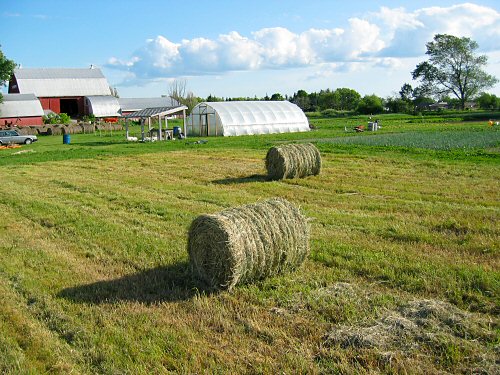
The garden, approaching 2.5 acres with this year’s addition, floats near one corner of a 9 acre field of hay. I could fairly easily expand into much more of the field, and ride around all day, machine seeding and cultivating. This is definitely not the plan. Instead, it’s stay small in area and add people—I’m somehow attached to the idea that, in a pinch, I could still (with help!) manage the whole thing without gas-powered machines…more or less. So, twice a season, Bob cuts and bales the hay that’s all around, using 30-year-old big tractor gear, carefully kept up over the decades. Since the whole farm is certified organic, I suppose we could find a specialty market for “organic hay”, but that seems a little precious—this stuff gets fed to the half dozen cows, couple of dozen goats, and single miniature donkey, who live to eat and loaf on other parts of the tiny farm (I call ’em 10,000 lbs of pet…they’re Bob and Karen’s, it’s not I who takes care of ’em!). This field is overdue for reseeding, the hay has lots of grass that’s grown into the diminishing clover and alfalfa. Oh, you can also see Conall’s old Volvo station wagon, in the parking circle mowed out of the hay in front of the stand—it’s rapidly become part of the season’s local errand routine (it will lose some character when he gets that rear bumper reattached). And that’s the hay story.

Beet greens harvest

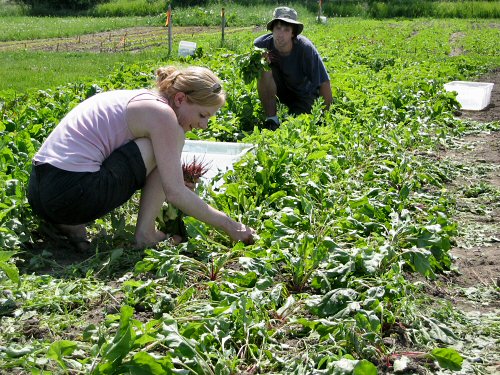
Andrea and Conall harvest Cioggia beet greens in the hot mid-afternoon sun. In tiny farming, it seems that every action has several different effects and offsets, some good, some not so, and a balance, hopefully leaning to the positive side, is struck each time. Here, harvesting greens in the heat is not the greatest for the freshly pulled leaves or the plants that remain, but this is the time we had (a cloudy afternoon with a mild, refreshing breeze every harvest day would be nice!). A quick bath in cold well water instantly refreshes the harvest, and the plants will recover overnight. This particular bed of beets had gotten quite weedy, so weeding while harvesting slowed things down. But, the fairly dense piles of pulled weeds, spread between rows, dries into a decent mulch that’ll help retain moisture and prevent more weeds from germinating. And, the harvest is also a thinning session, giving the remaining plants the space to fill out into proper beets. It all works out…!!

Not a pretty picture

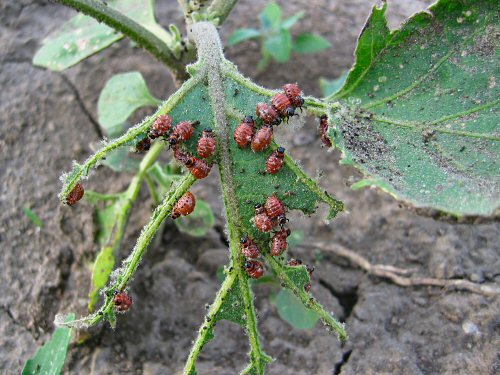
In today’s field photo selection, there was a kinda cool shot of a last-season carrot starting to flower, a freshly hand-weeded onion patch looking quite sharp, or this shiny, slimy cluster of baby Colorado potato beetles, going to town on a Black Beauty eggplant…

Pests and disease have thankfully not been a big problem in this organic field. I like to think that the garden is in some sort of balance, but perhaps it’s just location and luck… In either case, there have been some outbreaks: many tomato hornworms on the…tomatoes in Year 1, same for Colorado potato beetles on potatoes, early blight on tomatoes three years ago when the summer was cool and almost always cloudy and damp, and, of course, the everpresent flea beetles (brassicas) and striped cucumber beetles (cucurbits).

The FBs and CBs are defended against with floating row cover. The rest have recently died down, to the point where I let them do their thing, handpicking a few, but really accepting a small amount of leaf damage (they all eat leaves) and no plant loss.

This year, the CPBs seem to have crossed over to eggplant (another of their natural targets, but one they never really took aim at in the past). They seem to be favoring the Black Beauty eggplant…

The worst of the major damage in the photo happened in probably less than a day, as I’d taken a walk through there just yesterday. Only about four or five of 60+ Black Beauties had a significant presence, with a few loner CPBs on other varieties (and I’d noticed no eggs on the leaves in earlier checks). So, I squished ’em. Vigilance is somewhat increased.