
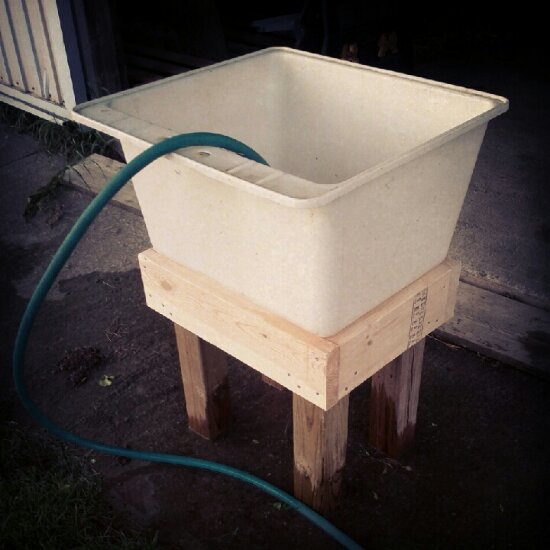
Friday is harvest day and we turn to the almost iconic white plastic laundry sink as veggie washing station. It’s a one-tub day today, with only beet greens to hydrocool (sometimes dunking in water is to wash off dirt, usually, and especially with above-ground crops, it’s to cool them down to keep ’em fresh, and the term for that is, yep, hydrocooling). The legs on this one gave out, so Jon replaced plastic with wood—a fair bit heavier overall for something we move around and stack, but then, still in service. Make do!
Tools
Equipment for large-scale agriculture is too big or too expensive, and many home gardening tools don’t work efficiently on larger jobs or break easily. Tiny farming on plots up to two or three acres requires its own special gear…
Watering cans
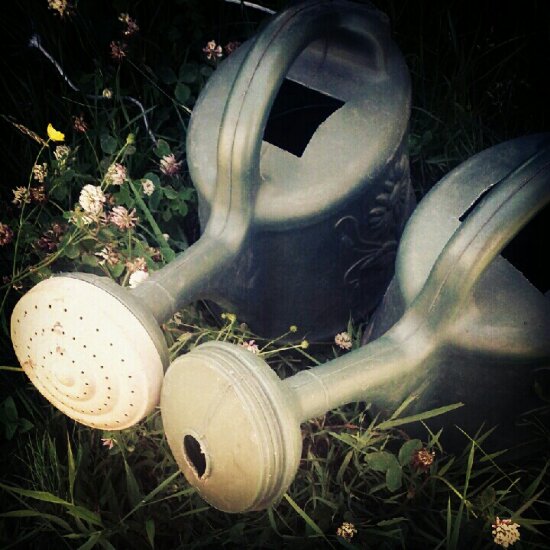
Good tool! These watering cans have been all over—seedling room, greenhouse, field—for the last few years, near perfect for hand watering missions. Five bucks, plastic construction means they’re lightweight, two gallon capacity is decent amount of water that’s still easy to handle, even with one in each hand. The spout cap pours a nice, heavy shower for speed and unscrews for cleaning and for filling smaller containers. I cut square holes on top for quick plunge filling from open barrels. Great!
Rain watch begins
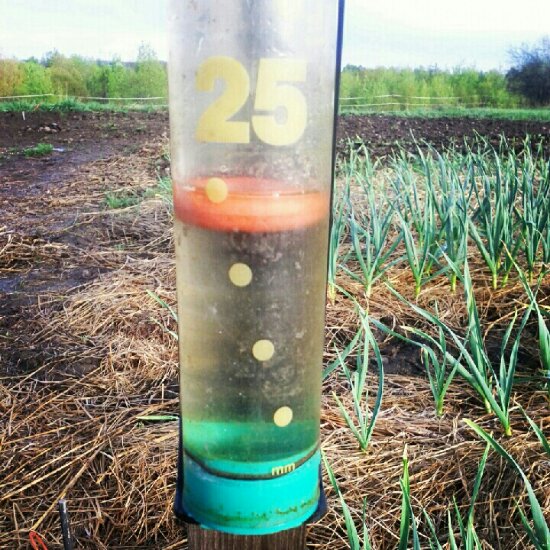
The season’s weekly rain watch begins. Weeks start on Monday. The big 25 on the rain gauge is the magic 25mm/1″ mark, the rule-of-thumb ideal for a week—an inch of slow and steady rain over a few hours, and of course all the rest, sunshine, that’s just…beautiful. A 1/2″ is an OK minimum for a bit. More than an inch a week ongoing for a while can be troublesome, depending on the crop and stage its—disease, small seed washed out, bigger seed rotting, whatnot, it is all possible :)—and it does occasionally happen. So far this week, 18mm here and 20mm total, so, doing fine!
Bucket loading
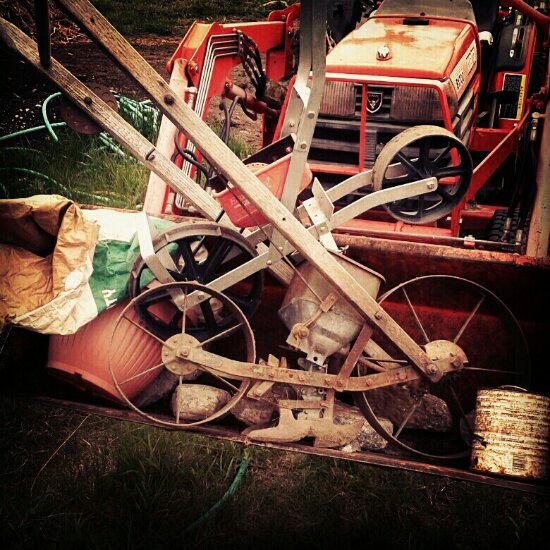
Especially in spring, with constant seeding and transplanting, moving gear around the field is a bigger deal than it may seem. Forget stuff, even little things like a hose fitting or a seed plate or some twine, and you’re heading back the equivalent of practically a city block to get it. A trailer of some sort is the ultimate for a 2-3 acre plot, but with decent packing skills, you can fit a lot into a tiny tractor bucket, too! This carefully balanced load includes everything needed for some direct seeding: the Planet Jr. and Earthway seeders (can’t forget the Earthway seed plates, they’re a perfect fit in that coffee can); seed, clipboard for notes, twine and stakes for row marking (all in that large flower pot); choice rocks for anchoring row cover (it’s never too early to protect brassicas from flea beetles!); and there’s the last of a 50lb bag of snap peas nestled in. It takes a practiced eye to fit everything you need so nothing falls out as you bump along—do it a few times and…easy peasy!
Mixing greens
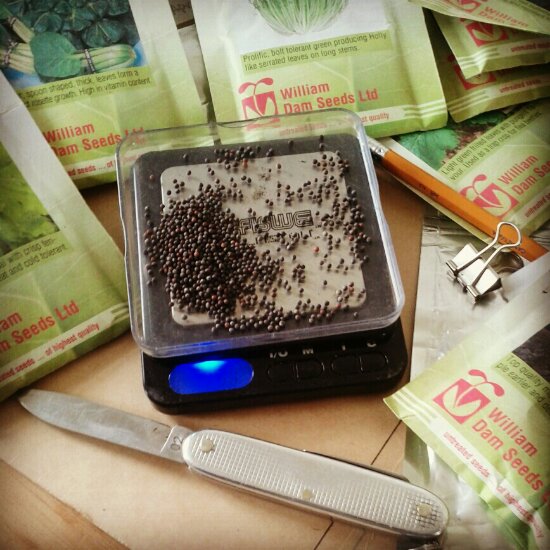
Measuring seed for lettuce and Asian greens mixes, using a digital gram scale from the local headshop. It works well, except I wish the auto-shutoff didn’t happen so quick. I was quite amazed by the selection of digital scales available, starting at, I think it was $20, and going up in $5 increments for a whole slew of models. Didn’t realize so many people were into making their own small-batch seasoning blends and custom salad mixes. Wow. Hahaha. The mixes are basically trial and error. For salad mix, it’s about color and texture at this point: frillier, greener, redder, crisper (baby Romaine is nice in there)—check the results, adjust the percentages for next round. For the Asian greens, it is more about taste, which so far has mostly come down to how much mustard to put in. Of course, how quickly they each grow is quite critically important, all varieties should grow at the same rate, in a fairly wide range of conditions. The lettuces are easier, and I started with some varieties recommended for baby leaf production for just that reason: fast-growing. The Asian greens, all brassicas at this point, are trickier. For example, tatsoi was included in our first runs, but it consistently grew lower than the rest, the leaves were a nice size, but when cutting, they tended to fall halfway below the blade. So, out goes the tatsoi, for now. It’s all about simple experimentation and adjusting things a bit as you go! (BTW, the knife is there just to slice open seed packs; for no real reason, that’s how I always do it…)
Planet Jr. rides again
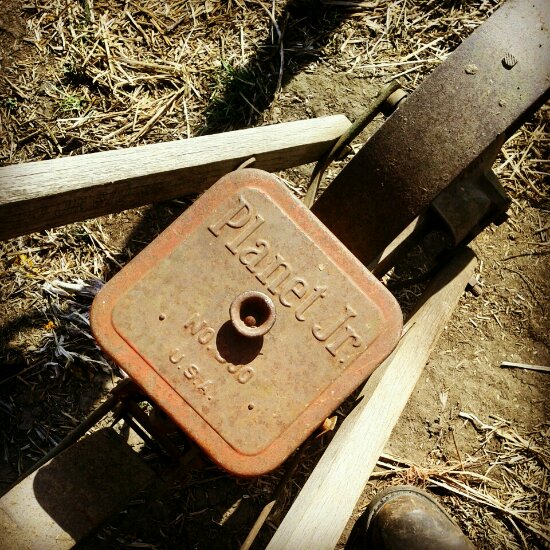
Rolled out the Planet Jr. seeder and got in a first 300′ of peas. Sugar Ann snap peas, that’s edible pod. This is just ahead of three days of colder temperatures, rain, and possibly snow. Since the weather forecast lately more often than not doesn’t even get the rest of the same day nearly right, who knows?! Still feels good to get that in. First direct seeding of the year. Yay. (Oh yeah, the new photo format is from Instagram, an app I’ve been playing with on my phone, kinda like Twitter for pics. And I started this post from my phone, but finished writing it on the laptop. Technology: enjoy it while you can! Hahaha. :)
Planting the rain gauge
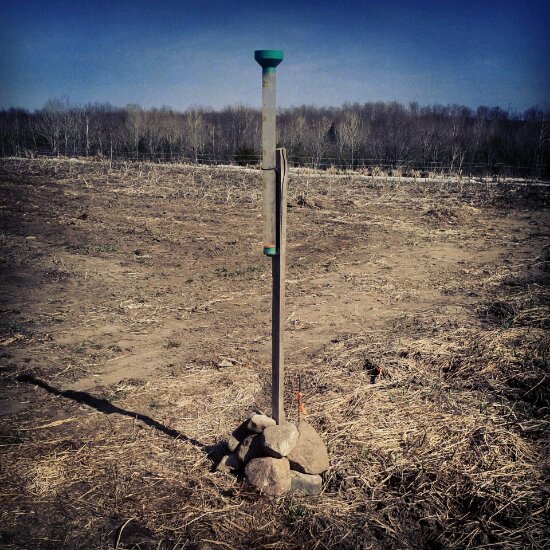
The field is way dry enough to till, so it’s time to get on the rain watch (yeah, and like as not there will be some snow in there)! Picked a new spot, just for variety, and set out the rain gauge once again. Hopefully it won’t fill up, then freeze and explode in some freakish lotsa-rain-then-cold-snap-all-in-one-night event. The 2×2 that it’s mounted on is starting to split from being pounded, so rather than change it at the moment, I only went down about a foot till it hit real resistance, and then shored it up with some rocks that were conveniently collected right there. Good for now, and probably all season! No effort wasted for real is my motto for the year. :)