
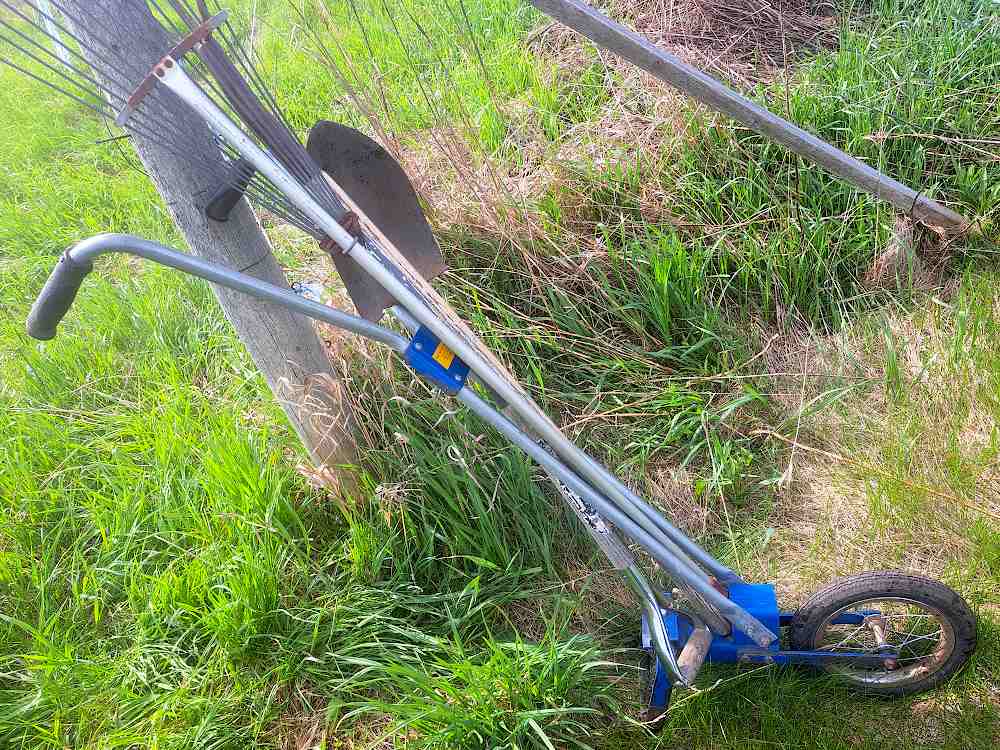
Today, a tiny farming breakthrough—I found I could securely balance multiple tools on the wheel hoe, and easily wheel the whole setup between the tool shed and the field! When the tiny farm was operating at a larger scale, I’d hitch the flatbed trailer to the John Deere riding mower, load up with everything we could possibly need for a job, and drive on out. That was deluxe! But for a couple of hand tools—here, a hay fork, leaf rake, shovel—plus the wheel hoe, driving is just overkill. It’s not that far a walk. Still…guiding a wheel hoe while carrying tools is a bit of a balancing act, and I usually make two trips. This new way, using the wheel hoe as a tool carrier, flips it from irksome to fun! I figured out how to quickly insert tools so they brace each other and don’t slip out the bottom, and that was it…upgrade complete. (Yes, I could just pick up the not so heavy wheel hoe, but then, that’s what wheels are for! :)
Tools
Equipment for large-scale agriculture is too big or too expensive, and many home gardening tools don’t work efficiently on larger jobs or break easily. Tiny farming on plots up to two or three acres requires its own special gear…
Garden vs the hungry hordes

Much of veggie farming is playing garden defense. Yesterday’s garlic surprise attack was handled as an immediate emergency action, by hand-picking larvae before they could really tunnel in. The other no-chemicals approach is row cover, which seems to be laid out on more crops as each season. (More words to follow.)
Wheel hoe underdog challenge!
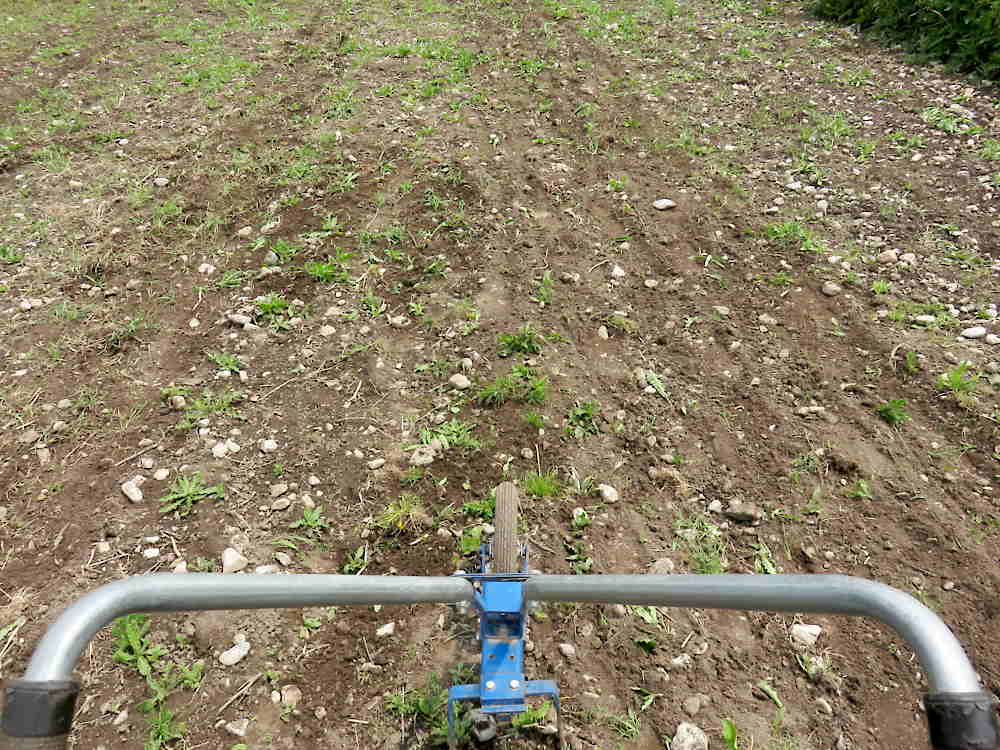
It doesn’t sound like a fair contest, the wheel hoe going up against the tiny tractor, but that’s the experiment underway this season. With all the rain recently, weeds are primed to surge. So far, it’s mostly thistle and clumps of grass itching to expand, with pigweed, lamb’s quarter and a couple of other regulars starting to emerge. This area, not yet planted out, has already been hoed, but that haze of green won’t stay down for long. A matter of days… With the 48″ rototiller on the tiny tractor turned by diesel horsepower rumbling like a tiny tank, it’s easy to put things off a bit. The tiller will churn up whatever’s in its way in no time. This fine wheel hoe has instead only an 8″ blade and a lone human…pushing. Every little bit of growth makes the going harder. The time to get in is early, when the blade can more or less glide smoothly and evenly, and you can move travel up and down with fair ease. There are other things to consider here—time, fuel, effect on the soil…more on all that as the experiment goes on—but timing is number one!
IN THE PHOTO: The wheel hoe is facing a strip that has just been walked. It’s hard to see the line between hoed and unhoed, especially compared to the cleanly erased path left by a rototiller. The weeds are sliced just beneath the soil—like cut flowers, they still look fine. Give ’em a day, especially a sunny, hot day, to dry out, and the difference becomes clear. Weeds, gone!
Wheel hoe vs weeds
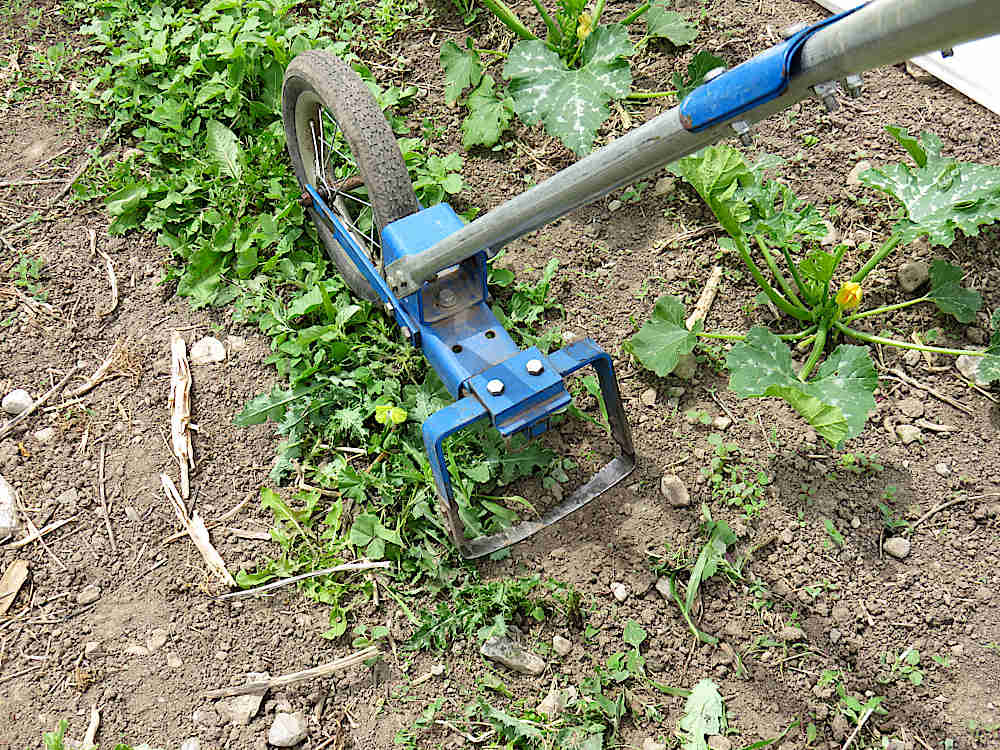
A tool in its element! Wheel hoes are great, and this particular one* is fantastic. Unchecked, you can see what weeds get up to given a week or two. This stretch of dirt was protected under the edge of the row cover that’s been protecting the zucchini to the right from cucumber beetles. Now there’s a dense mat of dandelion (weed or excellent salad green?: right now, weed), thistle, mallow, and lambs quarter. And there’s the steel blade that will run through them, gliding just under the soil, slicing them down. Brutal sounding, and all part of the garden balance. (The zucchini have powdery mildew, those white splotches on the leaves, which usually happens when there’s not that much sun. It can get really bad and ruin things, but usually, zucchini will outgrow it. It’s about sunny days…the weather. Another “we shall see…”)
*I got this wheel hoe well over a decade ago from Valley Oak Tool Company, one of the few companies that are a pleasure to recommend, purely out of appreciation for quality product that does its job!
Squash to the field
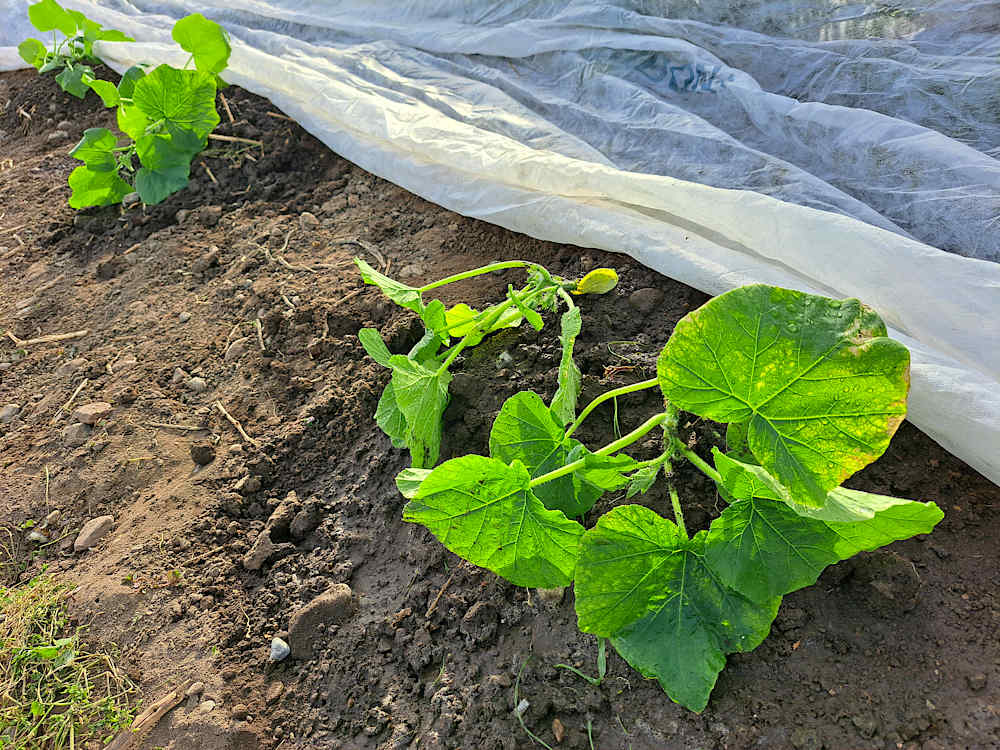
Transplanted butternut squash seem to be doing fine in the great outdoors. The row cover will protect them from the fairly cucumber beetles, until they’re big enough not to be bothered. The beetles eat the plants and can also pass on bacterial wilt (I’ve experienced hungry cucumber beetles, but luckily so far, no wilt). This rock cover is medium weight, thick enough that it’s easy to handle without tearing and can be reused, and thin enough that it lets 85% of the sunlight through. A small tradeoff for no chemicals!
Onion seed, dead and alive
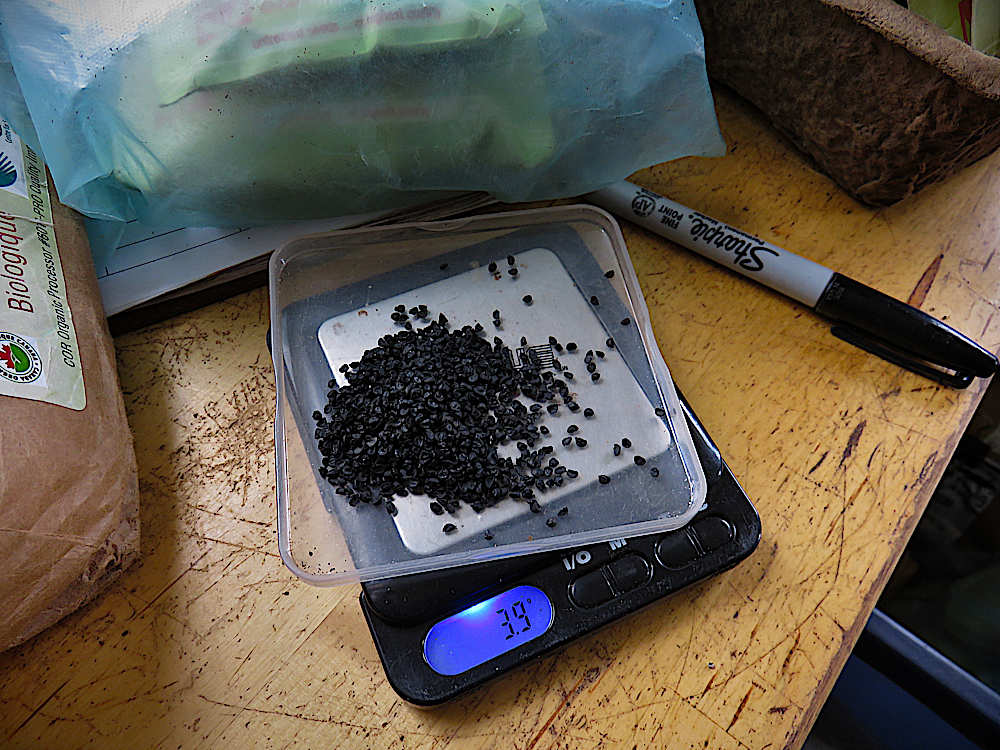
Mixing a small batch of green onion seed, half fresh from this year, half from years ago and no longer viable. Why? The mix of dead and alive seed makes it easy to spread quickly, getting good coverage and not having to thin out a bunch of seedlings that pop up too close together. Works when seeding by hand, as I’m going to do with these, or with seeders that tend to drop a lot of seed, like the Planet Jr. and the Earthway!
Thin white lines
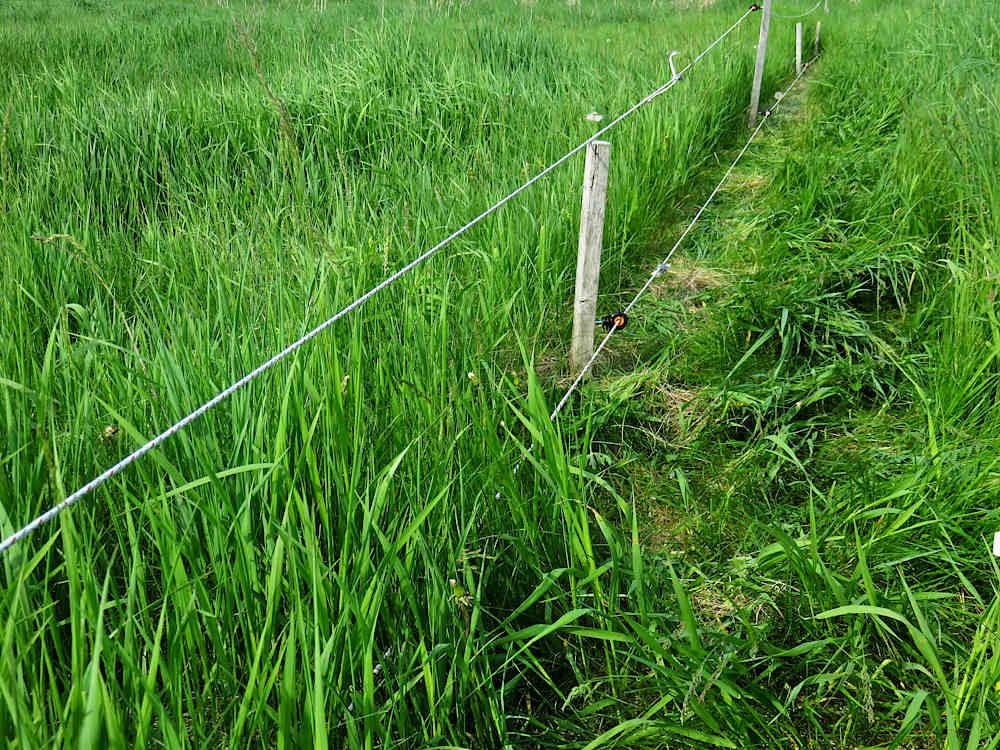
Two lines of electric fence rope, one for deer, one for groundhogs, running through the so-very-healthy grass, perfectly illustrates the nature of the war on weeds. Maybe I should use less militaristic terms, but that’s what comes naturally—guess it’s my cultural upbringing. And it does feel like a battle. On the ground, face to face, against a well-adapted indigenous…opponent. Spraying herbicides would be like an impersonal aerial war, bombing from on high. In this tiny farming, it’s hand pulling and snipping, and using the pulled weeds as mulch to hopefully smother reinforcements that are ready to spring up. Here, letting the grass swamp the fence lines would be bad for the system, draining the battery and reducing the strength of the all-important ZAP!