Rack built

spr08_new_grow_rack.jpg

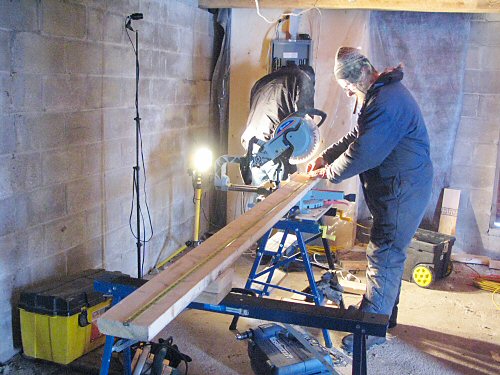
New lumber turns into new grow rack. This adds a fourth to the set, a measure of tiny farm growth. I started with two in Year 1, built another one last year (Year 5). It’s not like the focus here is on rapid expansion…this is the speed of staying tiny! ;) Although I don’t build these often, it seems to get quicker every time. Well under a hundred dollars of wood, wheels, screws, bolts, brackets, hooks and chains, plus a chop saw, a drill and a couple of hours, and there it is! Light fixtures are extra. In the pic, the shelves still have to go on. Lying across the middle supports is one of the four old fluorescent fixtures, given to me instead of being tossed in the trash. Not only free, they’re BETTER: the tubes are spaced further apart than in the standard shop lights I’ve been using, the light will spread more evenly over a larger area—for the seedlings, a lot less leaning and stretching…

Comments (6)

New lumber

Lumber delivery

Went through the lumber delivered yesterday, selecting the straightest pieces for a new grow rack. There’s all kinds of scrap wood around the farm, except, there are never enough 2×4s and plywood… I order construction grade for most things, quite inexpensive but the boards have to be hand-picked if you don’t want a lot of warped wood. For rough carpentry, this works fine: the savings add up, and rough edges add character! There’s the grow rack, a double screen door for the Milkhouse, the composting toilet-ice fishing hut conversion, the chickenhouse reno, new tables and trays for the farm and market stands, more… All needed pretty soon. Spring building starts now!

Comments

Rough carpentry

Surform pocket plane in action

Added a shelf to the potting table today, a quick bit of rough carpentry. It also needs a couple of coats of varnish to waterproof it for the season, so I took the time to shave down the little edge where the sides join the tabletop. Normally, I wouldn’t bother with a minor detail like that, but I spotted the cool little surform plane (the blade is kinda like a grater) in one of the toolboxes and felt like using it! Rough carpentry may sound like nothing much, but it’s really a particular, essential skill of its own on the tiny farm. I’ve been learning as I go. The “rough” doesn’t mean sloppy or shoddy, just practical: functional, sturdy, simple construction, as much as possible using whatever materials are at hand, and not waiting around to get things done. Need a shelf over here? A workbench fit in right there? A couple of quick walls to turn a corner into a storeroom? A roof on the veggie stand? Grab the tools, hunt down the materials, and bang it up!

Potting table with new shelf

The simple shelf is a couple of 1×6 boards. It’s for keeping plug sheets handy when I’m seeding lots of trays of transplants at once. The potting table started out as a long, shallow bin, built from scraps of plywood, to hold harvested tomatoes. I later reassigned it: flipped it over, added legs, and voila! (There’s that trusty saw again.)

Comments (3)

Roofing the stand

Screwing down galvanized steel roofing

Finally got around to putting the roof on the farm stand. We recycled the old galvanized steel roofing that was replaced during the Milkhouse extension last fall. In the end, a quick job, three hours or so of matching pieces, handing them up one by one (watch the wind), and screwing ‘em down. Luckily, there was very little cutting to do, sheets of old metal can be a real nightmare for slicing and gashing (working without gloves, I nicked a finger only once—every so often, it’s good to see a little bit of your own blood running red and true :). In the pic, I’m screwing things down while Bob selects sections. The farm stand is definitely not on course for the ambitious plans of earlier this season, but in good tiny farming fashion, it’s moving along! (Guest photo by Mami.)

Comments (1)

Making stakes

Making tomato stakes

In the building and fixing department, there’s always a queue. Jobs are usually one of three degrees of urgency: Right Away (fix it or we can’t go on!), It Would Be Really Good To Have This Done Soon, and When There’s A Little Extra Time (and that’s often, all the way to Fall). Today, it’s finishing a Right Away job: making up more wooden stakes for the tomatoes. Last year, I bought for very cheap a pile of scrap wood, 10-12′ lengths, rough cut to around 2″ square, from a local sawmill. This year, we found pounding stakes made from this stuff a foot or so into the ground took an insane amount of sledgehammer effort, especially when driving into dry soil. Cutting them down just a bit made a HUGE difference. Using a table saw out in the barn yard, we shaved about 1/2″ lengthwise off each width, winding up with maybe 80 1-1/2″ square stakes. It took a couple of hours overall to save many more in the field, not to mention energy, sweat, frustration. The little things do indeed make all the difference! (Also in the pic, painted white, an old door scrapped during the Milkhouse Extension, and a nice, solid pallet (probably from the seed potato delivery), both to be reused in the composting toilet enclosure, an IWBRGTHTDS project.)

Comments

Sorting

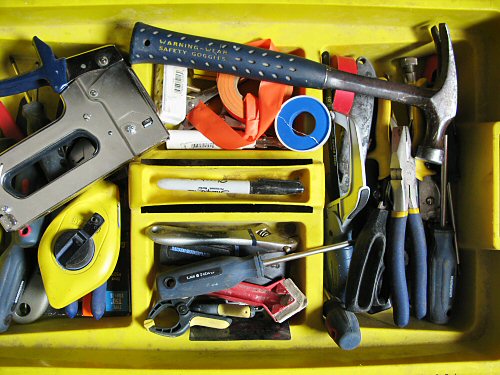
Tools sorted out

Tiny farming requires lots of bits and pieces, gear inevitably gets jumbled and misplaced, and the whole show can start to slow down as things get in your way and you spend time searching for this or that. Sorting things out is an on ongoing, neverending process. Last year, it seemed like a fine idea to stick all the hand tools in a 55-gallon barrel, so that nothing would be leaning against the hoophouse plastic. What a bad idea. Everything got tangled up, I began leaning my most used stuff against the barrel, and this year, when other people also started using the tools, it got completely out of control. Today, I screwed a couple of boards across the studs in the end wall—instant (if temporary) relief, and it got the barrel out of there, making it easier to move around the seedling tables. A place for everything and everything in its place—here, that often annoying recommendation does make sense!

Tags: , ,
Somewhat similar posts: • SortingRough carpentryFramed!Calendars love catalogsValuable stuff!

Comments

Wood pile

Lumber

It’s too wet today for fieldwork, and the seedlings are all set till starting squash, cukes and melons in a few days. There’s always lots of other stuff to do, like building an enclosure for the new composting toilet (a modern outhouse in the field). For that I did a quick inventory of scrap lumber. This outdoor pile (there’s more in the barn) comes mainly from the demolition when we extended the old Milkhouse last fall. Some of the wood is over 50 years old and in fine shape for framing. Building and fixing the stuff you need is a natural part of tiny farming. It’s even more satisfying when you can use materials you have on hand—recycling that you can actually see in action! It makes sense!!

Tags: ,
Somewhat similar posts: • Wood pileNew lumberMaking stakesFramed!Raw materials

Comments

New rack ready to roll!

New grow rack

The new grow rack, lined up with its brothers, ready to go to work. The carpentry’s real rough, but it’s sturdy and tried-and-true functional. The addition of 3″ casters has created an unexpected PLUS: when the racks are rolled together, the overall light from the fluorescents spills across the shelves, giving a little more to the plants on the outer edges of the trays. This is good! There is a fairly big difference in early seedling growth from being even a couple of inches further from the lights. (Before, moving the racks around was a pain, and you need to get at both sides quite regularly for watering, rotating trays, generally checking things out. Yay for wheels!) In the end, most things even out, but you take every edge you can get and…they do add up!

Comments

Raw materials

Grow rack parts

The materials for building a new grow rack just arrived. With this one, there’ll be three in all. It’s a bit a of milestone. I’ve used just two racks, built from ridiculously warped wood, to start literally thousands of seedlings over the last four years. Adding one more means a huge jump in production capacity. Well, 50% more, to be exact… Here we have wood, wheels (casters are a new addition this year for all racks), chain and dowels for hanging the lights. Cut up, screw together, add fluorescents…dead easy! And needed in the next few days when seed starting begins in earnest.

Comments

« Previous entries

TFB & the Web

Locations of visitors to this page

Best Green Blogs

Home and Garden Blogs - Blog Catalog Blog Directory

Add to Technorati Favorites

Foxkeh banners for Firefox 2