
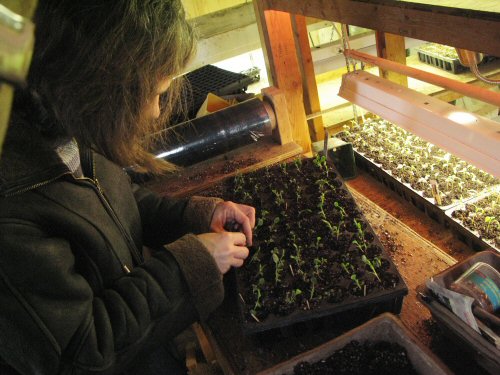
It will soon be time to move many of the seedlings to roomier quarters—there’s only so much space under the lights, so the greenhouse has to go up soon! Timing is getting trickier by the day, but we’re still doing fine. Here, Tara, at the very start of her tiny farming career, manages her first tray of cauliflower, splitting cells with two seedlings, and filling any empty spots. There’s not always time for this sort of micro-gardening, but there is right now…!
cauliflower
Veggies in snow
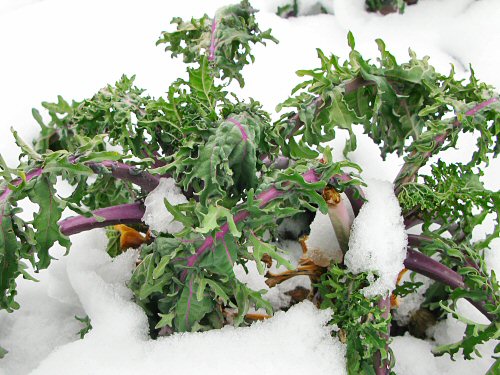
Every season there’ve been hardy veggies left to the cold and snow, and this season, it’s a record quantity, with nearly 2,000′ (610m) of broccoli, cauliflower, cabbage, and kale that mostly started sizing up just as the farmers’ market finished at the end of October. It seems like a waste, but it’s only a typical garden gamble on the weather (I was trying for an extra, really late crop). The risk was clear back in August, and we didn’t get enough sun to push things along a tiny bit quicker. We did harvest a lot of the Red Russian flat-leaf kale (above), for a good four weeks, and one round of 1-2 lb (450-900g) cabbage (a nice size for a meal for one or two). And there’s been a lot of personal-use picking in November. The rest is a giant farm lab experiment, more exploration of the snow-on-veggies effect…
More than the snow, the many nights of extreme cold (-15°C/5°F) that came with it this year really blasted these guys, wilting them and burning leaves and buds. So, none of the crops are too firm or pretty, BUT, they’re still alive: for the most part, there’s good color and texture. The kale, always super-hardy, did the best from a let’s eat some perspective, with good texture and great taste. The broccoli, while a little wilty on the stems and burned on the buds, also tasted great, fresh and flavorful. The cauliflower did the worst, the heads really damaged by the freezing and thawing, too mushy for me to bother with a taste. (Eating raw was fine, but how would this all cook up? We may see…) We’d already reaped most of the filled-out cabbage, so the rest aren’t going to go anywhere from here…
What’s all this odd information worth? Not much, I guess, I’m not planning on deliberately planting for snow harvests. But checking things out is always fun, no experience goes to waste, and there is at least one advantage to knowing there’s still good eating out there: the laying hens will be feasting on a fabulous greens buffet for a while!
This week’s share
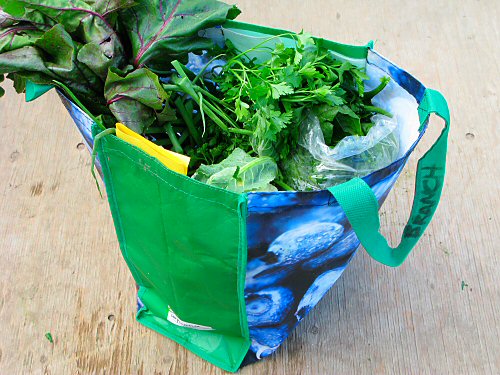
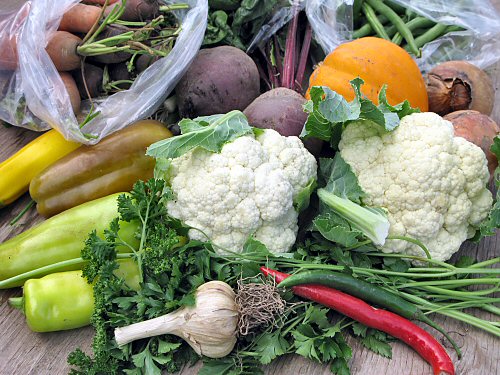
Another rather nice fall CSA share this week! Thanks to no killing frost so far, we’re still picking beans (Jade), peppers (Gypsy, Ace, Cayenne Long Slim), and zucchini (Golden Dawn III). There’s also winter squash (Table Gold acorn), cauliflower (Minuteman), onions (Stuttgarter), beets (Scarlet Supreme), carrots (Nelson, Purple Haze), spinach (Spargo, Bloomsdale), parsley (Green River curly, Plain Italian flat), and garlic (Music). Plus a newsletter. Monday shares are left at a drop-off spot, with shareholders’ names printed on the handles…
Friday harvests get quicker!
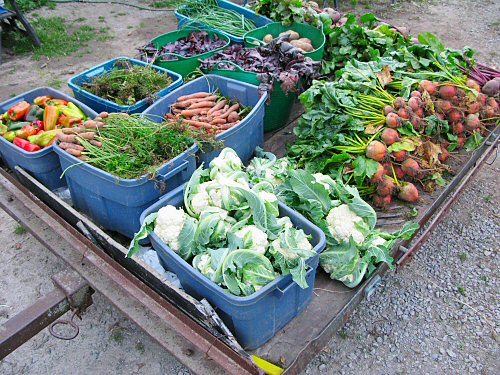
Friday harvests are getting quicker as the season winds down. This has happened at least for the last couple of years. Where earlier in the season, we finish around 8-9pm, we’re now mostly wrapped up by 5 or 6, and sometimes with less people than during the summer. I’m not quite sure why this happens. Probably, a big part of is that everyone out there in the field is now experienced and comfortably fast. Also, many of the crops in the weekly veg line-up are pre-harvested: garlic and onions first, and now, winter squash, pumpkins, potatoes and the new sweet potatoes. Still, it’s a pretty big harvest, and quantities are the same now as earlier in the year. Then there’s the shortening days—it’s starting to get dark around 7:30 pm now, down from 9:30 in late June-early July—and CHILLY WEATHER that likely speed us up! Anyhow, this is the most time I’ve spent wondering why—whatever the reasons, getting done quick is good! The trailer-load in the pic is about half of the day’s field haul, and there’s also the pre-harvested stuff. In this week’s harvest, in no particular order: carrots (2 varieties), cauliflower, beets (3 varieties), sweet peppers (several varieties), hot peppers (several varieties), green onions, spinach (2 varieties), summer squash (3 varieties), beans, tomato (several varieties), parsley, basil, all from the field, plus, pre-harvested, garlic, potatoes, winter squash (several varieties) and onions (2 varieties).
Fall crop watch
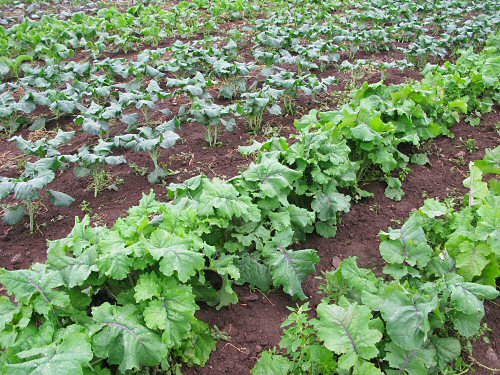
After a good weeding and another round of rainy days, the fall brassicas are pretty well on their own. It’s amazing how quickly growth slows down in September—what a difference the sun pulling away makes! The kale and collards are doing fine—we’ll be harvesting some Red Russian kale tomorrow. Broccoli and cauliflower will come through. Whether cabbage, planted this late for harvesting at baby size, will make it by mid-October is up in the air. More gambling and waiting to see…!
Fall crops
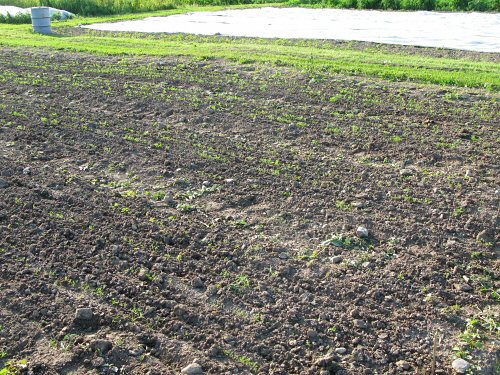
Not much to look at, yet, but the last plantings of 50-day-plus fall crops are doing fine. Here, carrots and, protected from flea beetles by floating row cover, one of two sections of brassicas, including broccoli, cauliflower and kale. There’s a bit of timing risk here, depending on the weather, if growing goes slow, they might not make it to maturity in time for market. But the sun’s been shining for a couple of days now, and the long range forecast is for more of the same. If all goes well, these will be ready for harvest through October!
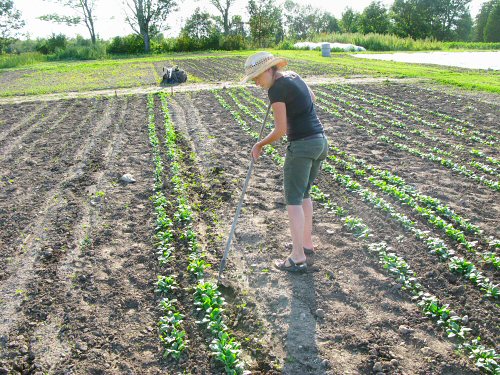
And the summer-seeded spinach couldn’t be doing better. There are two plantings, the first on July 22, and the second (left of the photo) a couple of weeks later. Here, Lynn hoes the first set: in this summer’s wet, cooler, cloudier conditions, germination was absolutely solid, as good as or better than regular spring seedings. Fall spinach has never been this good, by far. Excellent!
Last of the season’s brassicas
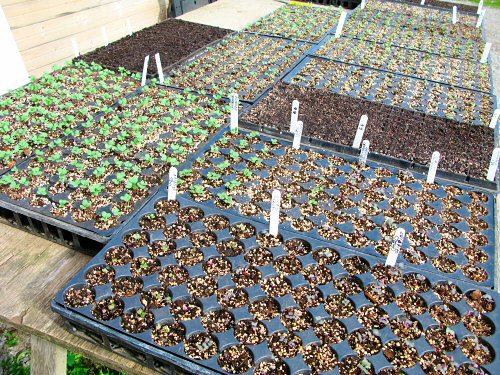
These brassica seedlings—broccoli, cauliflower, kale, early-maturing cabbage—were started a week ago, way late by any planting guide standard for our region, but I’m going by the reality of our recent crazy weather. Last year’s “late” cabbage family seedlings did just fine, so I’m gambling again! There are a couple of 200-cell trays of lettuce in there as well…