
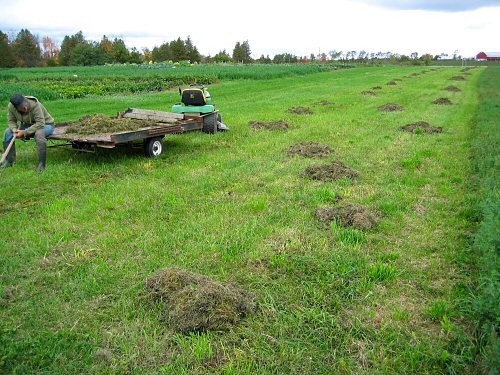
Working just ahead of more rain, Conall (fighting a cold that’s knocking people out around here—farmers can’t get sick!) and I raked the mini-windrows of grass and alfalfa into little mounds, piled it on the trailer, and dumped it in the greenhouse to finish drying. In the week since it was mowed, there was enough rain here and there to keep it damp, which wasn’t in the plan. Oh, well. A grass catcher for the riding mower would be the time-saving mechanical approach. This was a lot more fun, quite relaxing, a couple of hours well spent. Now, let’s hope it’ll dry, not rot!
mulch
Making mulch
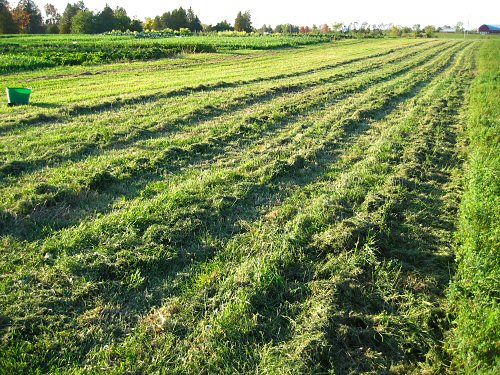
Yet another experiment: making mulch from some of the hay that grows alongside the garden. The hay, originally alfalfa and red clover, is dying out, and what’s left is mainly grass and alfalfa, currently around 10″ (25cm) high. I cut it with the riding mower, which instead of scattering the clippings, leaves a convenient tiny windrow. A couple of days drying in this year’s hot October sun, and it should be good to go. I tried thoroughly dried grass clippings as mulch a couple of years ago on a few tomato plants, and it worked out well, so on to a larger scale. This crop will be used on the garlic, to be planted in a month or so. The mower is sadly in need of new blades, so the cut is rough, but it should work out fine.
Beet greens harvest
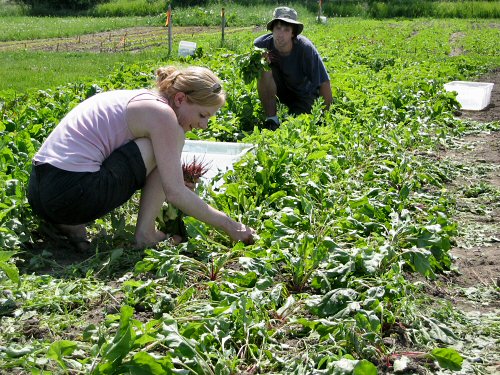
Andrea and Conall harvest Cioggia beet greens in the hot mid-afternoon sun. In tiny farming, it seems that every action has several different effects and offsets, some good, some not so, and a balance, hopefully leaning to the positive side, is struck each time. Here, harvesting greens in the heat is not the greatest for the freshly pulled leaves or the plants that remain, but this is the time we had (a cloudy afternoon with a mild, refreshing breeze every harvest day would be nice!). A quick bath in cold well water instantly refreshes the harvest, and the plants will recover overnight. This particular bed of beets had gotten quite weedy, so weeding while harvesting slowed things down. But, the fairly dense piles of pulled weeds, spread between rows, dries into a decent mulch that’ll help retain moisture and prevent more weeds from germinating. And, the harvest is also a thinning session, giving the remaining plants the space to fill out into proper beets. It all works out…!!
Working in the rain
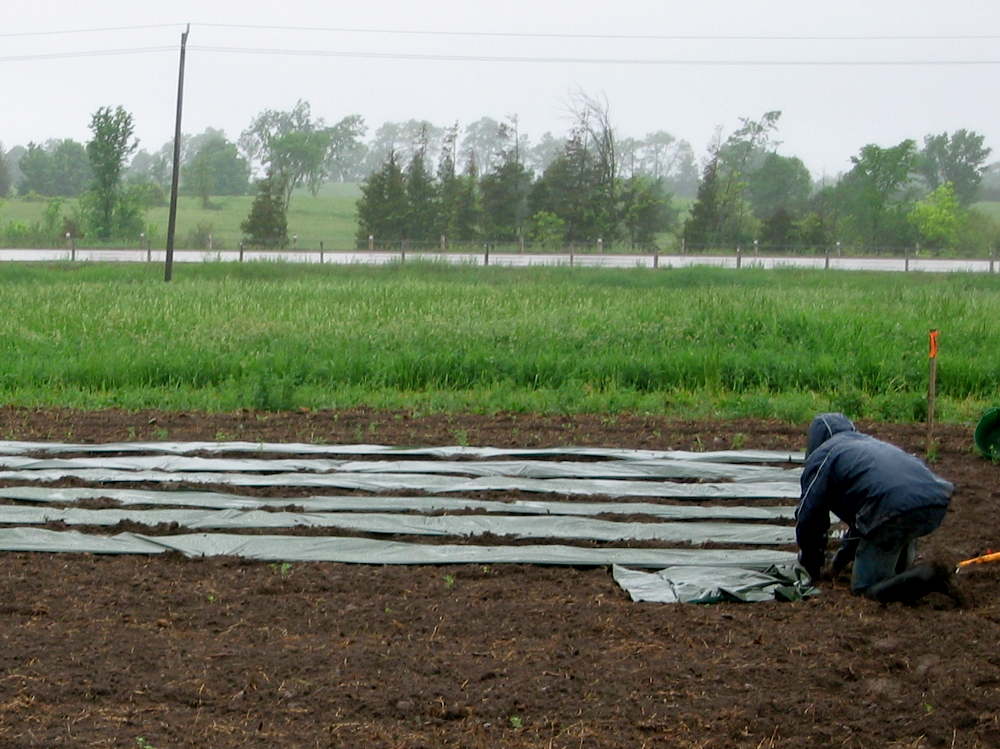
The rain is good (15mm over the last day), the chill (there’s a frost warning for tonight and tomorrow) and sticky clay-loam mud are not so good. But the calendar is flipping and there’s really no time to take shelter. Conall puts in plastic mulch for melons, anchoring it every few feet by scooping out soil, pushing down the plastic, and replacing the soil. We’ll cut X’s to transplant into, and water by hand around each plant as necessary. Labor-intensive, but it’s the most reasonable way to decent melons I’ve found so far, and it worked out well two years ago. After experimenting with straw mulch for tomatoes and melons last year, I’m back to using plastic for melons, and that’s it. Straw is great, but the extra work of spreading and then the fall clean-up seemed like stretching it for everything else that has to be done this year.
Carrot science
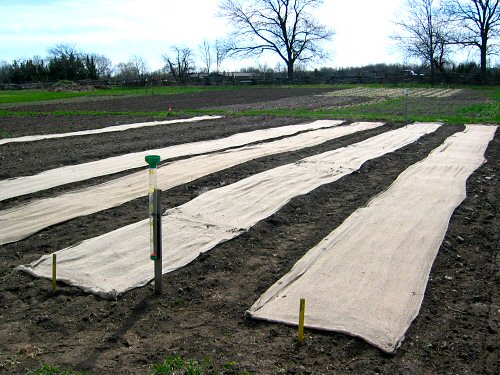
Welcome to my carrot lab! Carrots have been my biggest early spring headache. In cool weather, they take forever to germinate, 2 or 3 weeks, and by that time, the chance of weed competition is pretty good, and just about anything growing around the tiny seedlings makes excruciatingly time-consuming surgical hand weeding a necessity. What to do? Last year, I tried IRT (plastic) mulch over the bed. This worked great, heating up the soil, speeding germination to 7 days, and keeping weeds down. Problem was, miss the germination window (when a good number have emerged) by a few hours or a day, and the seedlings got toasted in the heat. Too delicate a balance. So, a new approach, something I’d read about. It involves a double layer of (untreated!) burlap. Simple. The burlap acts as a mulch to retain moisture and increase soil temperature, and it also allows in water and some light. What could be easier?!?! Now, all it has to do is WORK! (Update: it worked like a charm…)
Checking on the garlic
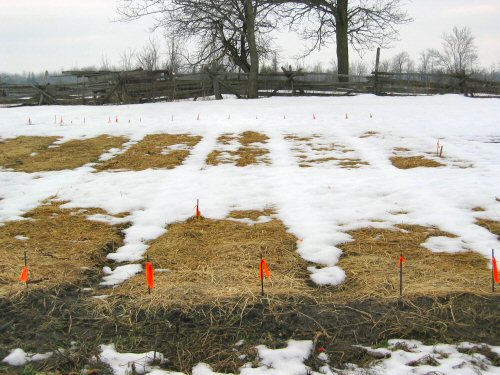
Today was the first walk around of the field of the year! The ground is still mostly frozen, but some spots have melted into a thick clayey muck that’ll take a while to dry out. So, you stick to the hard spots. Here, the fall-planted garlic beds are showing up. The row markers are there to prevent tilling accidents. The straw mulch is supposed to protect the cloves from heaving up during any quick freezing and thawing, by evening out the soil temperature (I doubt that would happen in this soil, it’s a just-in-case). The mulch does keep down weeds and hold in moisture during the spring and early summer, which alone is worth it. Garlic will be the first in-field veggie greenery of the season…if all has gone well.