
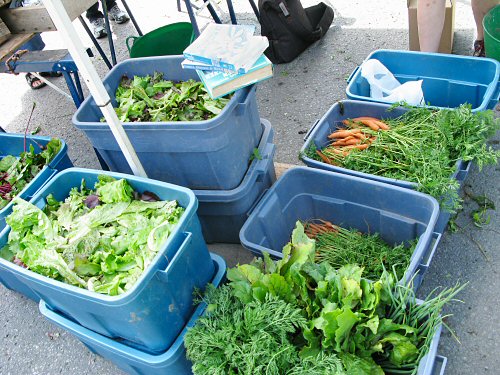
Rubbermaid storage bins are the main harvest containers again this season (I suppose that’s a plug for Rubbermaid, unintended, it just seems like they’re the only company in the plastic storage bin market!). They’re inexpensive (around $8 each), hold a little over a bushel, and the lids fasten well. They’re easy to clean, and they stack well, loaded and covered, or empty. And they’re durable. I somehow ran over one with the Kubota compact tractor, pulled it back in shape, and it’s in service again. They’ve changed color this year, the new ones available around here are a kinda tacky metallic blue, but that’s no reason to give ’em up. We have about 25, along with a dozen or so green bushel trugs…so I guess that’s the cap for the maximum harvest haul for now! Today at market, there were about 15 of ’em full… Balanced on the edge of one is a stack of three selected gardening books, brought to market for customers to check out…
post-harvest
Harvest wet work
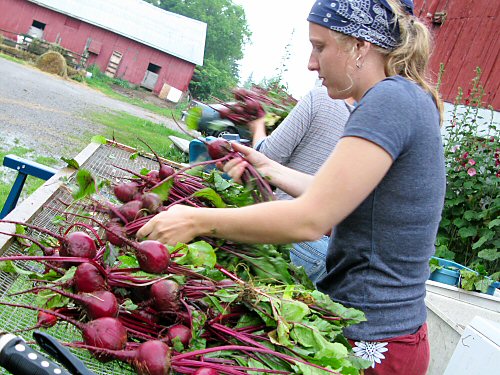
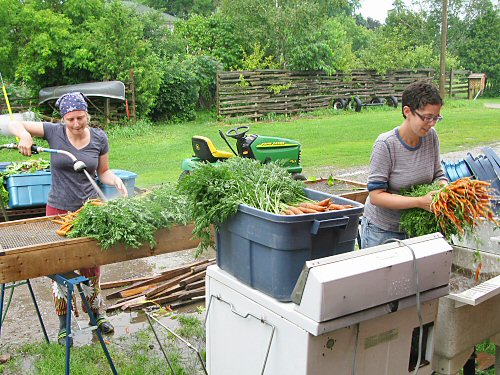
Yet another in this summer’s series of wet and gray afternoons, the weather blending perfectly with the wet work of rinsing and sorting muddy root crops. Instant efficient team chemistry between Rachel and Mel, both doing post-harvest here for the first time. (Above, carrots, below, beets.) The process is very small scale and manual. Crops are first dumped from harvest bins onto the screen table, clinging earth is quickly blasted off with the jet setting on the water wand. Next, double handful bunches are dunked for a final rinsing. Then it’s back into the bins… Simple and quick for a few bushels. Get wet!
Pick your own CSA share pick-up
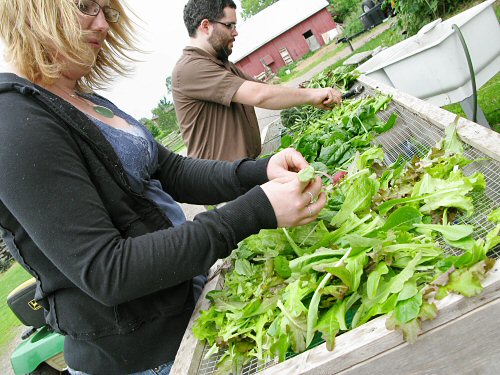
CSA shareholders coming to the farm this year are encouraged to harvest as much of their share as they feel like! Here, it’s sorting through mesclun and spinach on the screen table, removing bad leaves and the odd weed, before packing in their own bags. This approach is great fun all around, with me explaining what to do and helping out when needed. There are only a couple of on-farm pickups (most are at the farmers’ market), so this approach might be a little more personalized than if the number of shareholders was bigger. Regardless, this DIY approach is a tiny farm first that seems to work!
First harvest 2008!
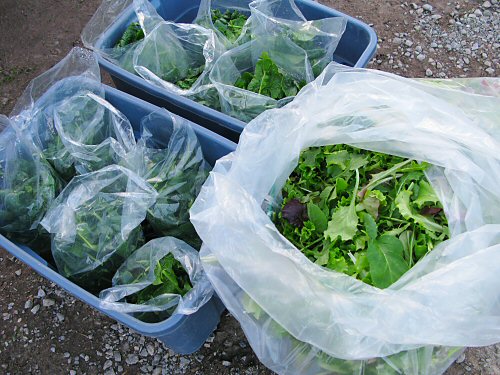
Tomorrow’s farmers’ market, the third of the season, will be the my first. This is the usual timing, although I made it on the second market day last year (our market starts on the first Saturday of May). The earliest harvest for field crops will probably be all-lettuce mesclun in a couple of weeks. But I do have the mesclun in the unheated greenhouse, a small quantity grown specifically for getting to the market as early as possible. So, today’s harvest-for-show: around 20 lbs (9kg) of lettuces-and-arugula mesclun. Not much. But, we also gathered about 10lbs (4.5kg) of “found” spinach (tasty new growth from spinach that made it to baby-leaf stage last year, overwintered, and started again this spring; green onion was last year’s early market found crop). Spinach and salad mixes are sold by the bag, and weight varies slightly depending on what and when: for this round, it was all 400g bags (just under a pound), around 35 units total. Also, collected an assortment from the herb garden: sage, thyme, oregano and chives. Plus, around 20 lbs (9kg) of Jerusalem artichoke. Enough to for a tiny spread! I love the market, for me, it’s as much part of veggie gardening as anything that happens in the field, certainly not a tacked on “business” end… Although cold, rainy weather is in the forecast, people always come out, and tomorrow should be fun!
Rinsing station gear comes out
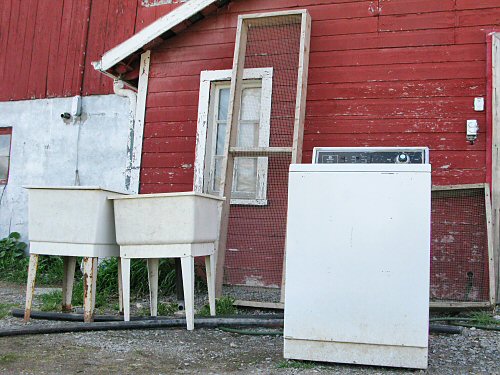
Today was the day I decided to bring out the rinsing gear! Upfront for its fourth (or fifth?) season, the trusty Maytag washer turned giant salad spinner. Once again, after a winter in the unheated drive shed, it started up (on Spin, of course) without a protest. (Maybe it’ll get a cool paint job this year, finally?!) Leaning up against the Milkhouse wall, there’s the original, square screen table (formerly used to sift gravel), and beside it, the new one I built last year—just add sawhorses… On the left, the pair of laundry tubs. Drainage pipes lie on the ground… First harvest can’t be far off!
Last big harvest of the year!
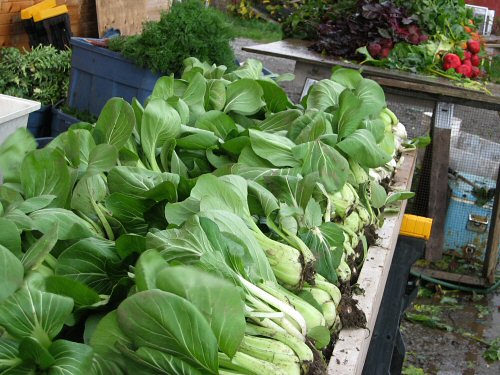
And then there were two! For the last big Friday harvest of the season—it’s the 18th and final CSA share and second to last Saturday at the farmers’ market—the crew was down to Conall and me. It was a rainy one, with the ground soaked from a couple of days of showers, but it was all smooth. With the cooler, cloudy conditions favoring a little extra storage time, Conall did the Brussels sprouts and eggplant yesterday. And with the shortening days, the mesclun growth has slowed to a near halt, and there’s not enough for CSA shares, so that fairly time-consuming task was out. In fact, things went so well, we managed to take a couple of hours off and head into town to pick up some things, and were still done by 7 pm. In the pic: bok choi and beets up for rinsing, with carrots and Brussels sprouts already in the bins. In today’s harvest: the spicy greens mix (arugula, tatsoi, mizuna, mustard), about 20 lbs (9 kg) of mesclun, collards, parsley, beets, carrots, bok choi, kale, a few broccoli and cauliflower, plus potatoes, onions, garlic, pumpkins and winter squash from storage. Conall’s done for the season tomorrow, so next week for the last farmers’ market harvest, it’s down to one. Time flies…!
Harvesting Brussels sprouts
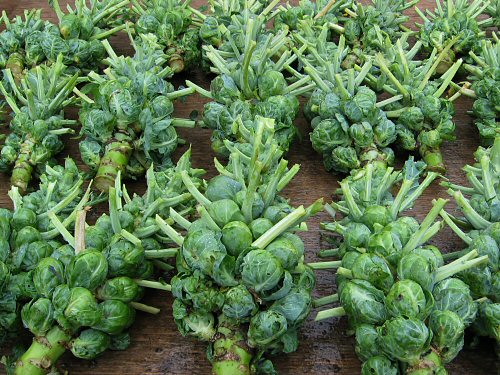
That was interesting! I’ve harvested Brussels sprouts by picking the individual heads, but for our first bigger harvest of about 60 plants, to speed things up, I decided to take the whole thing.
First try: chopping the base of the stem with the machete-like harvest knife was like hitting a piece of hardwood. Wow! Tough and cut-resistant… Next up, a sharp hatchet fared no better: a solid whack hardly penetrated.
So, we pulled ’em up, roots and all. They set in pretty good, but the main roots are shallow, so even with knocking off the clumped soil, this went quickly.
Next, we discovered that removing the roots is easily accomplished with a short, fairly rigid hand saw. Once we figured out the right starting angle, one and half strokes cut through the stems like butter: zip-zip!
Then to the harvest knife: swipe off the head, and then, holding the base of the stem, about four downward lopping strokes, rotating after each, to shear off the leaves. Kinda odd looking results, but efficient all around.
The sprouts, catching up from the summer drought, haven’t all filled out, still, a healthy yield of full-size to tiny heads from each one.
It was a completely novel, different harvest process than for all the other veggies. All the chopping and cutting was…fun!
UPDATE: The kind of odd presentation was loved at the farmer’s market—certainly said, “Fresh!”