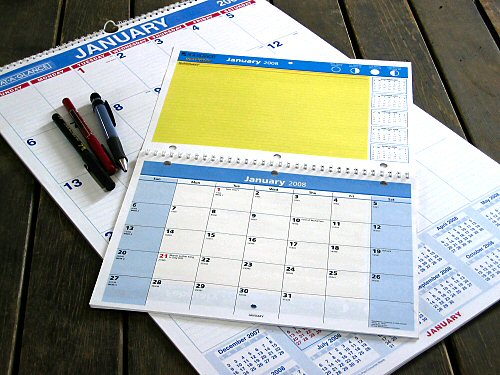
Calendars love catalogs

I got these about six weeks ago, when the selection was good (because, just any calendar will not do!). Today, I busted them out of their plastic. It’s only three weeks to the new year, the Holidays will vanish in a blur as they always do… I don’t know if it’s the new extra focus that comes from garden BLOGGING, this year’s extended Real Winter, Garden Season SIX coming up, or merely some planetary alignment thing (or…something else), but I am really, well, unusually EDGY and wanting to get started… Hmmm. Anyhow, the calendars…

It comes down to record-keeping. You read about all kinds of intense systems of garden notes and, from market gardeners, intricate planting schedules distilled from reams of precise planting data. I started out with all that in mind, recording every crop and variety by planting date on a map, and meticulously noting all the action in a pocket notebook (use waterproof ink, field notebooks in your pocket inevitably get SOAKED…forgotten in the laundry or otherwise!). This note-taking activity would trail off a bit as the season got underway, and more so over the years…

Now, I’m a minimalist when it comes to records, and this season’s system is the simplest yet. Almost everything worth noting goes into these two fabulously FRESH calendars. And there they are! Like the new seed catalogs, for me, new calendars in December hold all the promise of things to come…!

Details! Well, these aren’t just any calendars, they’re At-A-Glance brand calendars. Like any other tool, when you find the right one, nothing else will do.

I’ve examined and tried all kinds of free and commercial calendars (and notebooks, and journals…) and there’s always been something missing, something slightly WRONG. Then I discovered the large-format AAG, which I’ve been using for the past three years. It is…just right. I tend to get distracted and a little messy when it comes to field notes as the season progresses, and a simple thing like not having enough space to write in can throw things off. The AAG large wall calendar gives me ample, uncluttered room for every day of the week, and a crisp, matt surface to write on. And it doesn’t get lost. I hang a pen on twine from the same nail and it’s set. Perfect!

The little AAG I found this year. It’s the ideal companion to the wall calendar, the missing link. It even has the monthly moon phases, which I used to fill in by hand on the big one (planting by moon cycles is somehow always at the back of my mind…). The little one replaces scraps of paper and various notebooks for jotting down field work hours, market and stand sales, and the like. It’s more “business”, while the wall model holds the field stuff: planting and harvest dates, mowing, rainfall and other weather notes, a very few other basics like gas can refills, repairs and the like, plus upcoming events and various due dates. Easy! Whenever possible, I use a black pen for notes, red to highlight future stuff, and a mechanical pencil to pencil things in.

Bonus: For the small mountain of annual organic certification paperwork, the calendar format is a ready-made chronological log (They really insist on one…!).

So there you have it! A straightforward, impossible-to-lose place for everything usually keeps me on track, and this two-calendar system certainly ought to do it. ;)

The joy of decay…

Winter squash decays

During the growing season, decay is the last thing you want to see, let alone observe over time. In the off-season, what with culling veggies from cool storage, I’m a little more thoughtful about…decomposition.

This miniature butternut caught my eye as it slowly returns to its essence in the Milkhouse. I’ve watched it instead of tossing it out. I like it! It’s soft, but seems to be drying faster than it’s rotting… Those little amber crystals, the product of ooze, are interesting: hard, translucent, sort of brittle, almost tasteless… I wonder what they are? I’m sure chemistry and biology would give me great, detailed explanations of the entire process of winter squash decay. But is that…good? Is that what I want?

I used to think that understanding how EVERYTHING worked was kinda the goal, you’d learn and learn and learn stuff and become…better. But tiny farming doesn’t seem to lead that way. You watch and you do learn lots of things when they’re useful, but simply tearing everything apart into little chunks of measurement and description, just for the sake of it, isn’t as appealing as it once seemed to be. I think I want to know LESS. Demand simplicity! Let the squash rot in peace… (Of course, things don’t really work that way, do they…)

Read more

Stakes vs cages

Every year so far, there’ve been two or three major projects that I’m sure just HAVE to be done. They’re usually EXPENSIVE (at least, expensive in the world of tiny farm finances!), which means, they take some thought. We’ve had the seedling greenhouse, excavating the pond, the Milkhouse Extension, the tiny tractor, the first full-time field hand (Conall!), and a few other steps… So far, so good. For the coming year, I have in mind a few more…important upgrades. I was reminded of one of them in the drive shed today, where the stakes used for my semi-effective semi-sprawl method of tomato support are stored, along with some of the couple hundred (largely useless) home-style tomato cages. For a while, I was dreaming of moving up to the basket-weave method—lots of twine and…weaving—although I have a hard time picturing all of that suckering getting done. What I REALLY want is BIG CAGES made from concrete reinforcing mesh…but it seems so expensive. Rough pricing: about $7 a cage times 500 cages, plus a fair bit of labor setting them up and taking them down. I know the method works well, but will it work well HERE, this year? Is it worth the money? For the same cash, I could almost build a second, production-size greenhouse. Or put more into drip irrigation. Or build a cooler for better short-term storage. Come to think of it, does growing dozens of varieties of tomato really make sense, couldn’t I just sprawl two or three big, round red varieties that would be easiest to sell…? In fact, I could grow a lot more of a lot less, cut out many varieties and entire crops, concentrate on the trendy best sellers, and get on the waiting list for an upscale farmers’ market in the big city. Top dollar! Maybe try for a bank loan for a bigger tractor (hey, there’s more acres in the garden field!) and a refrigerated truck?! If this is a (tiny) farm business, that seems to make sense: GROW! Yet somehow I’m heading in the OTHER DIRECTION. Stopping the city CSA to go local. Trying more crops and varieties every year and figuring out ways to buy stuff for them, like big tomato cages… It seems so…contrary. Which, in tiny farming, is something I guess you gotta like!!

Root cellar check-in

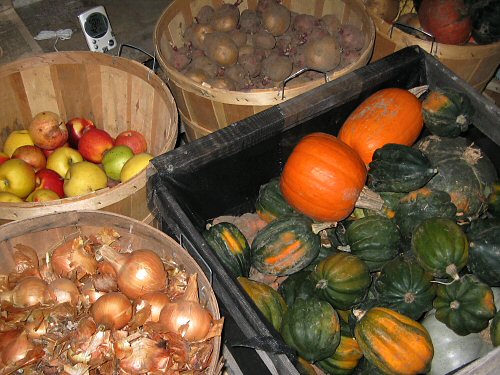
This is going quite well! Mainly, the idea is to do the regular tending, and see how things hold up. Although I’m calling it root cellaring, it’s really quite a limited experiment this first time round. The veggies weren’t too carefully sorted for long-term storage to start with, and I’d pay more attention to getting everything into cool conditions quickly. And really, I’d make sure the space was proper root cellar material! Here, the temperature didn’t drop from 60°F until the last week or so, and it’s only at 50°F now and around 45% humidity. Not exactly ideal. Still, not bad so far. I’ve culled about half a dozen onions from a bushel, lots of the smallest squash (there’s LOTS left), a couple of apples. The pic shows about half of what’s there. If I were holed up in the wilderness and this was my food cache for the next four months, I’d be worried. But I’m not, and we’ll be eating storage veggies for a while… It’ll be interesting to see what’s up in another month. I wonder, how many ways are there to prepare winter squash?!

Local food luxury

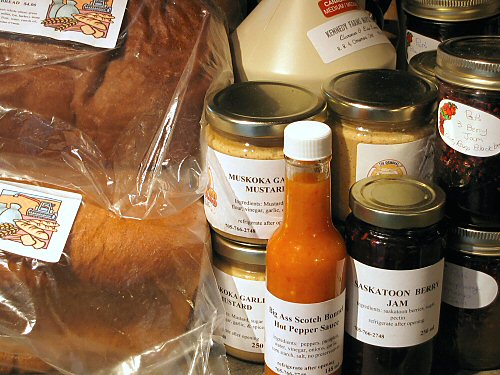
Today was the farmers’ market’s annual winter market, held indoors in town. It’s supposed to be local produce and locally made crafts, no reselling of manufactured stuff, and for the most part it is. I go to hand out CSA flyers. On the food side, there are storage veggies, like potatoes and carrots, and lots of baking, condiments and preserves. So I did some shopping.

Every Saturday during the market season, I buy from other vendors, but winters I’ve trailed off. This year, with the small but purposeful start on the way to a CSA root cellar, my mind’s more on personal, year-round “eating local”, and I’m doing something about it. One way is to stock up when you can. I bought half a dozen bottles of a really fine maple garlic mustard that I’d tried before, and a variety of preserves (we’ve been eating local jams and jellies almost exclusively for a while). I’m also trying a Scotch bonnet hot pepper sauce (it has a slow, steady burn, gonna get a six-pack!). There’s two liters of pure maple syrup (I’ll check out the farm it comes from, down the road, when the sap is running this spring). I also picked up several loaves of whole wheat, multigrain and Ezekiel bread, which I’ll slice and freeze (and I can order a minimum of four or five loaves from Barb, custom baked, for pick-up when I’m in town). With the stored veggies in the basement and in the freezer (like the simple, tastes-like-summer tomato sauce), it’s a pretty good start.

And local food feels excellent. I absolutely look forward to the taste of everything or I wouldn’t be eating it! From reading and from watching the garden grow, I really do believe in the superior nutritional quality of non-industrially raised food, even if it’s something you mightn’t SEE on the day-to-day. And the satisfaction of knowing my food right to the people who make it and the raw ingredients they make it from is deep and really fun. This to me feels like luxury, and it’s only getting started!

Whiteout

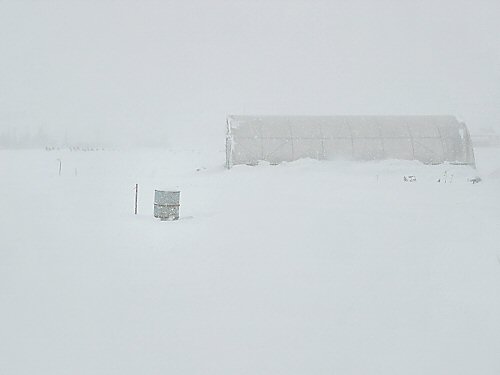
A full day of snow, probably about a foot in all. It started overnight, this pic is early afternoon, over 12 hours in. The winds were pretty high, guess it qualifies as a blizzard, but overall, not bad! The main concern is snow load on the greenhouse and the Milkhouse roof, but the wind has kept the snow moving, and there’s no big build-up so far. For storms in general, the worst non-disaster situation is the power going out (especially in the winter when there are seedlings in the electricity-heated Milkhouse). Outages aren’t a big problem here, but when it goes and it’s cold, things can get miserable. Here on the farm, this storm seems like no problem!

Snowbanks

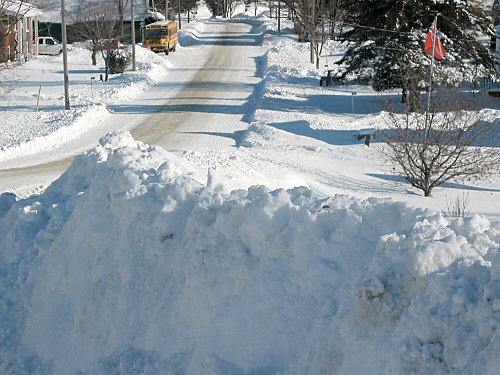
A brilliant sunshiny day after our 24 hours of snow. There are deep drifts everywhere, and the snowplow’s been by, leaving 3′ snowbanks along the roads. The farm is on the edge of a village of 300. Here’s a view down one of the two intersections. I’m on my way to pick up the mail from the bank of mail boxes in the convenience store/post office. It IS convenient, a pleasant three-minute stroll down the country lane (well, two-lane secondary road). And open till 9:30 most nights, too!