
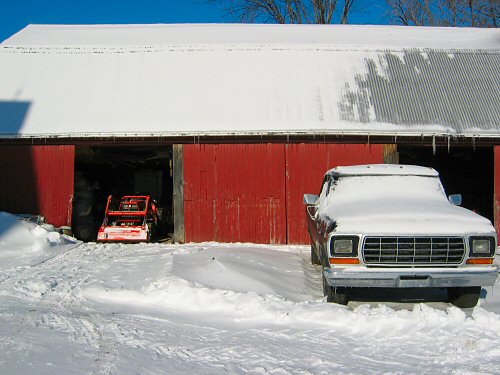
Finally got the tiny tractors in out of the weather. The diesel Kubota took hours and some warming and recharging to get started (I should’ve put ’em in sooner, but I wasn’t believing in the COLD). You can just make out the John Deere riding mower, parked sideways and in for the winter. The Kubota I fire up every few days to keep it limber, and it goes on snow clearing outings, mainly to make paths to the greenhouse. Unheated and uninsulated, the Drive Shed is still the place to be for machines in the cold! This version was built in the 1940s (here’s a view from the other side, it’s sticking in on the left), and like most things on the farm, has quite the history of…uses. All manner of vehicles, probably in the hundreds, have been stored or repaired here: tractors, cars and trucks, dirt bikes, snowmobiles, buggies and sleighs (that’s a 1977 Ford F-150 pick-up on the right, slowly being repaired by Bob’s son, Robert). The upper level is quite huge. It’s now mainly crammed with parts and pieces—assorted useful “junk”—but back in the day, a pulley system raised and lowered a wooden platform (it’s a manual, open elevator), and as the seasons changed, the farm’s various horse-drawn carts and buggies would be swapped up and down with sleds and sleighs for different purposes. Now, they’re long gone—one sleigh and no horses remain—but maybe they’ll be back!
Year: 2007
Catalog season
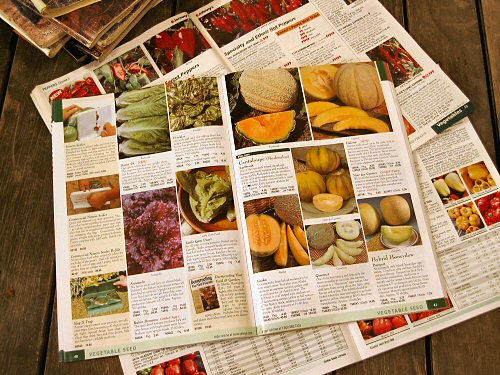
As pure, abstract small farming pleasure, for me so far, catalog season can’t be beat. This year’s catalogs started arriving two or three weeks ago. The first from one of my main seed suppliers has been here only a couple of days, and I’ve started flipping pages and poring over tiny type. What’s all the fun about? Simple. It’s the clean slate, the chance to START OVER, with the little edge of knowing what you know now, after another way less than PERFECT but oh so educational growing season. EVERYTHING is more than possible…next year! I’m picturing—visualizing!—a two-month continuous harvest of succulent MELONS, plump, super-early hybrids followed by exotic long-season heirlooms. Never mind that, between water issues, cucumber beetles and roller coaster temperatures, the melon crop here has never been too fine. That’ll change. Melons, and all manner of crisp, mild salad greens right through the summer heat, parsnip without endless hours of tedious, fingertip weeding while waiting for germination, plentiful red and orange and yellow and chocolaty brown peppers well before first frost (several varieties of eggplant, too!),… Wow, it’s almost unbelievable!! Especially with the pristine new CUT FLOWER GARDEN. And it all starts with the catalogs! I realize this is an odd sort of consumer world pleasure, and most of this is about hybrid seed that HAS to be bought every year. Still, I can imagine it as SIMPLE, and it’s great fun, until I get around to seed saving… ;)
Checking on the greenhouse

Where am I going? What am I doing here? (Heading out to check the greenhouse. Got more snow today… :)
Return to the trays
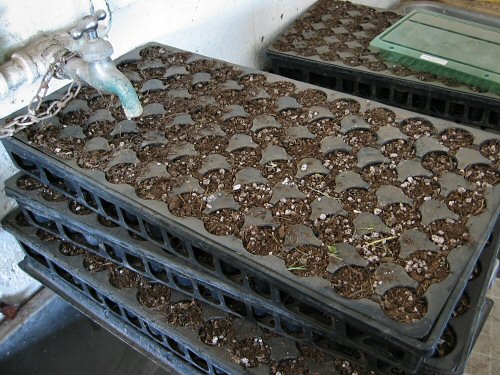
These 72-cell plug sheets, filled with now bone-dry starter mix, have been sitting in the Milkhouse on one half of the double sink since early last summer. They were extras from the final round of seed starting (the last of the brassicas). Now, it’s their time again, as I start the set-up for next year’s seedlings. I usually only do this stuff after the Holidays, but this year, I’m unusually anxious to get going. Maybe it’s a reaction to the unexpected snow and cold. After the recent, freakishly short winters that happened to coincide with my entire farming career, maybe I’m edgy about being cut off from the garden for so long. I mean, all I see is white. I want more greens and browns!! (And there’s the new adventure in fine dining to get started, sparked by Amanda at Apartment Farm’s recent peppy post: “Winter Gardening: Micro Greens”!)
Broccoli flowers (flashback!)
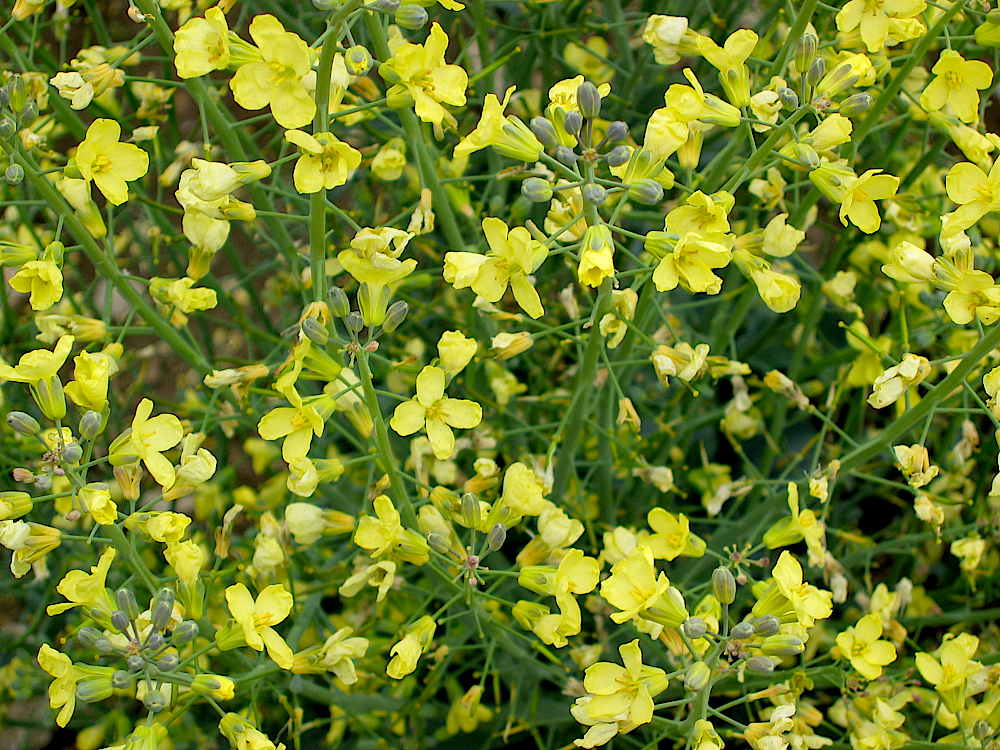
No real farming action today, but here’s an alternate entry from 2-Oct-2007—never let a perfectly serviceable post go to waste!: On my way to seed saving, I tend to let things go to seed! Here, the secondary shoots in a bed of Early Dividend broccoli have exploded, the tiny green beads turning into a gently rolling sea of miniature flowers on long thin stems. Unfortunately, the eventual seed from this hybrid variety wouldn’t be reliable…but it’s a step in the right direction! Also going to seed around the field: lettuce, radish, cauliflower… There’s some cleaning up to do. :)
Update: As mentioned in the comments below, these little guys are delicious as edible flowers, slightly sweet, tasting mildly of broccoli. We take them to market to offer as a free garnish for salad mix.
The seed…
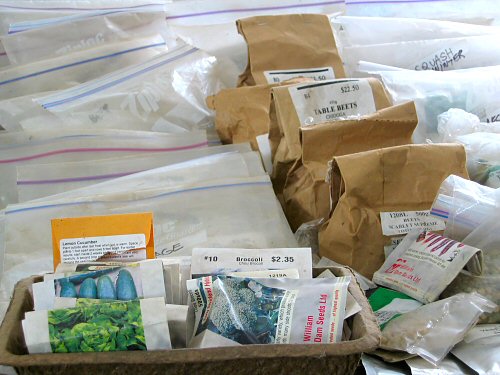
Keeping up with the early start, I got out the seed from its storage chest to take a look. With the tiny farm’s growing HISTORY (hey, Year 6, coming up!), keeping the seeds sorted for freshness is an ever more…serious consideration. Old seed won’t work, and there’s always lots of carryover from year to year. For this garden’s veggie selection, seed life in cool, dry storage conditions falls into three categories: nice and long (around 5 years, for brassicas, cucumber/squash family, lettuce, tomatoes,…), medium (around 3 years: beans, peas, carrots,…), and SHORT (1-2 years, for onions, corn, parsnip, parsley,…not too many here). Luckily, this is all book info, not gathered from painful personal experience! But I listen closely, ’cause one of my biggest garden nightmares is THINGS NOT GERMINATING… There are enough reasons why gazing happily on those newly seeded, semi-straight rows might be the greatest satisfaction they ever offer, and dead seed shouldn’t be one of ’em. My first germination test last year seemed to bear out the wisdom of others: normally-stored seed is not forever… So, it’s checking packs and taking dates!
Winter watch: the greenhouse
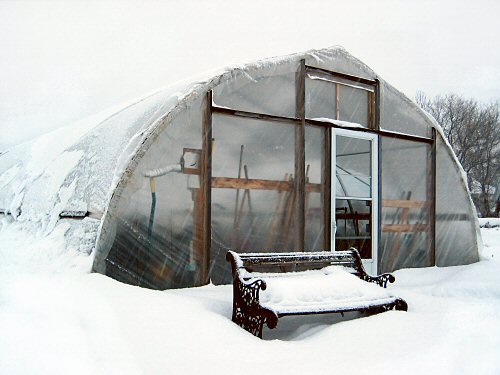
We haven’t gotten a really heavy single dumping of snow so far, but it’s coming down steadily every couple of days and the weather’s staying cold, so there’s build-up. That means increased vigilance on the greenhouse front. The right combination of freezing, a little thawing, and more snow can stick heavy slabs of ice on the hoophouse plastic. It usually slides off, but the weight can build up quick, so I check. If things were to get really weighty, besides removing the ice, I’d have to support the whole thing on the inside by wedging wooden beams under the ridge. I doubt it’ll come to that. And there’s the build-up around the base, some sharp shards of fallen ice could have puncture potential, none so far. AND THEN, this is going into the fifth year for the plastic. The special 6mil hoophouse covering is UV-resistant and rated for four years, so round about now, it’s time to look out for signs of fatigue and disintegration. I haven’t seen this before. I imagine it’ll start tearing at exposed pressure points, the way regular plastic shreds or tears under slight pressure after a while in the sun (well, in the UV, sun or not). I should ask around. The west-facing side, with the door in the picture, is most exposed to really battering winds that occasionally sweep across the fields with not much of a windbreak nearby. (It took me a season to get over being amazed that the hoophouse was still standing after bad storms—I’d actually head out in the howling wind in the middle of the night to check!) So, the usual winter greenhouse watch is on, upped a little. (I should drag that bench inside…)