
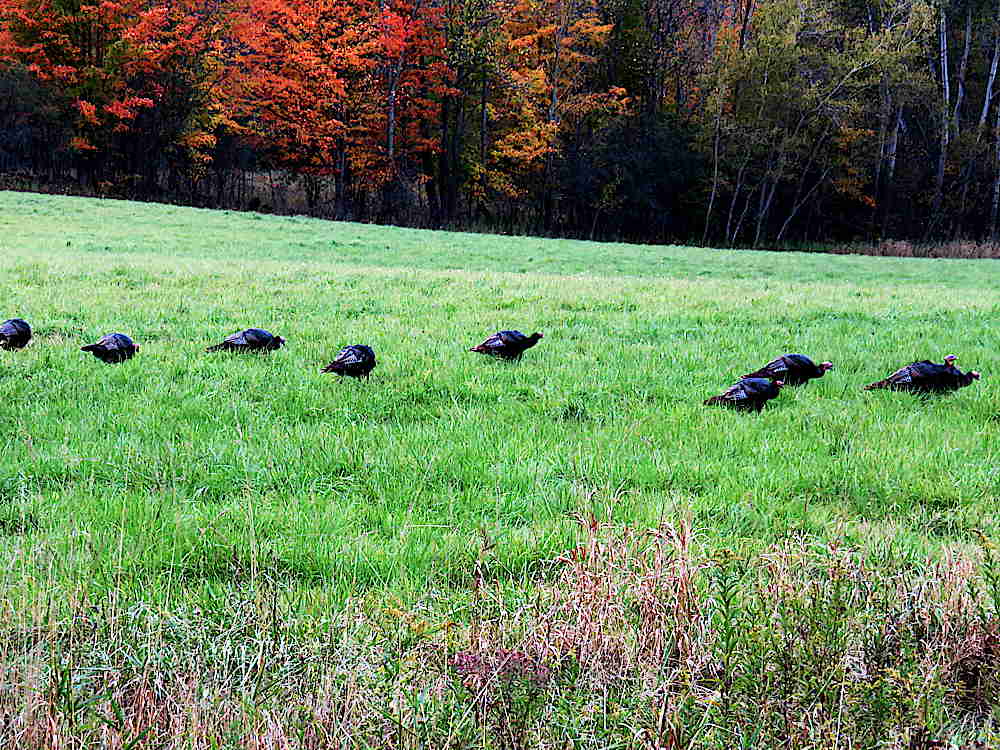
Wild turkeys foraging in a field. I see them all over, all seasons, always looking quite alien as they dart across the road, make their way in a straggling line across fields, take off on short bursts of flight for whatever reason. They haven’t bothered the veggie garden over the years, so I think of them as fellow travelers, their own separate tribe, in a near orbit that hasn’t intersected with mine. (I do hear their meat is excellent, lean and flavorful, though I haven’t properly tasted it, only in homemade meat pie.)
Animals
It’s a snake eats toad world
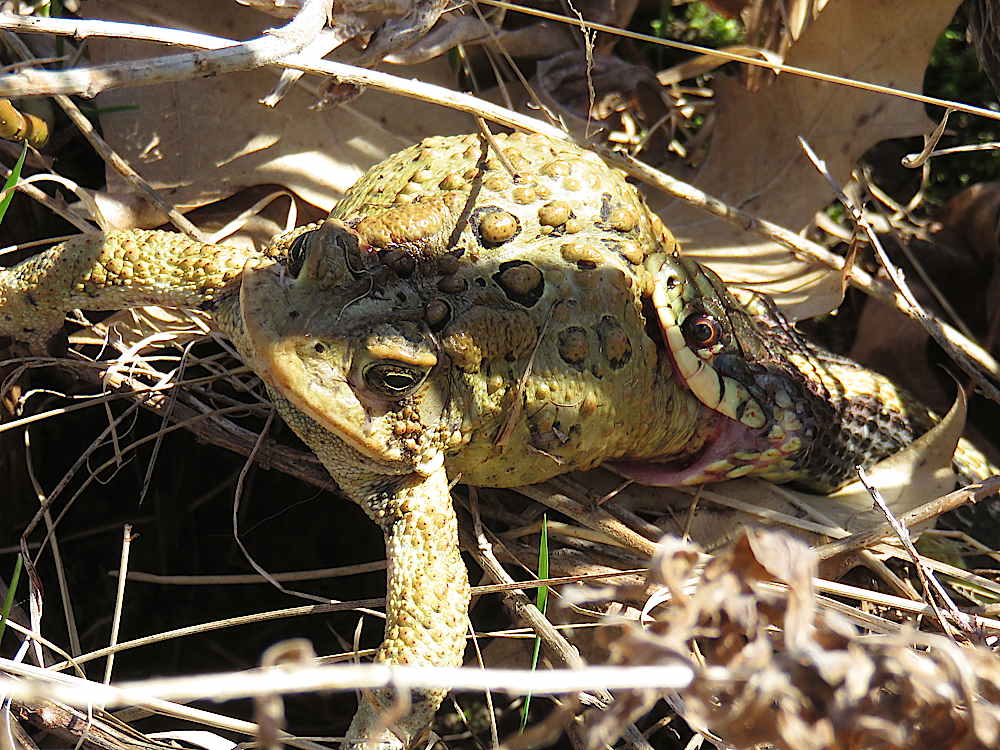
Spring is here, the air is mild, birds are madly chirping, and the intricate interplay of life at ground level is back in full swing. Exhibit A: a snake eating a toad! It takes a long while, could be hours, for the toad to get swallowed alive and eventually die by suffocation. Seems extremely unpleasant for the toad, but in Nature’s grand scheme of things, a snake has got to eat like the rest of us! We humans do the same with oysters, minus the big swallowing challenge.
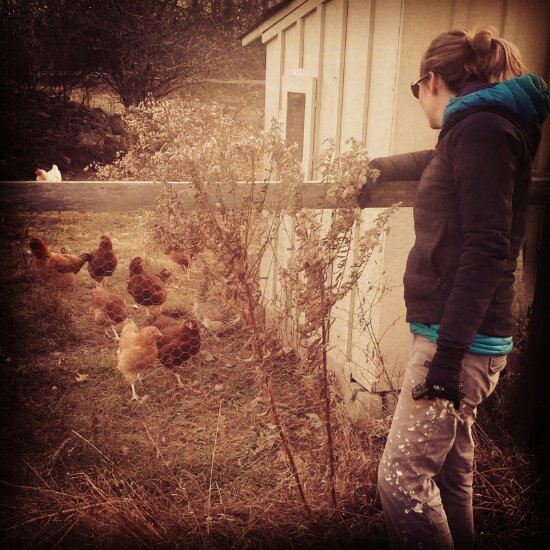
The morning farmscape
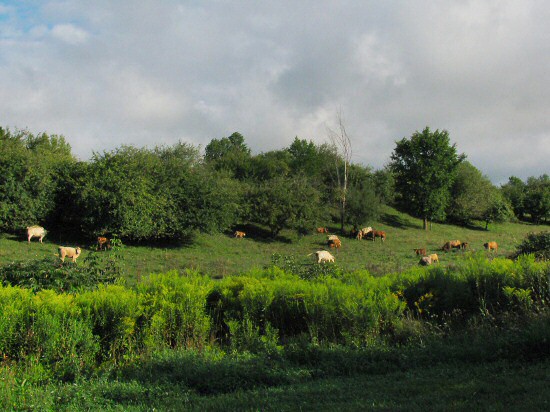
My morning landscape is back to being a farmscape. Around 7 a.m., the cows drift over to this area of pasture, right across a trenched pond from me (behind that goldenrod hedge!), and then drift away out of sight in an hour or two. They’ve pretty well grazed that whole slope by now, so I guess this is just their wandering, miss-nothing routine! It is what I wake up to right now…
Chicken Tractor: The Book
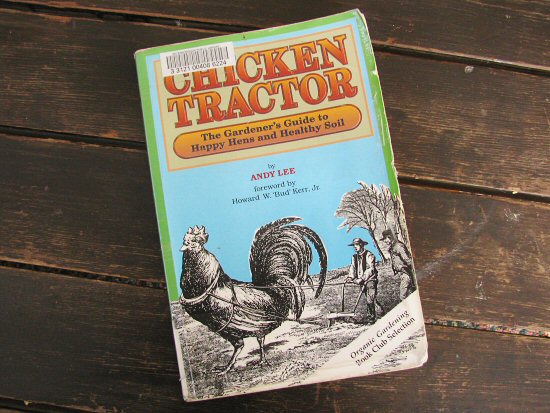
CHICKEN TRACTOR! My book-of-the-moment, a happy find at the municipal library (thanks to Kendall, I rediscovered LIBRARIES a couple of months ago—haven’t held a library card since school days, long, long ago).
The chicken tractor concept is simple, and it’s been chatted about around here quite often over the last few years…but not yet tried. The idea is to provide a mobile enclosure for your chickens, and move them to new sections of land every day or so, rather than keeping them in the usual chickenhouse and yard set-up. The chickens work up a small area of ground and fertilize it with their manure, and then it’s on to the next patch—the birds are always happy with fresh places to scratch and bits to eat, and a large area can be improved in no time. The rig can be any design you come up with that keeps the chickens in, predators out, offers shelter from the weather, and is easily moved. Easy!
Like most good things in smaller-scale farming, the chicken tractor is a startlingly simple and inexpensive approach that offers deep returns on many levels, from food quality to all-round satisfaction. It’s also kind of the EXACT OPPOSITE of high-tech industrial farming gear and methods that make so little sense to me. And the system works for various other farm animals as well, as in well-known (celebrity!) indie farmer Joel Salatin’s chicken-and-beef rotation at Polyface Farm.
So simple, why do you need a book? Well, it’s WINTER around here, all is snow, and reading about growing is the next best thing! In this case, Chicken Tractor, like its to-the-point title, is a perfect example of an energizing just-do-it how-to book, written in enthusiastic, full-on farmer-scientist mode. It’s jam packed with practical instructions and advice, the text assisted by numerous charts and illustrations, with a non-oppressive serving of sustainability philosophy and general food politics worked in, plus chicken trivia (the term “chicken tractor” was apparently coined by permaculture founder Bill Mollison, so now I know).
It’s cool to see this copy so considerately well-worn, although this being the original edition from the mid-1990’s, maybe it hasn’t seen that much use. It was published in 1994, quickly followed in 1998 by an “All New Straw Bale Edition,” with the subtitle upgraded from “The Gardener’s Guide to Happy Hens and Healthy Soil,” to the better-keyworded, “The Permaculture Guide to Happy Hens and Healthy Soil.” In any case, this edition is fun tiny farm reading from the library.
Anyhow, so much for the book review, let’s see how well this year’s chicken tractor plans actually fly! :)
Carrot germination refinement continues
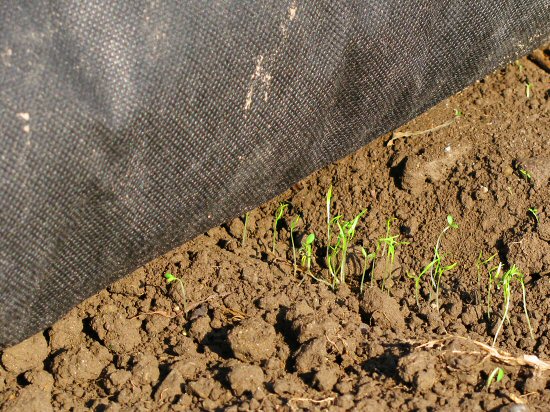
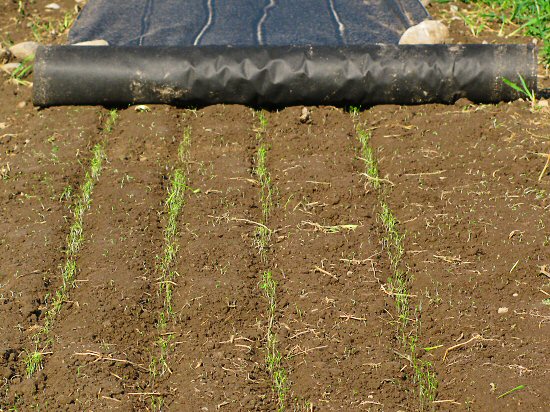
Another successful carrot germination event, with trusty, open-pollinated, heirloom Touchon, and our latest refinement in cover. Although this landscape fabric looks like the stuff we started with last year, it’s a heavier grade that doesn’t tear and become useless after one or two outings—it should last FOREVER, or, hopefully, for at least 10 uses, at which point, the cost will be near zero.
This germination, in mainly hot, sunny weather, is exactly one week after seeding, with no watering in. Pretty good! Deprived of light, the seedlings are already stretching—I might’ve taken off the cover a day or two earlier if I’d checked—but they’ll be fine. And if you’ve used an Earthway seeder, and ever doubted the incredible amount of seed it can dump down, don’t (see above): I’d rather see all those carrots pushing up than too few, but the waste from overseeding is quite severe, and major thinning is in order, adding to the labor. Still, it’s all part of the joy of farming largely by hand… :)
Tug-o-war
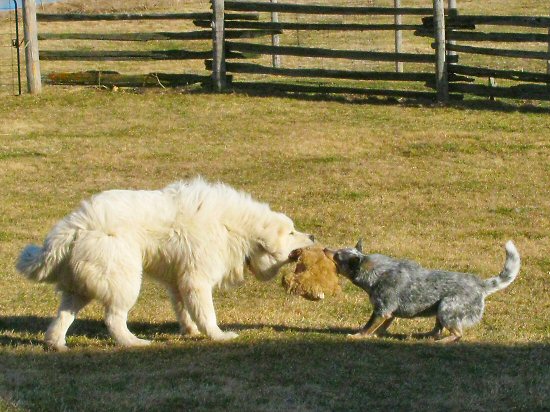
The farm this year is an animal farm, for sure! I farmed alongside cows and goats for a few seasons, raised chickens for meat and eggs for the last two years, BUT, this is the year I’m plunging headfirst into the world of FARM ANIMALS EVERYWHERE, critters of all shapes and sizes (and breeds), woven into the daily tiny farming experience.
The relationships between the seven dogs and two cats alone is complex, entertaining…and useful. The four Great Pyrenees are working livestock guardian dogs, living outdoors (and in the barn) year round, keeping watch and patrolling the property. They keep predators out, killing intruders when necessary (you don’t want foxes in the henhouse!). This is a critical job because there are also free-ranging chickens, turkeys and geese, baby pigs, sheep about to lamb…lots to look out for, lots to EAT.
Meanwhile, with all that protection work, at least one of the Great Pyrenees still finds lots of time to kick back and mess around. In the pic, Rollie, the youngest GP, and just a huge puppy at around 8 months, tugs it out with Pi, an Australian Cattle Dog, also under a year old (it’s just a stuffed animal they’ve got there). Business as usual!