
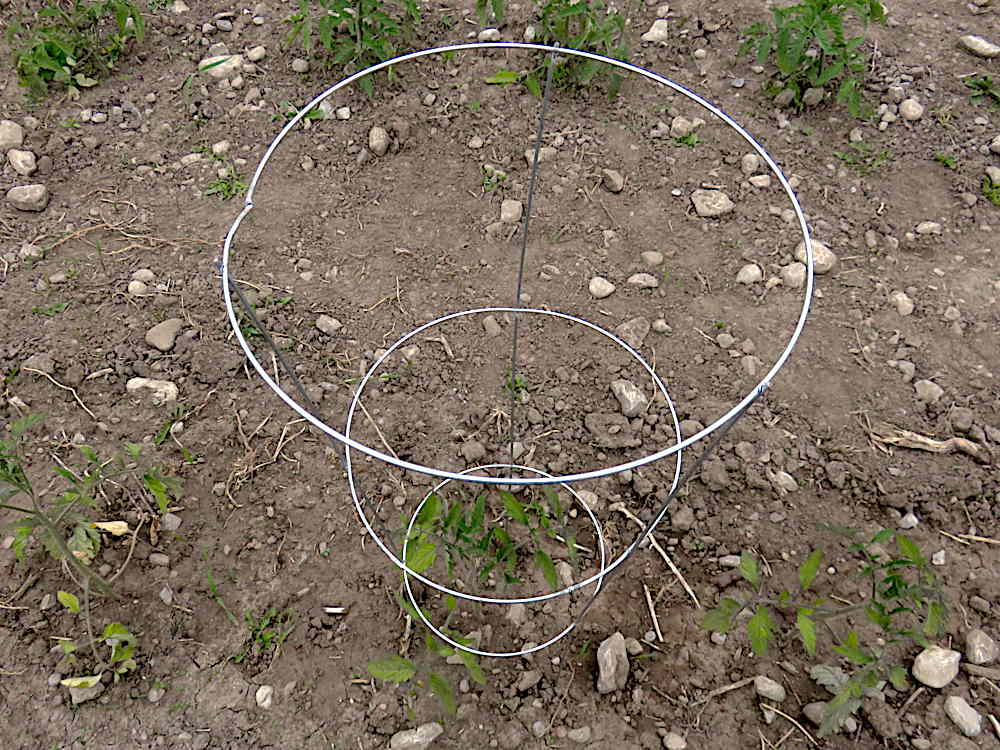
Ran into these cheapest of tomato cages in town, two bucks a pop, so I picked up a few. They’ve been around unchanged since I started growing veg over a couple of decades ago: three hoops flimsily spot welded to three support legs. Can’t speak for every last use, but from first-hand field tests, they’re pretty useless—a nice, neat-looking gesture to being in control when the toms are tiny, but prone to sag or tilt or snap at the joints under the weight of grown plants. Not great for a home veg garden, and really not for any sort of tiny production quantities. So why bother now? Well, one can always hope and dream. Since these toms went in late, given our short season, and the small number of plants, I can imagine carefully tending them—suckering enough to keep them productively compact, harvesting regularly before they get heavy. Plus, they take literally 30 seconds to place, and, at first at least, they look kinda cool and organized. Like a Jetsons garden. We’ll see how it goes!
Fieldwork
Debatably late
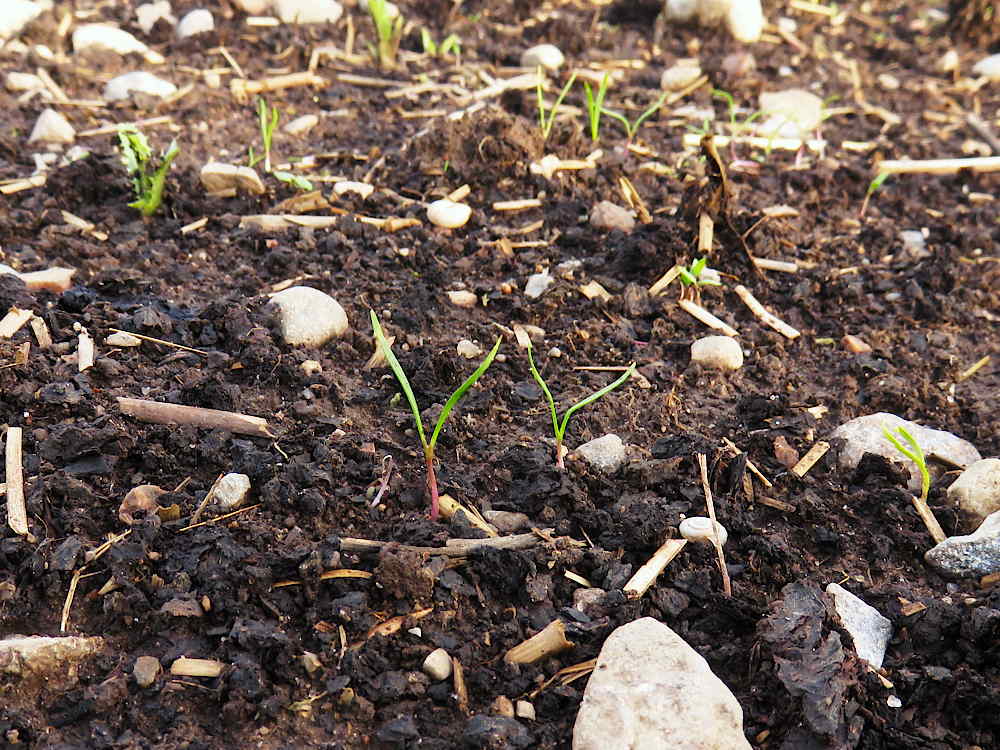
Much more me than the carrots in thinking they were taking so long, they weren’t going to arrive at all. The variety is Miami, a reliable hybrid, and the seed is from last year. To me, that’s fresh and ready to go. Given the recent soil-warming heat, uninterrupted moisture from watering and rain, and nice thick black landscape fabric cover to keep the heat and moisture in, I figured when I checked on day 7, then 8, they should be up and yelling for the sun. But there was nothing. I took off the cover, and didn’t let the bed dry out, but I was about to reseed. Then one more day went by, and there were a few tiny carrot seedlings starting to arch out of the soil. Still skeptical, I ignored it for another day, then checked this evening and…decent germination—actually, they’re really popping!
It’s not out of the ordinary, this production thinking that gets out of sync with reality. Patience is often rewarded. In this case, it’s not as dense germination as an Earthway seeder overseed, but it’ll do for a first round, and that’s over a week not wasted in re-starting the season’s first carrots! :)
Looking for leaks
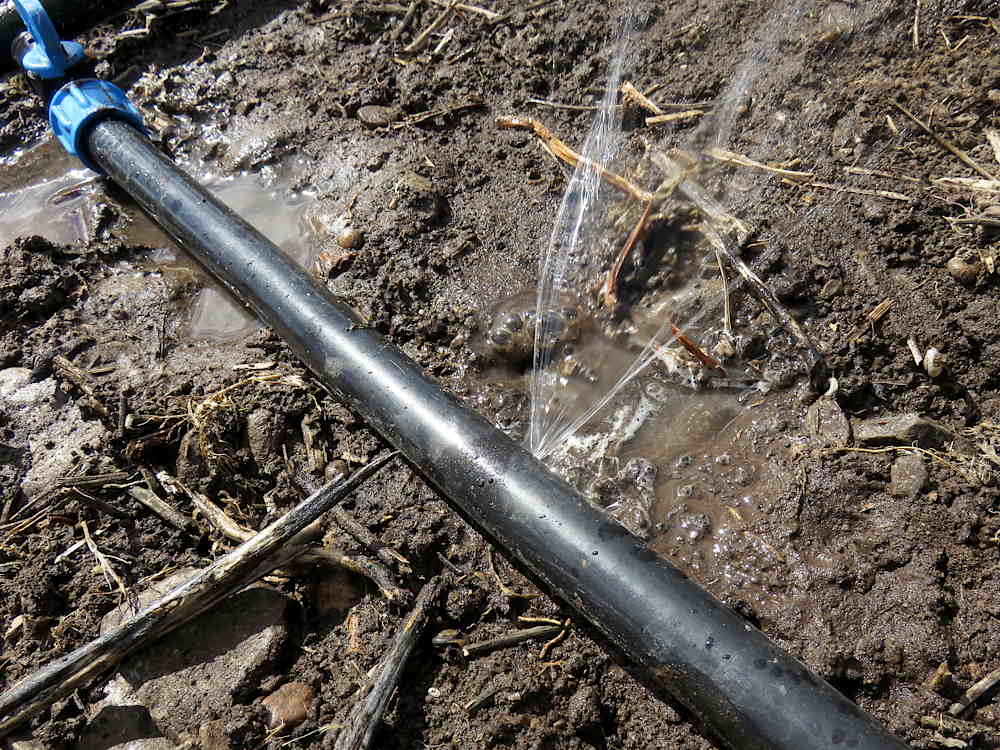
Drip tape is a really fantastic way to irrigate: low-pressure, drop by drop, straight into the ground leaves no room for being blown off target or evaporated by a hot sun. Slow and steady. Peaceful. For years now, I’ve been set up with the tape and fittings to fully drip-ify an acre or two. And it’s really not expensive. Yet somehow, it’s never gone all the way. Whose loss, if anyone’s, I wonder. Instead, the crops have gotten by with natural rain, and in desperately dry times, it’s been dragging around hoses to water by hand, or deploy the water-wasting but quick and easy sprinklers. I have used drip for melons, because they really don’t seem to grow well without the extra ground heat of black plastic mulch, and drip tape underneath waterproof plastic is a perfect pairing. Still, haven’t always used it even there. This year, for the tiniest melon row, it’s drip tape deluxe. Eliminate leaks, then turn the water valves to low!
Thirstier and thirstier
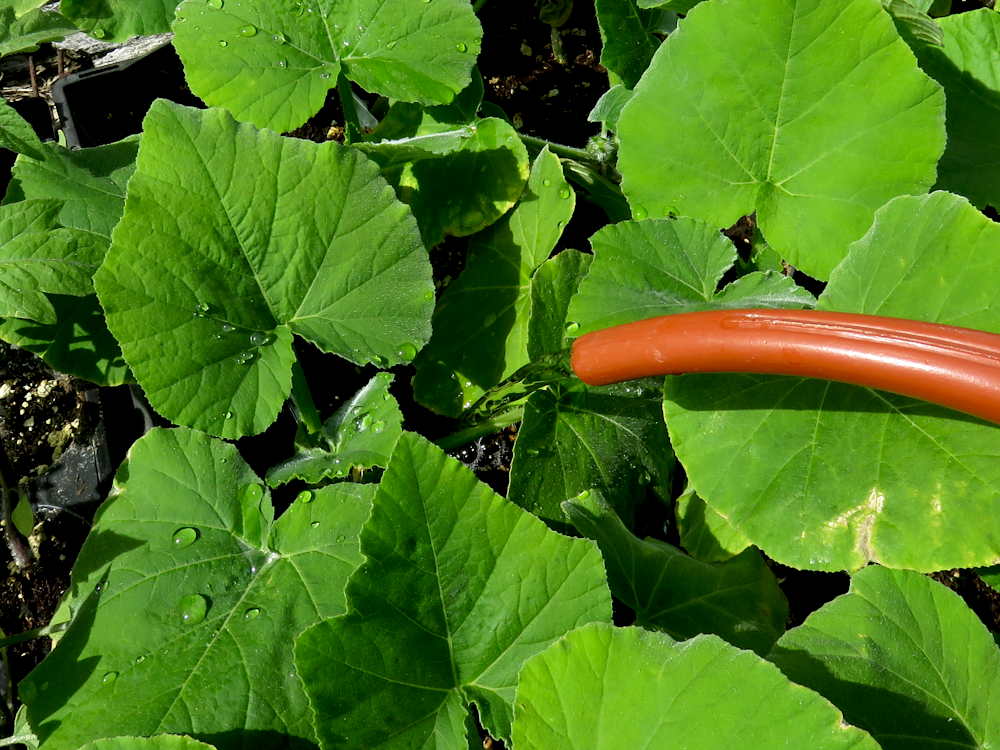
The seedlings are filling out fast now, with full days in the sun. Feels like they’re raring to break out! Stuck in their little pots, they could be being called to by their siblings already transplanted out in the field. Who knows?! One thing for sure is how fast they’re soaking up water now. Of course, it makes sense, it’s no surprise—but the little routine meter in my head sees that a good watering lasted a couple of days just a week ago, and now, especially in the tiny plug sheet cells, the surface is dry in hours and the trays feel light. There’s the sun and the wind to help evaporation, but still—thirstier and thirstier as they wait for the field!
Wind and more wind
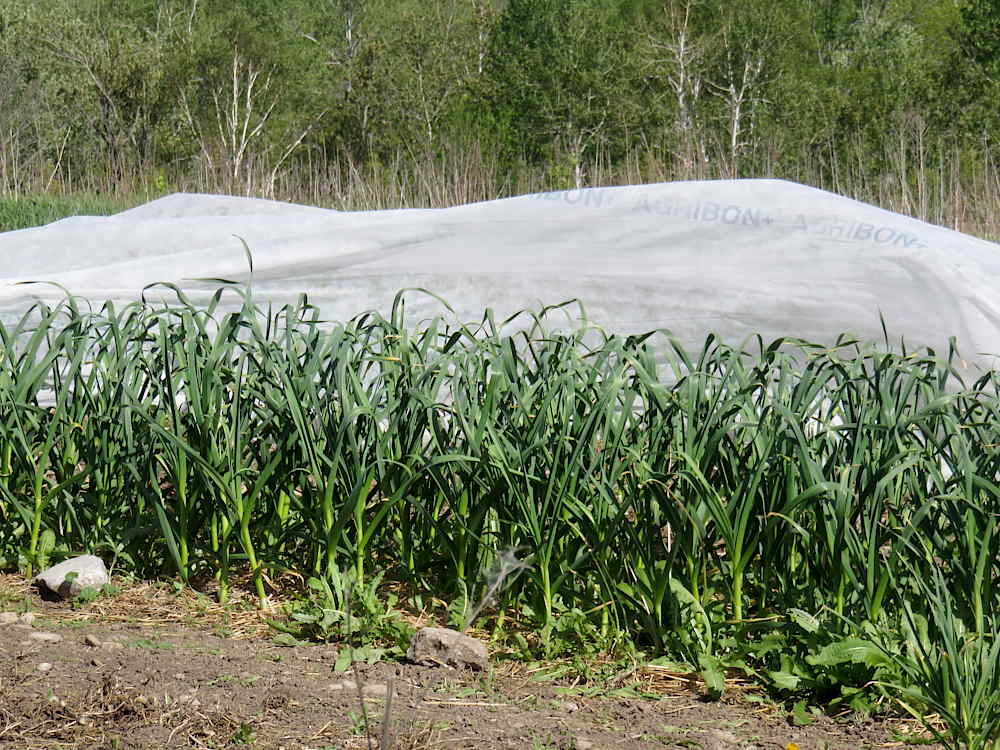
At this point, end of month, I’d have to say WIND has been the weather theme of this May. Practically every day. Gusty enough to sometimes threaten the more delicate seedlings, and to put off ladder work on the big greenhouse. Here, the wind has blown off the garlic’s row cover. Not a problem as far as protection from the nocturnal leek moth horde that may be lurking, but more work to put back. Complicating this little matter, the garlic is growing up and straining at the cover, gradually pulling it out from being fully weighted by the rocks. Since the cover should stay on through June, that will have to be solved. Stay tuned!
Morning carnage
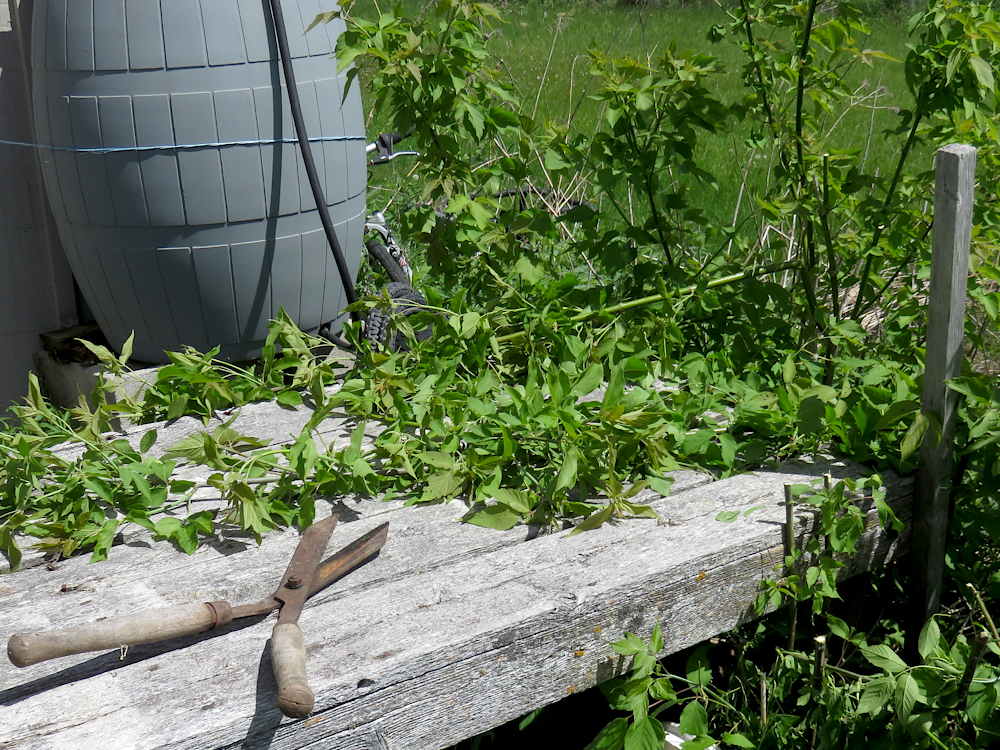
Weed tree, trash tree, table-eating tree, time to step back!
Cutting back the invading box elder from the work table, using antique garden shears, the best tool I have at hand, seems kind of brutal, but this is tiny farming. The whole idea is to direct some space, some land, to your liking. It is kind of militaristic in nature, there’s no getting away from that! Take over, suppress what you don’t want, install what you do, and hunker down to maintain position. I’m kidding, of course, actually thinking about farming and gardening in those stark terms is stressful, not useful or fun. IMHO, you layer on your story to suit the situation, and do what you have to do.
The garden shears only work well on the pencil-thick still-green upper stems, but that’ll do for now. Loppers—lopping shears, with long leveraging handles—would be perfect here, the tool for the job, though at the base this tree is probably a little past even them. So then, a pruning saw. I have neither, so a real saw, a sharp pocket knife, and some bending and twisting may be involved for a decent cutback. Or, much as I don’t want to invest in a box elder battle, I’ll get ahold of a pruning saw. I wonder how much the roots can expand, year after year, without any leaves to feed them…
Weed tree
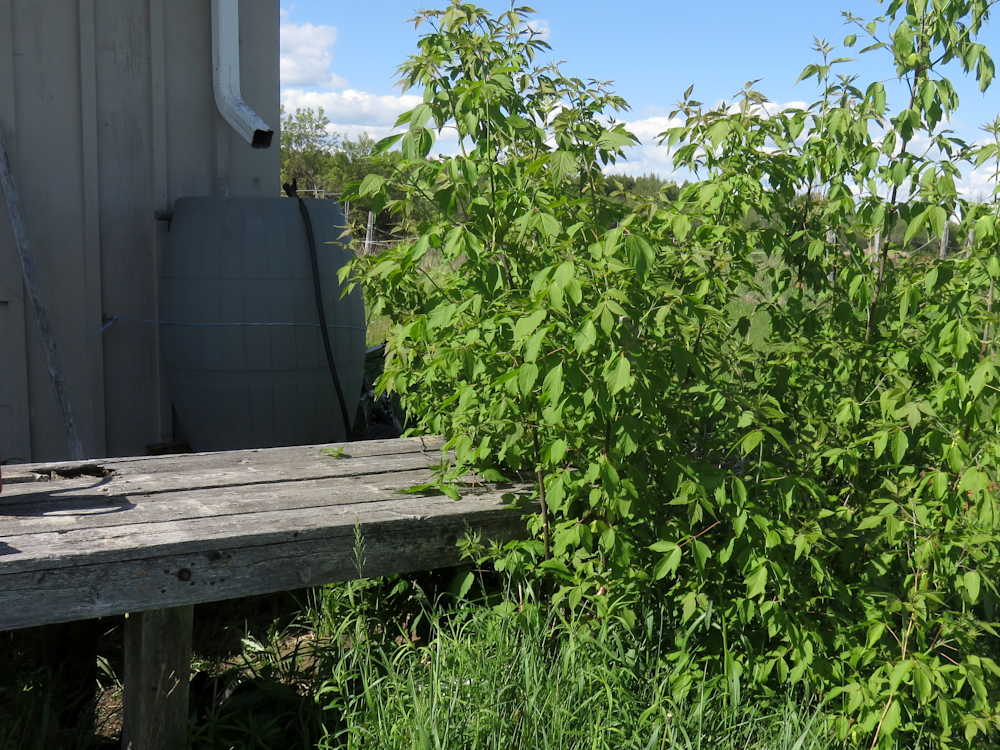
This volunteer tree started growing there maybe four or five years back, and is now almost literally trying to eat a table where I work on gear and put out seedlings, blocking the morning sun, getting in the way. Plus, what’s that dense little micro-environment hosting that might crawl or fly directly onto the veg plants?
It’s known as the box elder, a scrappy, scrawnier member of the maple family that’s described unaffectionately as a weed tree, or even a trash tree. That’s cold, but I’m pretty sure it doesn’t know or wouldn’t care about what people call it. It’s too busy growing at an insane rate for a tree, at the same time spreading its multiple stems. In some countries, it’s officially classified as invasive, a menace to society.
Cut it off at the ground, which I’ve done every year since it appeared, and its resilient root system cheerfully sends up more. I don’t have time for a root excavation and eradication project at the moment. You’d think I’d have gotten to it earlier, but this growth snuck up in the last week or two, as the weight of the new leaves bent its weak and spindly stems over the table. Guess I’ll chop it back again for now. Carnage!